Free teaching diagram
Deep-Sea Fish Pressure Diagram: Why They Don't Implode
Pressure is hardest on air. Many deep-sea fish carry little or none, and three adaptations keep their bodies working down to a predicted limit of about 8,200 m.
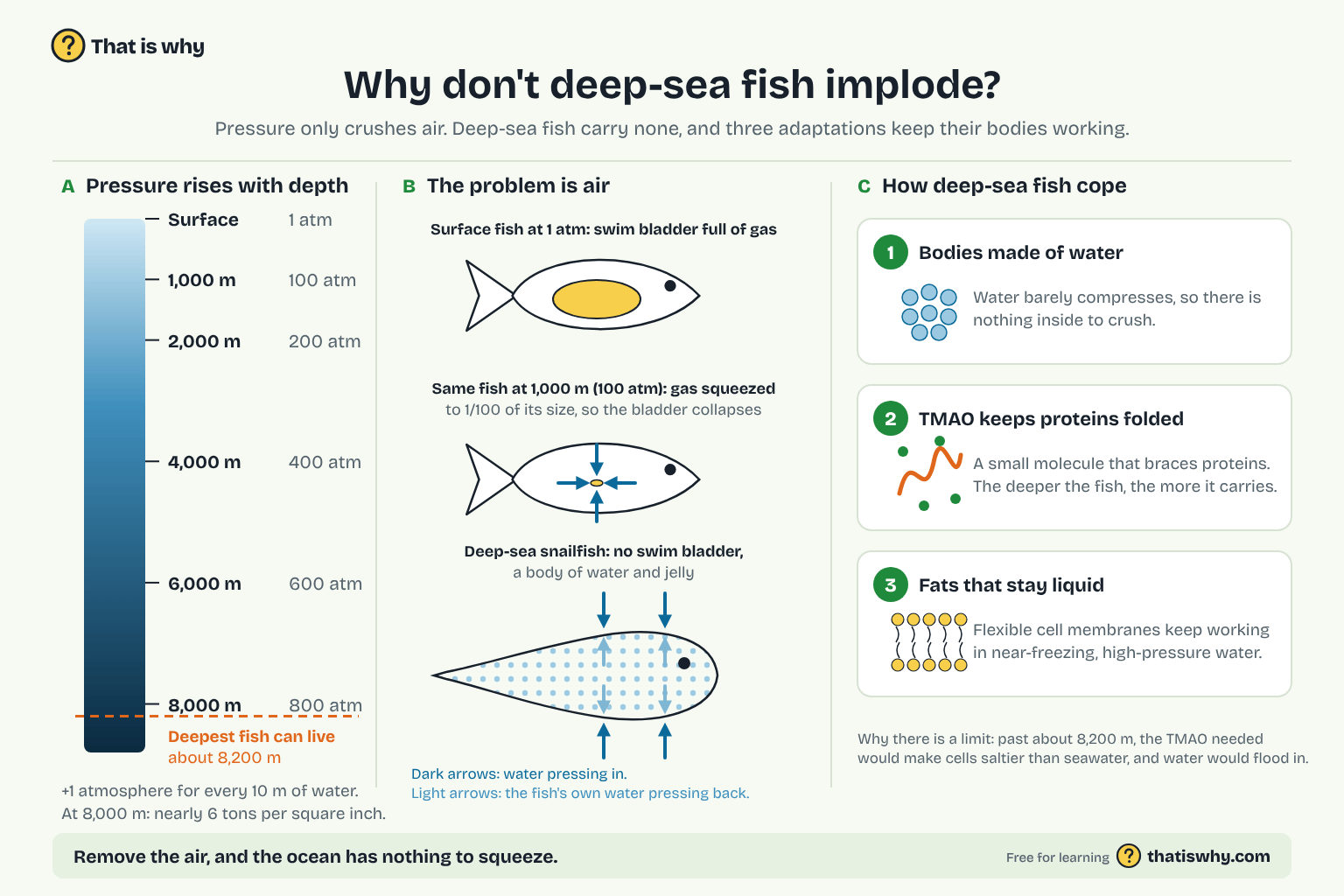
What the diagram shows
The diagram reads from left to right, in three panels.
A. Pressure rises with depth. Seawater is heavy. Every 10 m of depth adds about one atmosphere (1 atm) of hydrostatic pressure on top of the 1 atm of air at the surface. At 1,000 m a fish carries about 100 atm; at 8,000 m, about 800 atm, which is nearly 6 tons on every square inch. The dashed line marks the deepest fish can live, at about 8,200 m.
B. The problem is air. Most shallow-water fish float using a swim bladder, a pouch of gas. Gas obeys Boyle's law: its volume falls as pressure rises. Take that fish to 1,000 m and the gas is squeezed to about 1/100 of its surface size, so the bladder collapses. A deep-sea snailfish has no swim bladder at all. Its body is mostly water and jelly, which are almost incompressible, so the water inside pushes back as hard as the water outside (the light and dark arrows).
C. How deep-sea fish cope. Three adaptations work together:
- Bodies made of water. With no air spaces, there is nothing inside to crush.
- TMAO keeps proteins folded. Pressure distorts proteins. The small molecule TMAO braces them, and the deeper a fish lives, the more TMAO its tissues contain.
- Fats that stay liquid. Cell membranes built from unsaturated fats stay flexible in near-freezing, high-pressure water, where ordinary fats would stiffen.
Why there is a limit. Below about 8,200 m, a fish would need so much TMAO that its cells would become saltier than seawater. Osmosis would then pull water into the cells. That predicted chemical ceiling fits what explorers see: no fish has been found below about 8,400 m.
Key numbers
| Depth | Pressure | What happens |
|---|---|---|
| Surface | 1 atm | A swim bladder is full of gas |
| 1,000 m | about 100 atm | Swim-bladder gas squeezed to about 1/100 of its size |
| 8,000 m | about 800 atm | Nearly 6 tons per square inch |
| about 8,200 m | about 820 atm | Predicted depth limit for fish |
| 8,336 m | about 835 atm | Deepest fish ever filmed, a snailfish (2022) |
Common misconceptions
Myth Deep-sea fish survive because they are tough and armored.
The truth It's the opposite. Most have thin, soft, jelly-like bodies. Rigid, air-filled structures are what fail under pressure; soft, water-filled ones don't.
Myth Deep-sea fish explode when they're brought to the surface.
The truth Fish without swim bladders don't burst. Their tissues lose their shape and sag once the pressure is gone. The dramatic damage is seen in fish that do have a swim bladder (see the barotrauma diagram).
Myth Pressure would crush any animal that goes deep enough.
The truth Pressure itself pushes evenly from every side. It only crushes things that contain compressible gas. The real limit for fish is chemical: the TMAO they need.
Questions to use in class
Tap a question to reveal a model answer.
1Why does the swim bladder shrink with depth, but the snailfish's body does not?
The swim bladder holds gas, and gas compresses: by Boyle's law, 100 times the pressure squeezes it to about 1/100 of its volume. The snailfish's body is water and jelly, which are almost incompressible, so its volume barely changes.
2Using the rule "about 1 atm for every 10 m", what is the pressure at 3,000 m?
About 300 atm from the water, plus 1 atm of air at the surface: roughly 301 atm.
3Why would a fish with too much TMAO in its cells start to take in seawater?
TMAO is dissolved in the cell fluid. If the cells hold more dissolved substances than the seawater outside, osmosis moves water into the cells, which would make them swell and stop working.
4Olive oil stays liquid in the fridge; butter goes hard. Which is more like a deep-sea fish's cell membranes, and why?
Olive oil. Like it, the membranes are rich in unsaturated fats, whose kinked chains don't pack tightly, so they stay flexible in cold, high-pressure water.
5Below about 8,200 m no fish are expected. What kinds of animals do live deeper?
Invertebrates, such as amphipods (small shrimp-like crustaceans) and sea cucumbers, which have been found all the way down to the deepest trenches, below 10,000 m.
Key terms
- Hydrostatic pressure
- The pressure a liquid at rest exerts because of the weight of the liquid above. It grows steadily with depth and pushes equally from every direction.
- Atmosphere (atm)
- A unit of pressure equal to the average air pressure at sea level (about 101 kilopascals, or 14.7 pounds per square inch). In the sea, pressure rises by about 1 atm for every 10 m of depth.
- Swim bladder
- A gas-filled pouch inside many bony fish that lets them float at a chosen depth without swimming. Because it holds gas, it shrinks under pressure and swells when pressure drops.
- Boyle's law
- At a constant temperature, the volume of a gas goes down as the pressure on it goes up, in the same proportion: double the pressure and the gas takes up half the space.
- Incompressible
- Describes a material whose volume barely changes when squeezed. Liquids such as water are almost incompressible, which is why a body made of water is not crushed by deep-sea pressure.
- TMAO
- A small molecule found in the tissues of marine animals that helps proteins keep their working shape under high pressure. Deeper-living fish carry more of it; when a fish dies, it breaks down into the compound that gives fish its "fishy" smell.
- Unsaturated fat
- A fat whose chains have kinks (double bonds) that stop them packing tightly, so it stays liquid at low temperatures, like olive oil in a fridge. Deep-sea animals use more of these fats to keep their cell membranes flexible in cold, high-pressure water.
- Osmosis
- The movement of water through a membrane from the side with fewer dissolved substances to the side with more. It is why cells packed with too much TMAO would draw in seawater, which sets a depth limit for fish.
- Snailfish
- A family of fish with soft, scaleless, jelly-like bodies and no swim bladder. Snailfish include the deepest fish ever seen: one filmed at 8,336 m in the Izu-Ogasawara Trench in 2022.
Sources
- How does pressure change with ocean depth? NOAA Ocean Service
- Scientists discover how low fish can go NIWA (National Institute of Water and Atmospheric Research, NZ)
- Deepest ever fish filmed at a depth of 8,336 metres Natural History Museum, London