Free teaching diagram
Deep-Sea Pressure Diagram: How Life Survives the Squeeze
Pressure picks on air pockets, diving lungs and cells, and deep-sea life has a fix for each.
The detailed teaching diagram
What the diagram shows
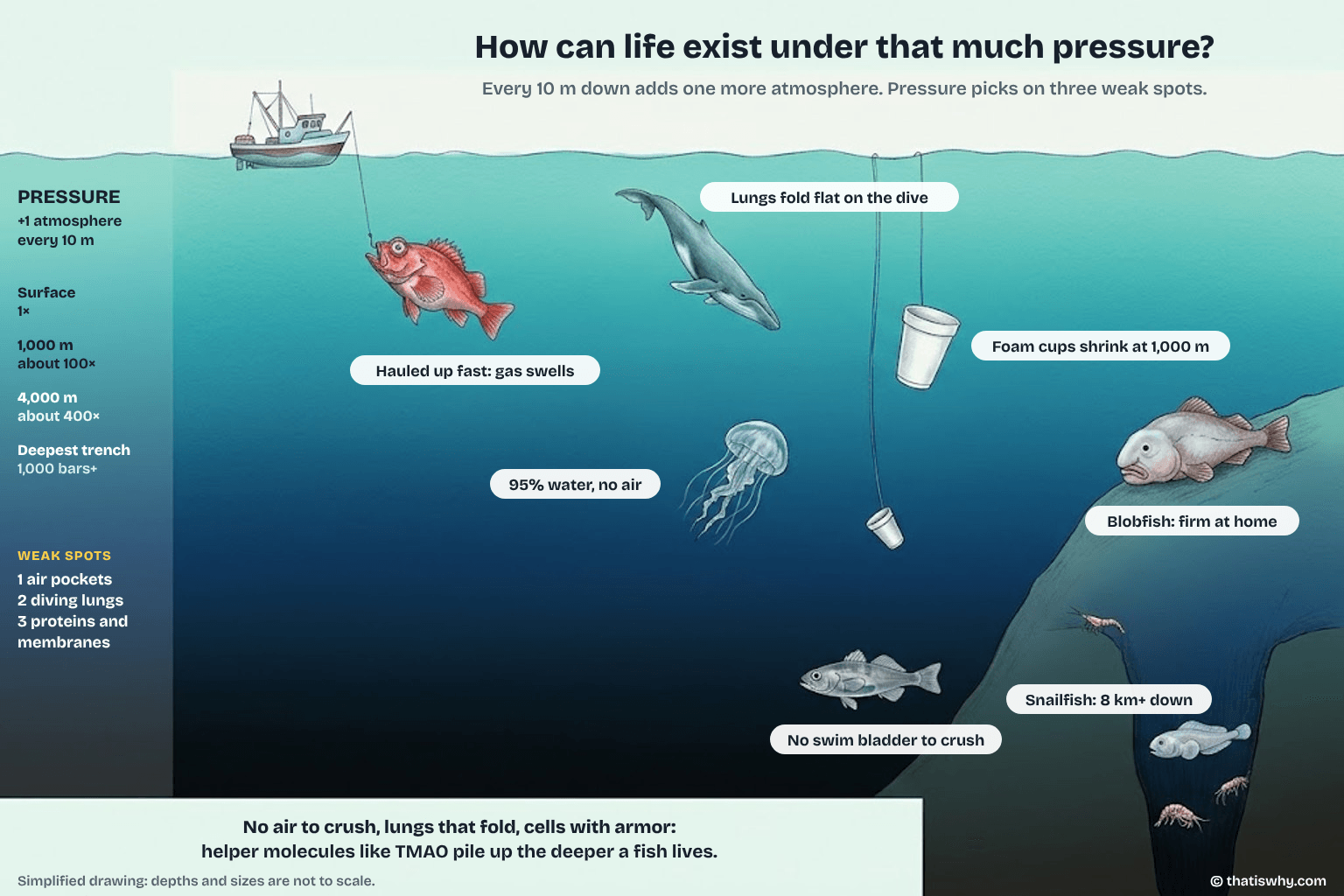
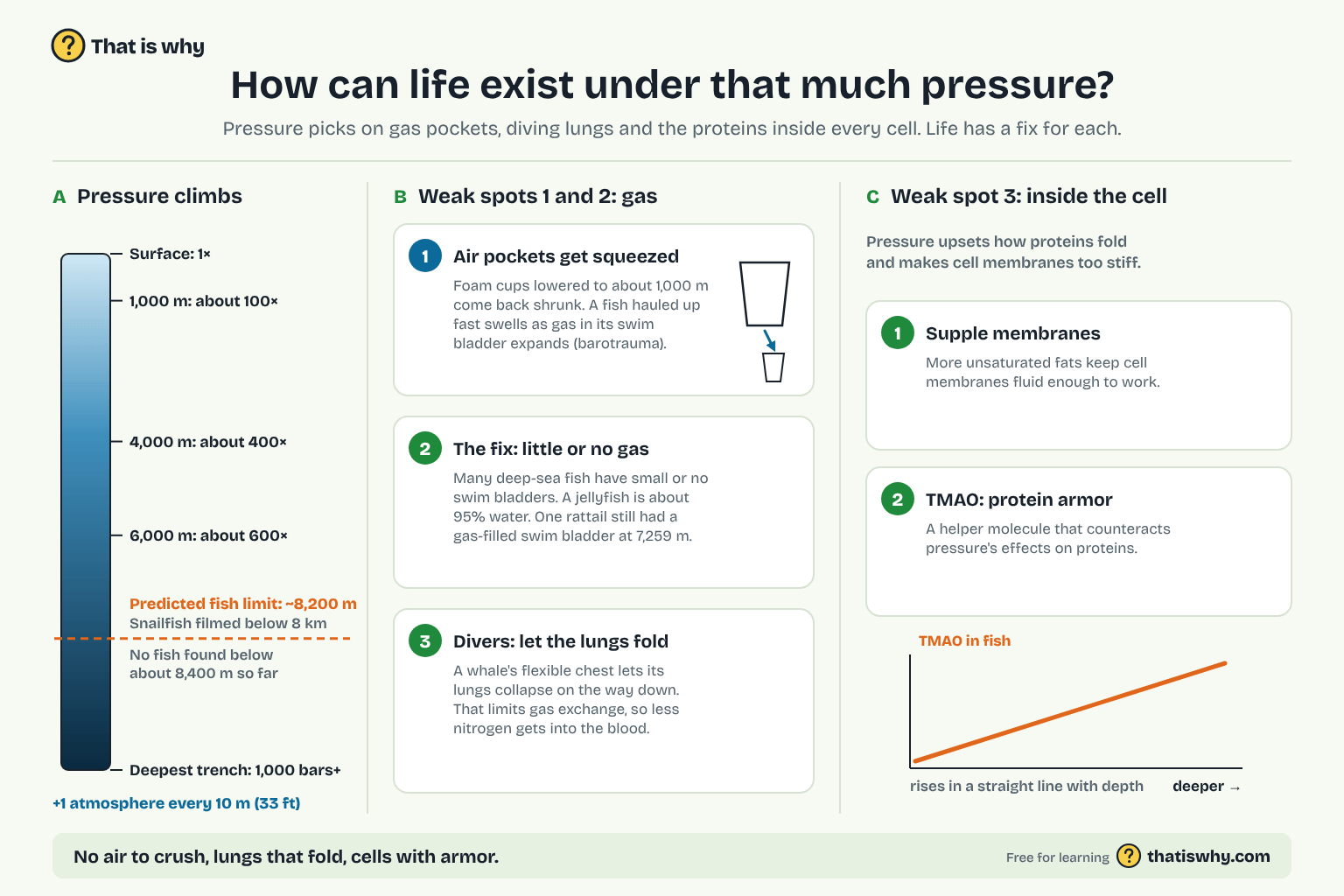
A. Pressure climbs. Every 10 meters down adds one more atmosphere. At 1,000 meters that is about 100 times the pressure at the surface, and in the deepest trench it reaches 1,000 bars or more.
B. Gas is the first weak spot. Foam cups lowered to about 1,000 meters come back shrunk, squeezed by the pressure. A fish hauled up fast suffers the reverse: the gas in its swim bladder expands and it swells (barotrauma). Many deep-sea fish keep their swim bladders small or have none, a jellyfish is about 95% water, and even so, one rattail fish was filmed at 7,259 meters with a working, gas-filled swim bladder. Diving whales take another route: their flexible chests let their lungs collapse, which limits gas exchange and the nitrogen they take up.
C. Cells are the third weak spot. Pressure upsets the way proteins fold and makes cell membranes too stiff. Deep-sea animals pack their membranes with more unsaturated fats, and they stock up on helper molecules (piezolytes) such as TMAO, which rises in a straight line the deeper a fish lives. Following that trend, researchers predict a limit around 8,200 meters; so far, no fish has been found below about 8,400 meters.
The drawing is simplified: depths and sizes are not to scale.
Key numbers
| Fact | Value |
|---|---|
| Pressure increase | 1 atmosphere every 10 m (33 ft) |
| Pressure at 1,000 m | about 100 times the surface |
| Pressure in the deepest trench | 1,000 bars or more |
| Depth where foam cups shrank | about 1,000 m |
| Water in a jellyfish | about 95% |
| Predicted limit for fish (from TMAO) | about 8,200 m |
| No fish found below | about 8,400 m |
| Deepest fish with a gas-filled swim bladder | 7,259 m |
| Deepest fish ever filmed | more than 8 km down (2022) |
Common misconceptions
Myth Deep-sea pressure would crush any animal flat.
The truth Gas-filled spaces are the easy target, and many deep-sea fish keep them small or skip them. Their cells are protected too, by supple membranes and helper molecules like TMAO.
Myth Deep-sea fish can live at any depth.
The truth No fish has been found below about 8,400 m. Researchers predict a limit around 8,200 m, set by how much TMAO a fish can carry, but it is a prediction, not a proven wall.
Questions to use in class
Tap a question to reveal a model answer.
1What are the three weak spots pressure picks on?
Gas-filled spaces, the lungs of air-breathing divers, and the proteins and membranes inside cells.
2What happened to foam cups lowered to 1,000 m?
The pressure squeezed them, and they came back shrunk.
3How do whales cope with pressure on a deep dive?
Their flexible chests let their lungs collapse, which limits gas exchange and so the amount of nitrogen taken up.
4Why can't fish live in the deepest trenches?
Fish need more TMAO, the molecule that protects their proteins, the deeper they live. Following that trend, researchers predict a limit around 8,200 m, and no fish has been found below about 8,400 m.
Key terms
- Swim bladder
- A gas-filled pouch inside many bony fish that lets them float at a chosen depth without swimming. Because it holds gas, it shrinks under pressure and swells when pressure drops.
- Barotrauma
- Injury caused by a quick change in pressure. In fish hauled up from deep water, gas in the swim bladder expands and can push the stomach out of the mouth or make the eyes bulge.
- Piezolytes
- Small helper molecules that help proteins keep their shape and work properly under the extreme pressure of the deep sea, such as TMAO.
- TMAO
- A small molecule found in the tissues of marine animals that helps proteins keep their working shape under high pressure. Deeper-living fish carry more of it; when a fish dies, it breaks down into the compound that gives fish its "fishy" smell.
Sources
- How does pressure change with ocean depth? NOAA National Ocean Service
- Styrofoam cups shrunk by deep-sea pressure NOAA Ocean Exploration
- What is barotrauma? RecFIN
- Inflation and deflation pressure-volume loops in anesthetized pinnipeds confirms compliant chest and lungs (Fahlman et al., 2014) Frontiers in Physiology
- Cellular responses in marine animals to hydrostatic pressure (Yancey, 2020) Journal of Experimental Zoology Part A (abstract)
- Marine fish may be biochemically constrained from inhabiting the deepest ocean depths (Yancey et al., 2014) PNAS (abstract)
- In situ observation of a macrourid fish at 7259 m in the Japan Trench (2024) PubMed (abstract)
- Scientists discover how low fish can go NIWA
- Scientists break new record after finding world's deepest fish The University of Western Australia
- Curious Kids: how do creatures living in the deep sea stay alive given the pressure? The Conversation
- Jellyfish National Geographic