Free teaching diagram
Deep-Sea Pressure Diagram: Why Animals Aren't Crushed
Deep-sea animals are full of water, not air, so the pressure inside matches the pressure outside.
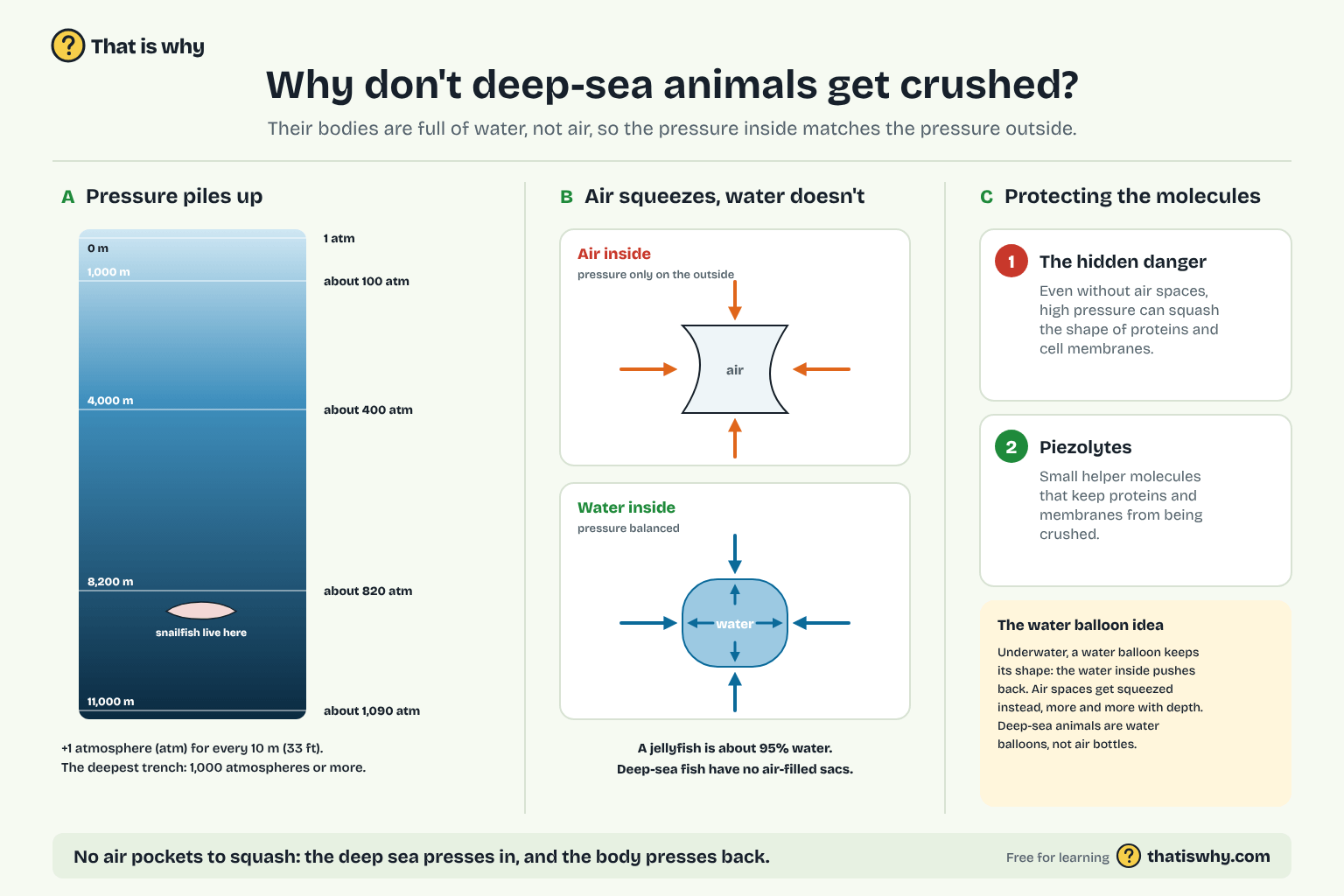
What the diagram shows
A. Pressure piles up. Ocean pressure rises by one atmosphere for every 10 m (33 ft) of depth: about 100 atmospheres at 1,000 m, about 820 at 8,200 m, where snailfish have been found, and roughly 1,000 or more at the bottom of the deepest trench. This weight of water is called hydrostatic pressure.
B. Air squeezes, water doesn't. A space full of air gets squeezed because the pressure acts only from the outside. A body full of water pushes back with the same pressure, so it stays balanced. A jellyfish is about 95% water, and deep-sea fish have no air-filled sacs to squash.
C. Protecting the molecules. Even without air spaces, high pressure can squash the shape of proteins and cell membranes. Deep-sea animals carry small helper molecules called piezolytes that protect them.
Key numbers
| Fact | Value |
|---|---|
| Pressure increase | 1 atmosphere every 10 m (33 ft) |
| Pressure at 1,000 m | about 100 atmospheres |
| Pressure in the deepest trench | about 1,000 atmospheres or more |
| Water in a jellyfish | about 95% |
Common misconceptions
Myth Deep-sea animals must be incredibly strong to resist the pressure.
The truth They have no air spaces to squash; their bodies are full of water, so the pressure inside matches the pressure outside.
Myth Pressure in the deep sea only pushes down from above.
The truth Water pressure acts from every direction at once.
Myth Without air pockets, pressure can't harm anything.
The truth High pressure can still squash proteins and membranes; piezolytes help protect them.
Questions to use in class
Tap a question to reveal a model answer.
1How fast does pressure rise in the ocean?
By one atmosphere for every 10 m (33 ft) of depth.
2What is the pressure at the bottom of the deepest trench?
About 1,000 atmospheres or more; roughly 1,090 atm at 11 km.
3Why aren't deep-sea animals crushed?
Their bodies are full of water instead of air, so the pressure inside balances the pressure outside.
4What are piezolytes?
Small helper molecules that stop proteins and cell membranes from being squashed by high pressure.
Key terms
- Hydrostatic pressure
- The pressure a liquid at rest exerts because of the weight of the liquid above. It grows steadily with depth and pushes equally from every direction.
- Atmosphere (atm)
- A unit of pressure equal to the average air pressure at sea level (about 101 kilopascals, or 14.7 pounds per square inch). In the sea, pressure rises by about 1 atm for every 10 m of depth.
- Piezolytes
- Small helper molecules that help proteins keep their shape and work properly under the extreme pressure of the deep sea, such as TMAO.
Sources
- How does pressure change with ocean depth? NOAA Ocean Service
- Curious Kids: how do creatures living in the deep sea stay alive given the pressure? The Conversation
- How much of a jellyfish is water? NOAA Ocean Service