Free teaching diagram
Whale Lung Diagram: Why Lungs Collapse on Deep Dives
Whales let pressure fold their lungs flat, and carry their oxygen in blood and muscle instead.
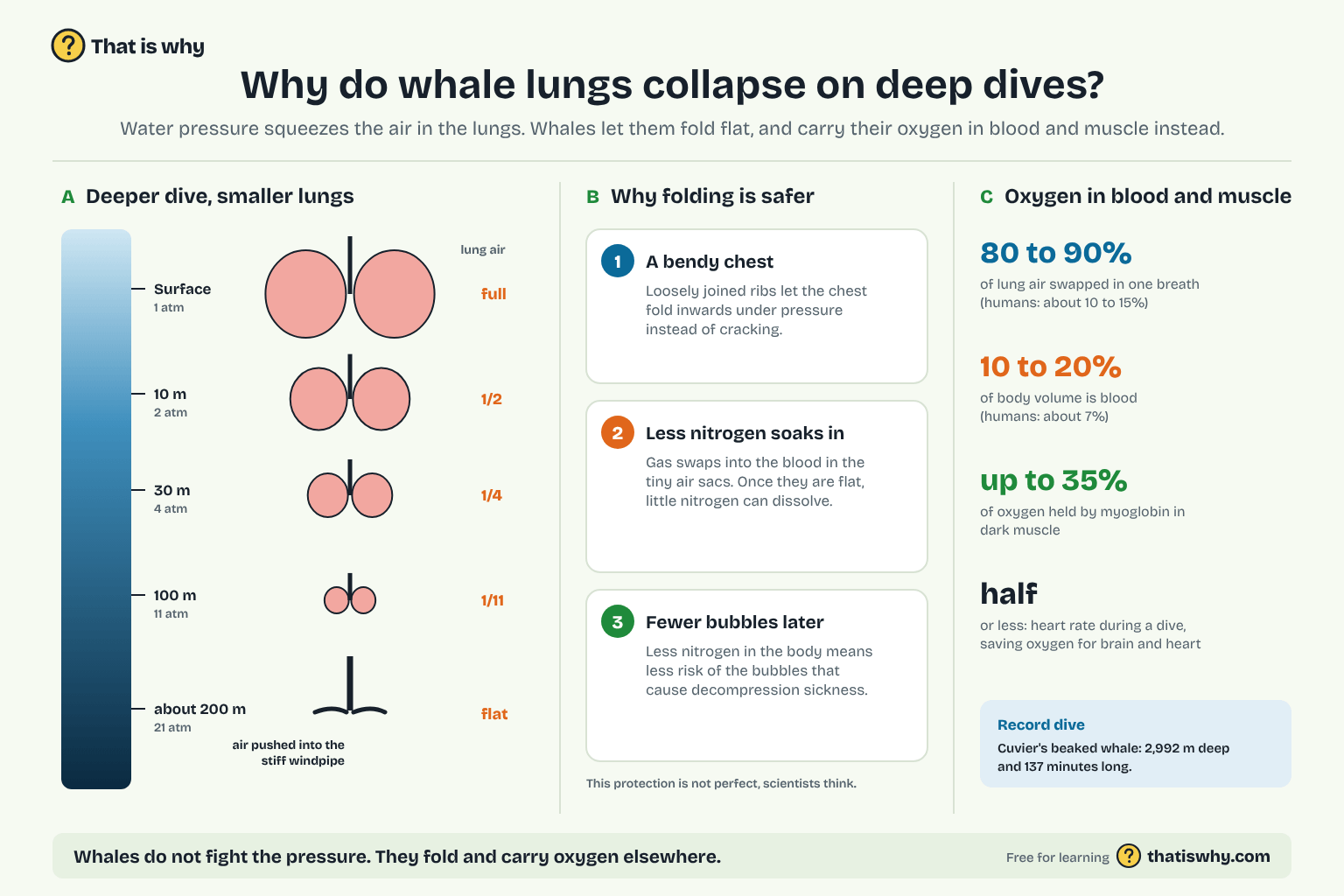
What the diagram shows
A. Deeper dive, smaller lungs. Every 10 m of seawater adds about one atmosphere of pressure. Gas obeys Boyle's law: double the pressure and its volume halves. So a whale's lung air shrinks to about 1/2 at 10 m, 1/4 at 30 m and 1/11 at 100 m. By roughly 200 m the tiny air sacs (alveoli) are flat, and the remaining air has been pushed into the stiff windpipe and large airways.
B. Why folding is safer.
- A bendy chest. Whale ribs are loosely joined, so the chest folds inwards under pressure instead of cracking.
- Less nitrogen soaks in. Gas passes into the blood only through the thin walls of the alveoli. Once they are flat, little nitrogen can dissolve.
- Fewer bubbles later. Less dissolved nitrogen means less risk of the bubbles that cause decompression sickness. Scientists think this protection is not complete: whales still absorb some nitrogen in the first 200 m.
C. Oxygen in blood and muscle. With collapsed lungs, whales rely on oxygen they stored before the dive. They swap 80 to 90% of their lung air in one breath (humans manage about 10 to 15%), blood makes up 10 to 20% of their body volume (about 7% in humans), and myoglobin in their dark muscles holds up to 35% of their oxygen. During a dive the heart can slow by more than half. The record holder, a Cuvier's beaked whale, dived to 2,992 m and stayed down for 137 minutes.
Key numbers
| Depth | Pressure | Lung air volume |
|---|---|---|
| Surface | 1 atm | full |
| 10 m | 2 atm | about 1/2 |
| 30 m | 4 atm | about 1/4 |
| 100 m | 11 atm | about 1/11 |
| about 200 m | about 21 atm | air sacs collapsed |
Common misconceptions
Myth Whales fill their lungs with as much air as possible before a deep dive.
The truth Many deep divers rely little on lung air. Their oxygen is stored in blood and muscle, and the lungs collapse as they go down.
Myth Lung collapse is an injury.
The truth It is normal for diving whales. Their flexible chest lets the lungs fold flat and reinflate safely when they come back up.
Myth Whales can never get decompression sickness.
The truth Lung collapse lowers the risk, but scientists have found signs of gas bubbles in some stranded whales, so the protection is not perfect.
Questions to use in class
Tap a question to reveal a model answer.
1Using Boyle's law, how big is a lungful of air at 30 m (4 atm) compared with the surface?
About a quarter of its surface volume, because four times the pressure squeezes a gas to about a quarter of its size.
2Why does pushing air out of the tiny air sacs into the windpipe reduce nitrogen uptake?
Gas passes into the blood through the thin walls of the air sacs. The windpipe is thick-walled, so air stored there hardly dissolves into the blood.
3Why is whale muscle so dark?
It is packed with myoglobin, an oxygen-storing protein that is dark red.
4Why does slowing the heart help a whale stay under longer?
Less blood is pumped to organs that can wait, so the stored oxygen is saved for the brain and heart.
Key terms
- Alveoli
- The tiny, thin-walled air sacs at the ends of the airways in the lungs, where oxygen passes into the blood and carbon dioxide passes out.
- Myoglobin
- An oxygen-storing protein in muscle. Diving mammals have so much of it that their muscles look almost black.
- Boyle's law
- At a constant temperature, the volume of a gas goes down as the pressure on it goes up, in the same proportion: double the pressure and the gas takes up half the space.
- Hydrostatic pressure
- The pressure a liquid at rest exerts because of the weight of the liquid above. It grows steadily with depth and pushes equally from every direction.
- Decompression sickness
- An illness in divers who rise too quickly: gas dissolved in the blood under pressure forms bubbles as the pressure drops.
Sources
- How man-made interference might cause gas bubble emboli in deep diving whales (Fahlman et al., 2014) Frontiers in Physiology
- Beaked whales can dive 2,000 metres below the ocean's surface. Why and how do they do it? Natural History Museum, London
- How do whales breathe? Whale and Dolphin Conservation
- First long-term behavioral records from Cuvier's beaked whales reveal record-breaking dives (Schorr et al., PLOS ONE 2014) PubMed