Free teaching diagram
Beached Whale Diagram: Why Stranded Whales Die If They Breathe Air
Water carries a whale's weight and its heat; on the sand, both turn against it.
The detailed teaching diagram
What the diagram shows
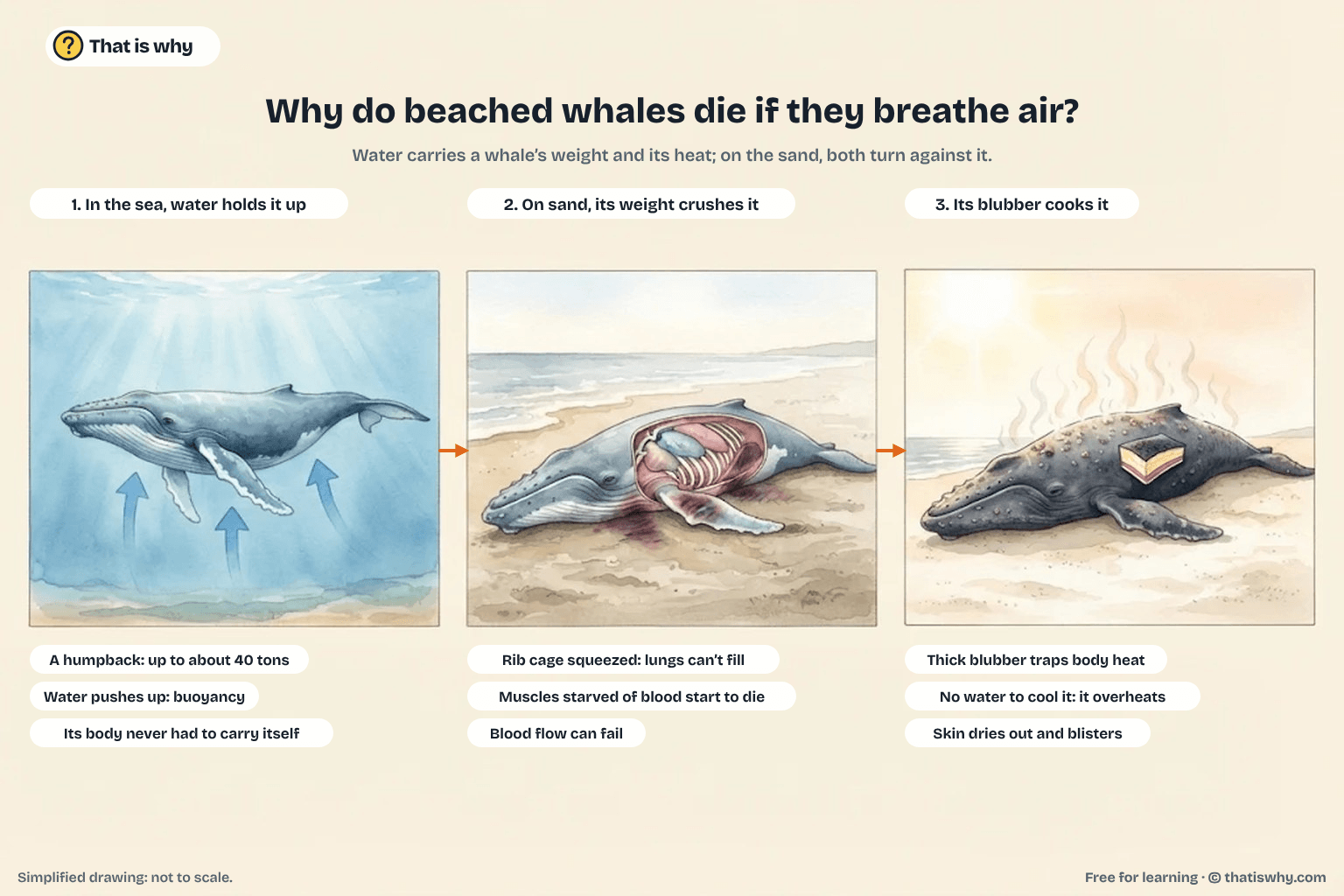
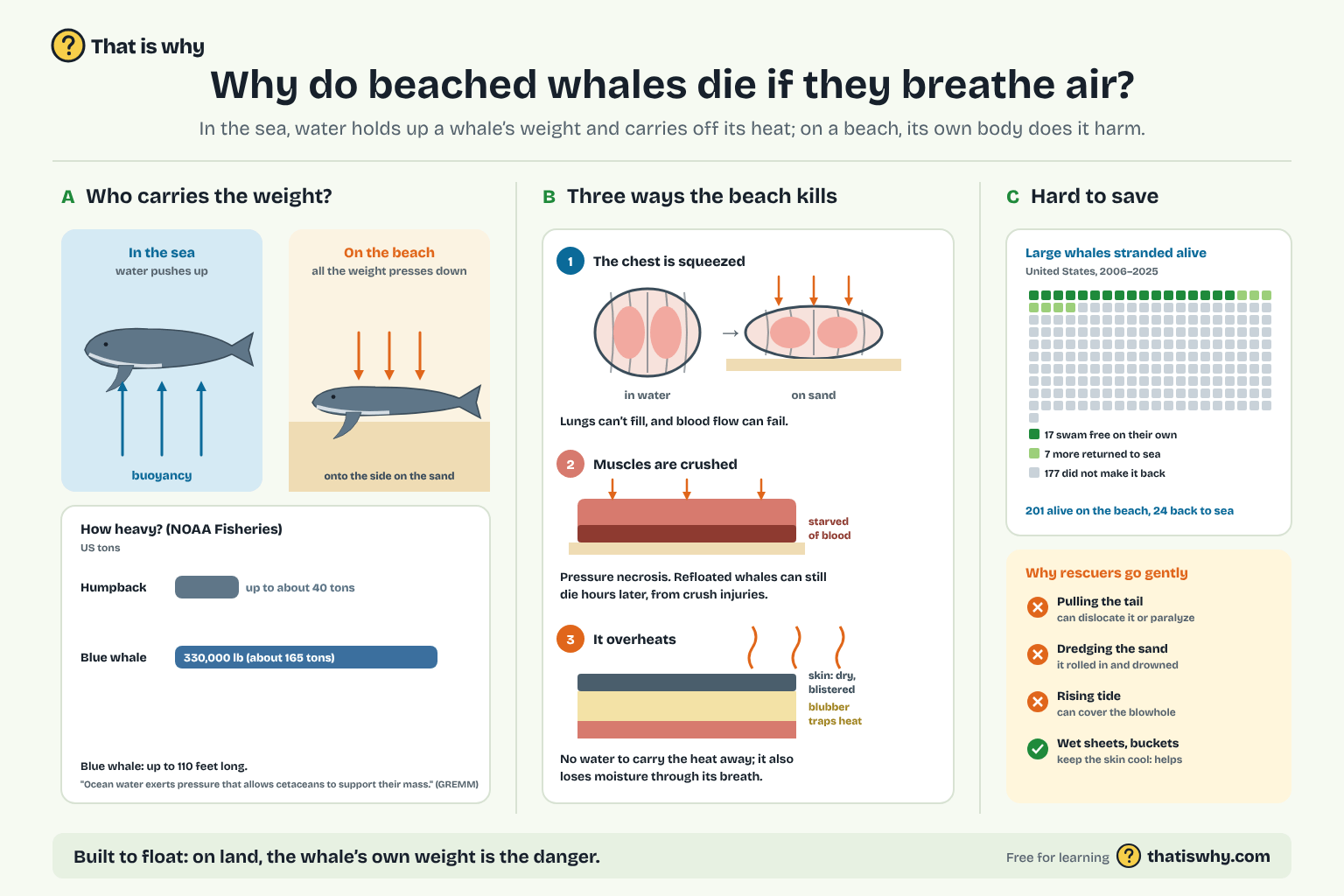
1. In the sea, water holds it up. Water pushes up on anything floating in it, a lift called buoyancy. That is how a humpback, up to about 40 tons, can move as if it weighed nothing. A whale's skeleton and muscles never had to carry its body off the ground.
2. On sand, its weight crushes it. On a beach, all that weight presses down on the side touching the sand. It squeezes the rib cage so the lungs can't fill, and it starves the muscles underneath of blood until they begin to die, called pressure necrosis. A whale in this situation is a live stranding.
3. Its blubber cooks it. A thick layer of blubber keeps a whale warm in cold seas, but on land there's no water to carry heat away, and its way of controlling temperature, its thermoregulation, breaks down. The whale overheats, and its skin dries out and blisters.
Key numbers
| Fact | Value |
|---|---|
| Humpback weight | up to about 40 tons |
| Blue whale weight and length | up to 330,000 lb and 110 feet |
| Large whales stranded alive in the US, 2006–2025 | 201 |
| Returned to the sea | 24 (17 freed themselves) |
Common misconceptions
Myth A beached whale dies because it can't breathe out of water.
The truth Whales breathe air through their blowhole. The trouble is their own weight pressing on the chest, so the lungs can't fill and the blood can't flow as it should.
Myth Once a stranded whale is back in the sea, it's saved.
The truth Many whales die a few hours after refloating, from crush injuries caused by their own weight on the sand.
Myth Pulling a whale by the tail is a quick way to get it back to sea.
The truth Towing a live whale by the tail can dislocate the tail or break the spinal cord, paralyzing the animal.
Questions to use in class
Tap a question to reveal a model answer.
1Why do whales die on land if they breathe air?
Their bodies are built to be held up by water. On land, their own weight squeezes the chest so the lungs can't fill, crushes the muscles underneath, and their blubber makes them overheat.
2How many stranded whales survive?
Between 2006 and 2025, 201 large whales stranded alive in the United States, and only 24 were returned to the sea, 17 of them by freeing themselves.
3How heavy is a whale out of water?
According to NOAA Fisheries, a humpback weighs up to about 40 tons, and a blue whale up to 330,000 pounds. In water, buoyancy carries that weight.
4Why do rescuers keep stranded whales wet?
Out of water, a whale can't shed heat and its skin dries out and blisters. Sheets, buckets and sprayers keep it wet and cool while rescuers wait for the tide.
Key terms
- Live stranding
- When a whale, dolphin or porpoise ends up stuck on a beach or in shallow water while still alive. Out of water, its own weight and the heat can kill it.
- Buoyancy
- The upward push a liquid or gas gives to an object in it. An animal less dense than the water around it floats; one that is denser sinks.
- Blubber
- The thick layer of fat under the skin of whales, seals and other sea mammals. It keeps them warm in cold water, but makes them overheat quickly out of it.
- Pressure necrosis
- Tissue that dies because steady pressure squeezes the blood out of it for too long. In a stranded whale, its own weight does this to the muscles underneath.
- Thermoregulation
- How an animal keeps its body temperature within a safe range, for example by sweating, panting, flapping ears or seeking shade.
Sources
- Frequent Questions—Live Large Whale Strandings on the West Coast NOAA Fisheries
- How can a live stranded whale die of asphyxiation? Baleines en direct (GREMM)
- Why do beached whales die so often? BBC Science Focus
- Humpback Whale NOAA Fisheries
- Blue Whale NOAA Fisheries