Free teaching diagram
Duck Feet Diagram: Why Ducks' Feet Don't Freeze
Warm blood heading down hands its heat to cold blood heading up, so the feet stay just above freezing.
The detailed teaching diagram
What the diagram shows
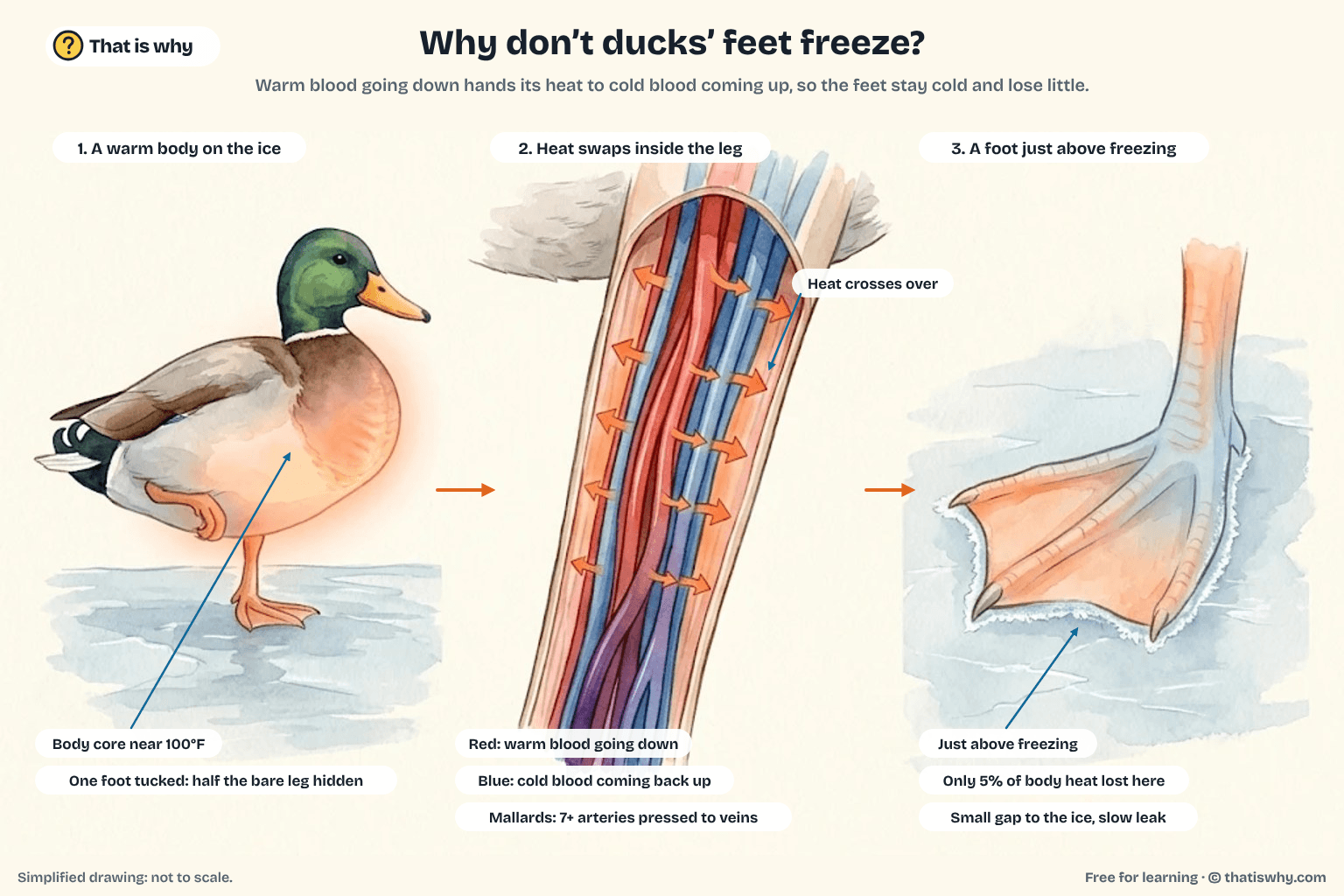
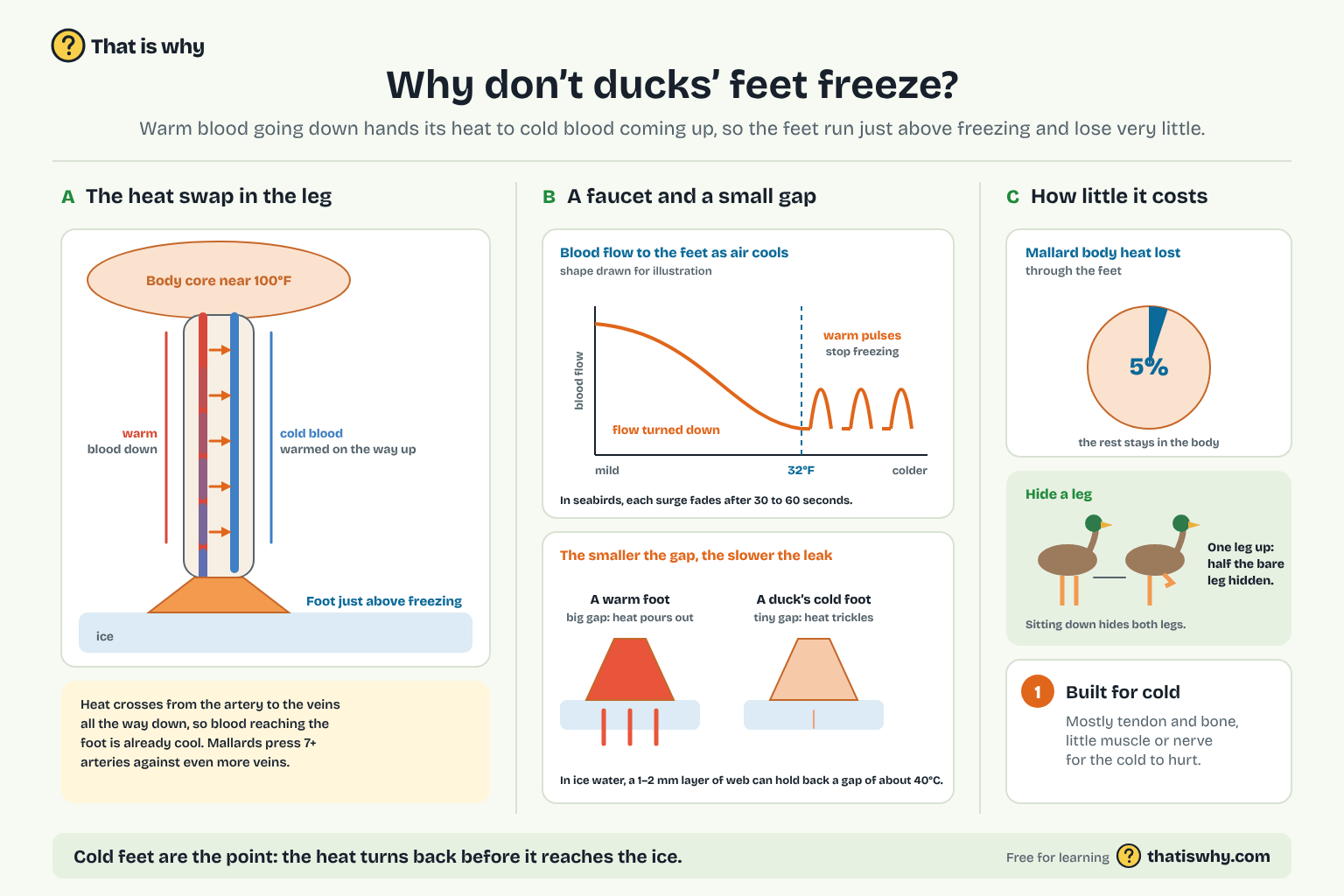
1. A warm body on the ice. A mallard's body core stays near 100 degrees Fahrenheit while it stands on ice. Tucking one foot into its feathers halves the bare leg surface it exposes to the cold.
2. Heat swaps inside the leg. Arteries carrying warm blood down to the foot run right beside veins carrying cold blood back up. Heat crosses from one to the other all the way down, a countercurrent heat exchange. Mallards have an elaborate version, with more than seven arteries pressed against an even larger number of veins.
3. A foot just above freezing. By the time blood reaches the foot, it is already cool, so the foot runs just above freezing. Because the gap between foot and ice is so small, heat leaks out very slowly. Keeping the core warm while the feet run cold is called regional heterothermy, and the duck adjusts it by narrowing the leg's blood vessels, a vasoconstriction, then sending pulses of warm blood below freezing.
Key numbers
| Fact | Value |
|---|---|
| Duck's body core | near 100°F |
| Duck's feet on ice | just above freezing |
| Mallard body heat lost through the feet | 5% |
| Arteries in a mallard's leg exchanger | more than 7 |
| Length of a cold flush in seabirds | 30 to 60 seconds |
| Bare leg surface hidden by standing on one leg | half |
Common misconceptions
Myth A duck's feet are frozen numb, and it just puts up with the pain.
The truth The feet run just above freezing, not below it. They are mostly tendon and bone with little nerve tissue, and the duck sends pulses of warm blood to stop them from freezing.
Myth Northern mallards have redder feet because more blood flows to them in the cold.
The truth The bright feet and bills of mallards come from changes in hormone levels during the pairing season in late fall and winter.
Myth Ducks keep their feet warm to stand on ice.
The truth They do the opposite. Keeping the feet cold shrinks the temperature gap to the ice, so very little heat escapes.
Questions to use in class
Tap a question to reveal a model answer.
1How do ducks stand on ice without freezing?
Warm blood flowing down the leg hands most of its heat to the cold blood flowing back up, so the feet stay just above freezing and lose very little heat.
2How much body heat does a duck lose through its feet?
In mallards, just five percent of their total body heat escapes through their feet, according to Ducks Unlimited Canada.
3Why do ducks stand on one leg in winter?
Tucking one leg into the feathers halves the bare leg surface exposed to the cold, and sitting down covers both legs.
4Why can't our feet do the same?
Human feet are full of muscle and nerves, so our own countercurrent exchange does not prevent frostbite.
Key terms
- Countercurrent heat exchange
- A way of saving heat where warm and cold flows pass close by each other, so warmth moves across instead of being lost. Birds of cold climates use one in the nose to keep back heat and water when they breathe out.
- Regional heterothermy
- Keeping the body core warm while letting parts such as the legs and feet run much colder. Ducks and gulls use it to stand on ice for long periods.
- Vasoconstriction
- The narrowing of blood vessels, which cuts blood flow to a body part. Ducks use it in cold weather to send less warm blood to their feet.
- Thermoregulation
- How an animal keeps its body temperature within a safe range, for example by sweating, panting, flapping ears or seeking shade.
Sources
- Getting Cold Feet? Ducks Unlimited Canada, Institute for Wetland & Waterfowl Research
- Webbed Wonders (J. Michael Checkett) Ducks Unlimited
- How Do Gulls Deal With Cold Feet? Cornell Lab of Ornithology, All About Birds
- Temperature Regulation and Behavior (Ehrlich, Dobkin & Wheye) Stanford University, Birds of Stanford
- Heat conservation during cold exposure in birds (vasomotor and respiratory implications) (Johansen & Bech, Polar Research 1983) Polar Research