Free teaching diagram
Emperor Penguin Huddle Diagram: Surviving the Antarctic Winter
Packed tight, taking turns in the warm middle, with feathers and nose holding the heat in.
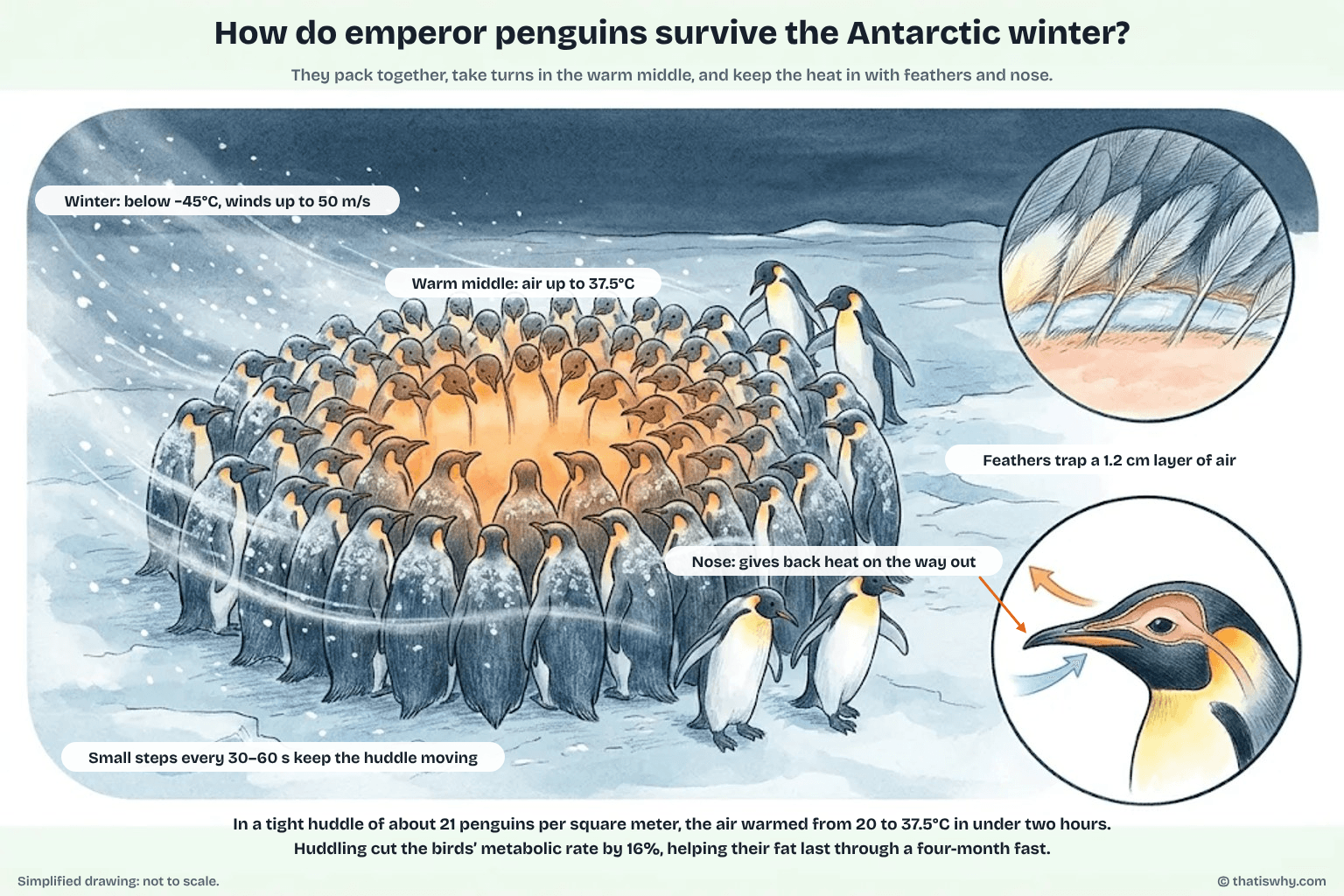
The detailed teaching diagram
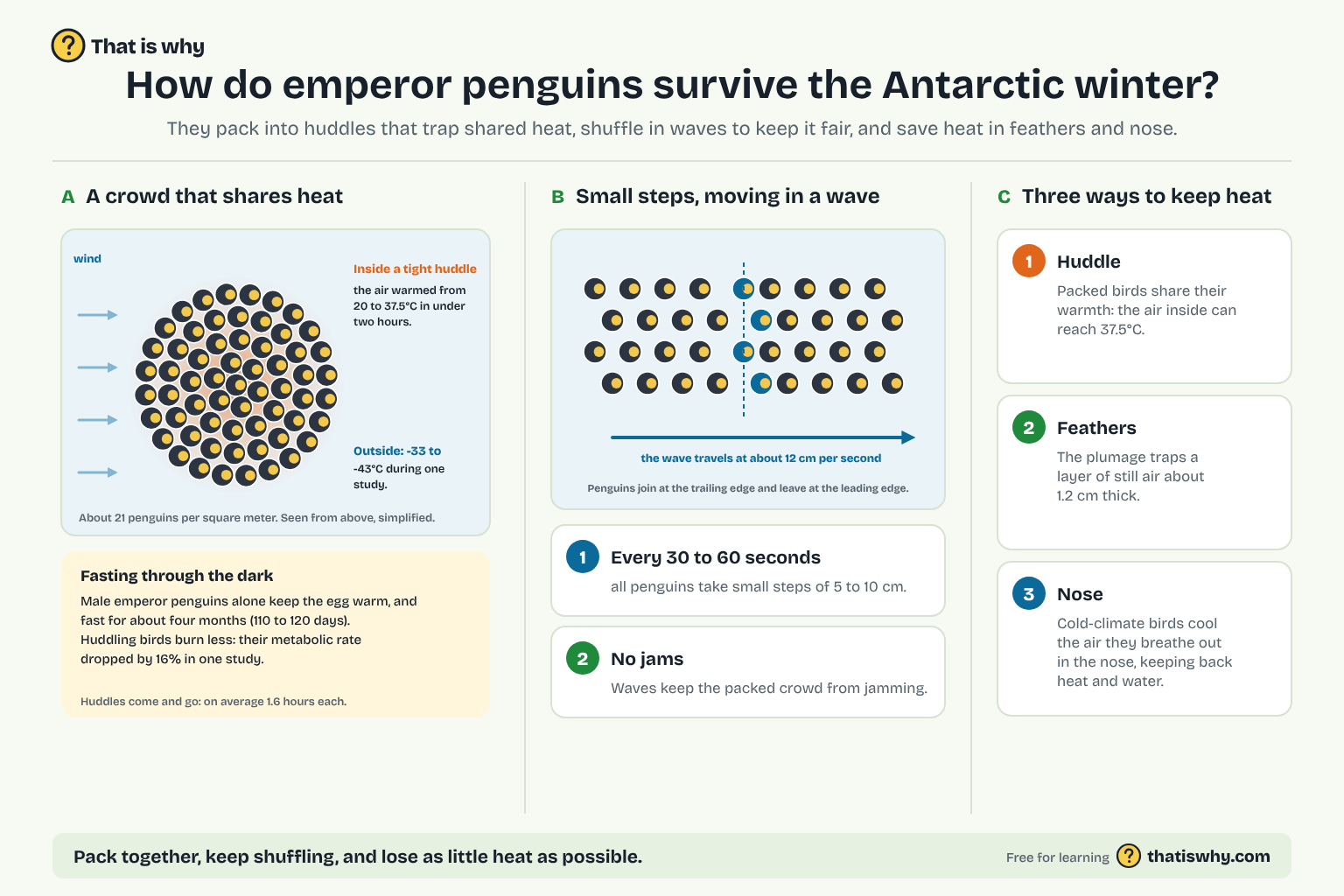
What the diagram shows
A. A crowd that shares heat. Male emperor penguins alone keep the egg warm through the Antarctic winter and fast for about four months (110 to 120 days). They pack together at about 21 penguins per square meter. In one study, the air inside tight huddles rose from 20 to 37.5°C in under two hours, while another study filmed a huddle with the outside air at -33 to -43°C. Huddling birds burn less energy: their metabolic rate dropped by 16% in one study. Huddles come and go, lasting 1.6 hours on average. The huddle is drawn from above and simplified.
B. Small steps, moving in a wave. Every 30 to 60 seconds, all the penguins take small steps of 5 to 10 cm. The steps travel through the huddle as a wave at about 12 cm per second, which keeps the tightly packed crowd from jamming. Penguins join the huddle at its trailing edge and leave at its leading edge.
C. Three ways to keep heat. The huddle lets packed birds share their warmth. The feathers trap a layer of still air about 1.2 cm thick. And like other birds of cold climates, penguins can cool the air they breathe out in the nose, keeping back heat and water.
Key numbers
| Fact | Value |
|---|---|
| Air inside a tight huddle | up to 37.5°C |
| Outside air during one study | -33 to -43°C |
| Male fast while keeping the egg | about four months (110 to 120 days) |
| Penguins per square meter in a huddle | about 21 |
| Time between waves of steps | 30 to 60 seconds |
| Step length | 5 to 10 cm |
| Wave speed | about 12 cm per second |
| Air layer in the feathers | about 1.2 cm |
| Metabolic saving while huddling (one study) | 16% |
| Average huddle length | 1.6 hours |
Common misconceptions
Myth Penguins huddle nonstop all winter.
The truth Huddles come and go: in one study they lasted 1.6 hours on average, and males spent about 38% of their time huddling.
Myth The same penguins always stay in the warm middle.
The truth Every 30 to 60 seconds the whole huddle shuffles in a wave; penguins join at the trailing edge and leave at the leading edge.
Myth Inside a huddle it is still freezing.
The truth The air inside a tight huddle can warm from 20 to 37.5°C in under two hours.
Questions to use in class
Tap a question to reveal a model answer.
1How warm is it inside a penguin huddle?
In one study, the air inside tight huddles rose from 20 to 37.5°C in under two hours.
2How long do male emperor penguins go without eating?
About four months (110 to 120 days) while they keep the egg warm.
3How do penguins move inside a huddle?
Every 30 to 60 seconds, all of them take small steps of 5 to 10 cm that travel through the huddle as a wave at about 12 cm per second.
4How do feathers keep a penguin warm?
They trap a layer of still air about 1.2 cm thick.
Key terms
- Thermoregulation
- How an animal keeps its body temperature within a safe range, for example by sweating, panting, flapping ears or seeking shade.
- Insulation
- A layer that slows the flow of heat, such as fat, fur, feathers or still air.
- Countercurrent heat exchange
- A way of saving heat where warm and cold flows pass close by each other, so warmth moves across instead of being lost. Birds of cold climates use one in the nose to keep back heat and water when they breathe out.