Free teaching diagram
Elephant Ear Diagram: Nature's Cooling Panels
Elephant ears are radiators: warm blood spreads through thin, flapping ears and comes back cooler.
The detailed teaching diagram
What the diagram shows
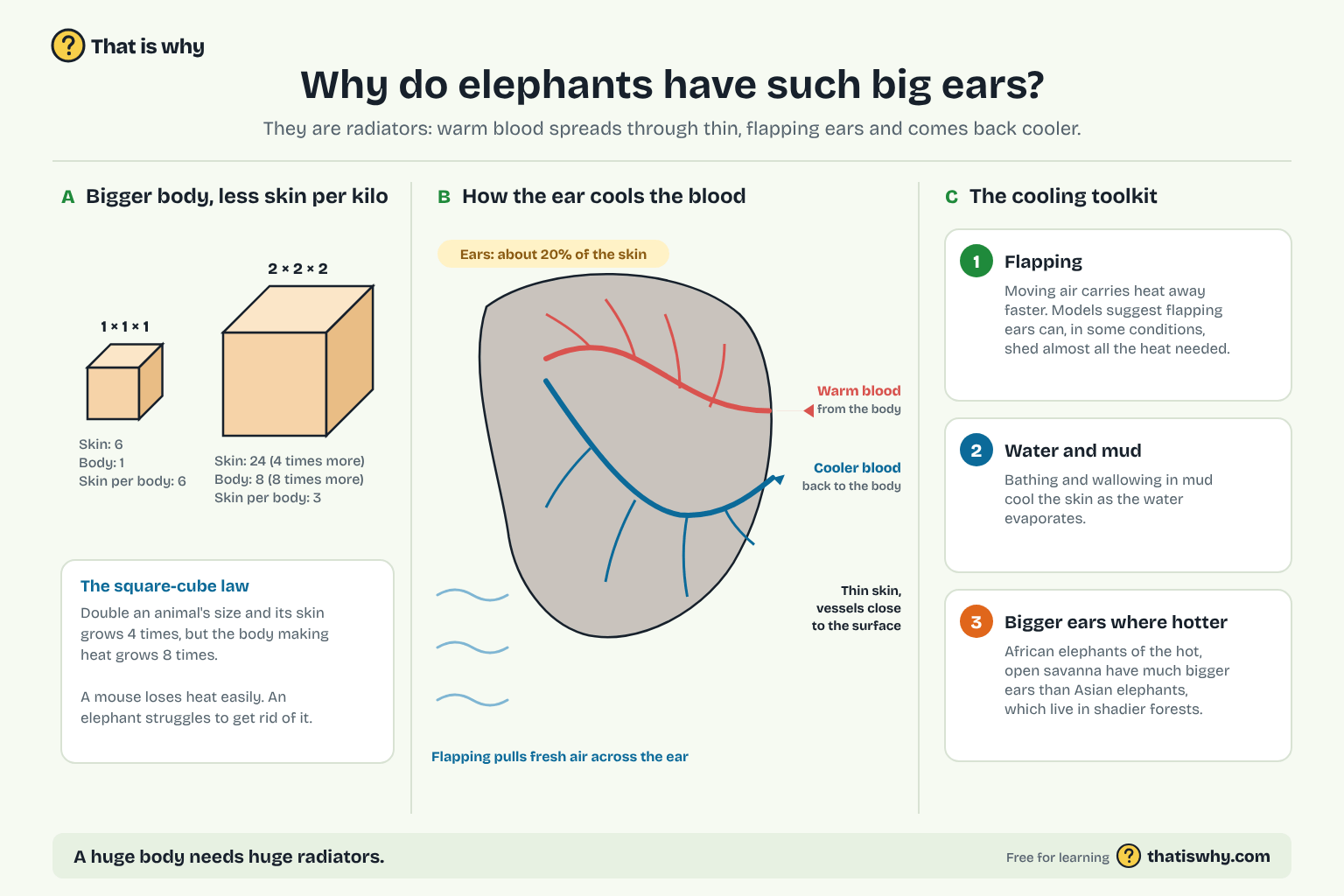
A. Bigger body, less skin per kilo. Heat is made throughout an animal's body, but it is lost through its skin. The square-cube law shows the problem with being big: if you double the size of a cube, its surface grows 4 times but its volume grows 8 times. The bigger cube has only half as much surface for each unit of volume. A mouse loses heat easily; an elephant, the largest land animal, struggles to get rid of it.
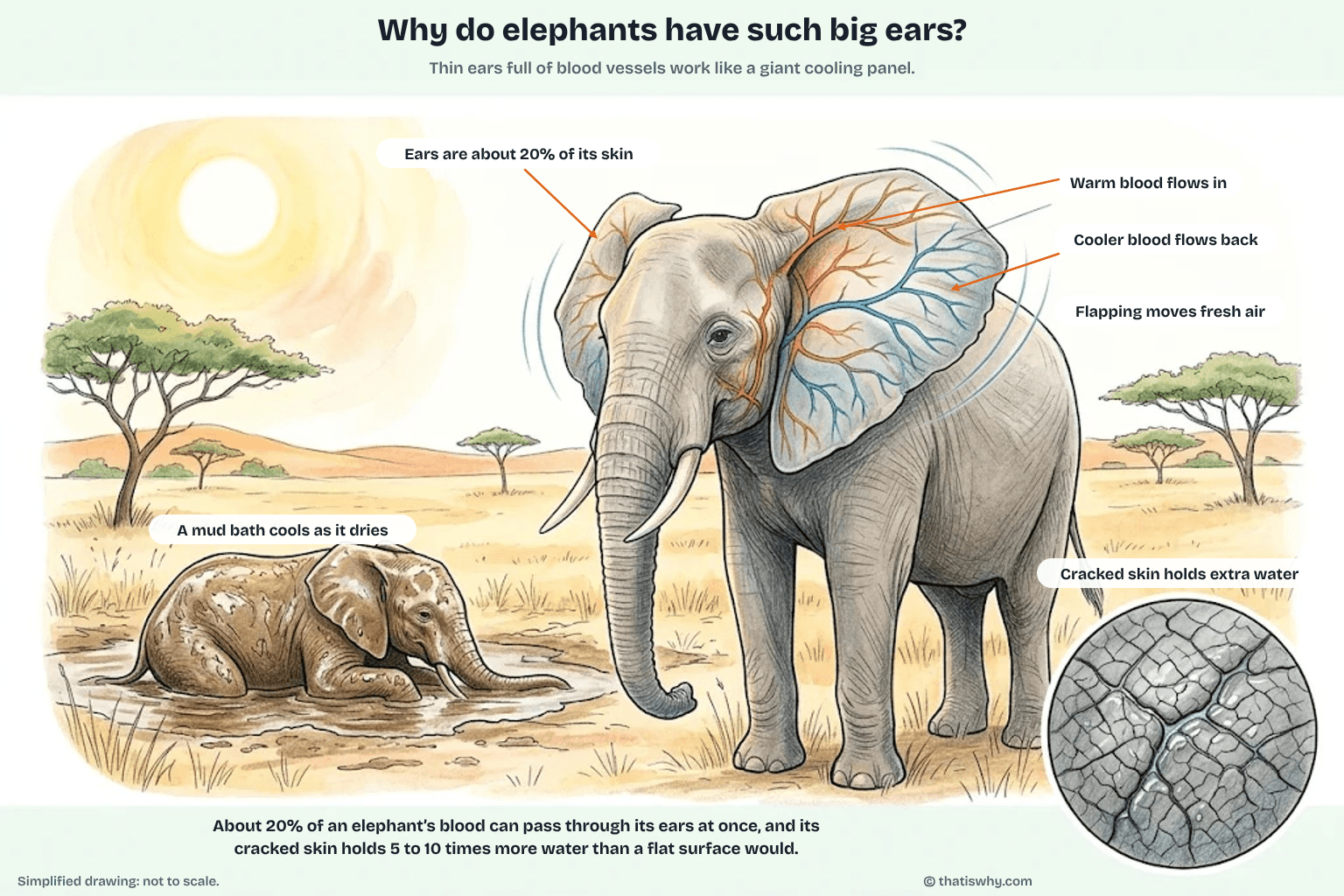
B. How the ear cools the blood. An elephant's ears are about 20% of its skin. They are thin and packed with blood vessels close to the surface. Warm blood from the body flows into the ear, spreads through the vessels, gives up heat to the air, and returns to the body cooler. Flapping the ears pulls fresh air across them, which speeds up this heat exchange.
C. The cooling toolkit. Flapping matters: models suggest that, in some conditions, ear movement can get rid of almost all the heat an elephant needs to lose. Elephants also bathe and wallow in mud, which cool the skin as they dry (evaporative cooling). And ear size matches climate: African elephants of the hot, open savanna have much bigger ears than Asian elephants, which live in shadier forests.
Key numbers
| Fact | Value |
|---|---|
| Ears as a share of skin area | about 20% |
| Double the size: surface | 4 times bigger |
| Double the size: volume | 8 times bigger |
| Body temperature range reported | about 35.0 to 37.5 °C |
Common misconceptions
Myth Elephants flap their ears only to look bigger or scare others.
The truth Ear-spreading can be a signal, but elephants also fan and flap their ears in response to heat. Flapping moves air over warm blood vessels and helps them shed heat.
Myth Big animals stay warm more easily, so they don't need to cool down.
The truth That is exactly the problem: a huge body makes lots of heat but has relatively little skin to lose it through, so elephants need extra cooling.
Myth Thick skin protects elephants from overheating.
The truth Thick skin doesn't stop heat building up inside. Elephants rely on their ears, water, mud and shade to stay cool.
Questions to use in class
Tap a question to reveal a model answer.
1A cube doubles in size. How do its surface and its volume change?
The surface becomes 4 times bigger and the volume 8 times bigger. So the bigger cube has less surface for each unit of volume.
2Why does this make it harder for a big animal to stay cool?
Heat is made throughout the body's volume but lost through the skin. A bigger animal has relatively less skin for its volume, so heat escapes more slowly.
3Why are thin ears with lots of blood vessels good at losing heat?
Warm blood flows close to the surface of a large, thin area, so heat can pass easily into the air, especially when the ear moves.
4Why do African elephants tend to have bigger ears than Asian elephants?
Many African elephants live in hot, open savanna with little shade, while Asian elephants often live in shadier forests. Bigger ears help where overheating is a bigger risk.
5How do bathing and mud help an elephant cool down?
As water evaporates from the skin, it takes heat with it: evaporative cooling, the same effect as sweating.
Key terms
- Square-cube law
- As an object grows, its surface area grows with the square of its size but its volume grows with the cube. Double the size: 4 times the surface, 8 times the volume.
- Surface-to-volume ratio
- How much outside surface something has for each unit of volume inside. A high ratio exchanges heat and water quickly; a low ratio keeps them in.
- Thermoregulation
- How an animal keeps its body temperature within a safe range, for example by sweating, panting, flapping ears or seeking shade.
- Heat exchange
- The transfer of heat from a warmer thing to a cooler one, such as from warm blood in an elephant's ear to the air moving past it.
- Vasodilation
- The widening of blood vessels, which lets more warm blood flow near the skin so the body can lose heat.
- Evaporative cooling
- Cooling caused when water evaporates from a surface and carries heat away with it, as with sweat, or water and mud on an elephant's skin.
Sources
- How the largest land animal stays cool, and what we can learn from it University of Notre Dame, Biomechanics in the Wild
- Why do elephants have big ears? Live Science
- Why do elephants have such big ears? There's not one answer. Popular Science
- Monitoring Thermoregulation Patterns in Asian Elephants Using Infrared Thermography (Lefebvre et al., 2023) Journal of Zoological and Botanical Gardens (MDPI)
- How the African elephant cracked its skin to cool off ScienceDaily (University of Geneva)