Free teaching diagram
Camel Hump Diagram: What's Really Inside It
A camel's hump is a store of fat, kept on top so the rest of the body can shed heat.
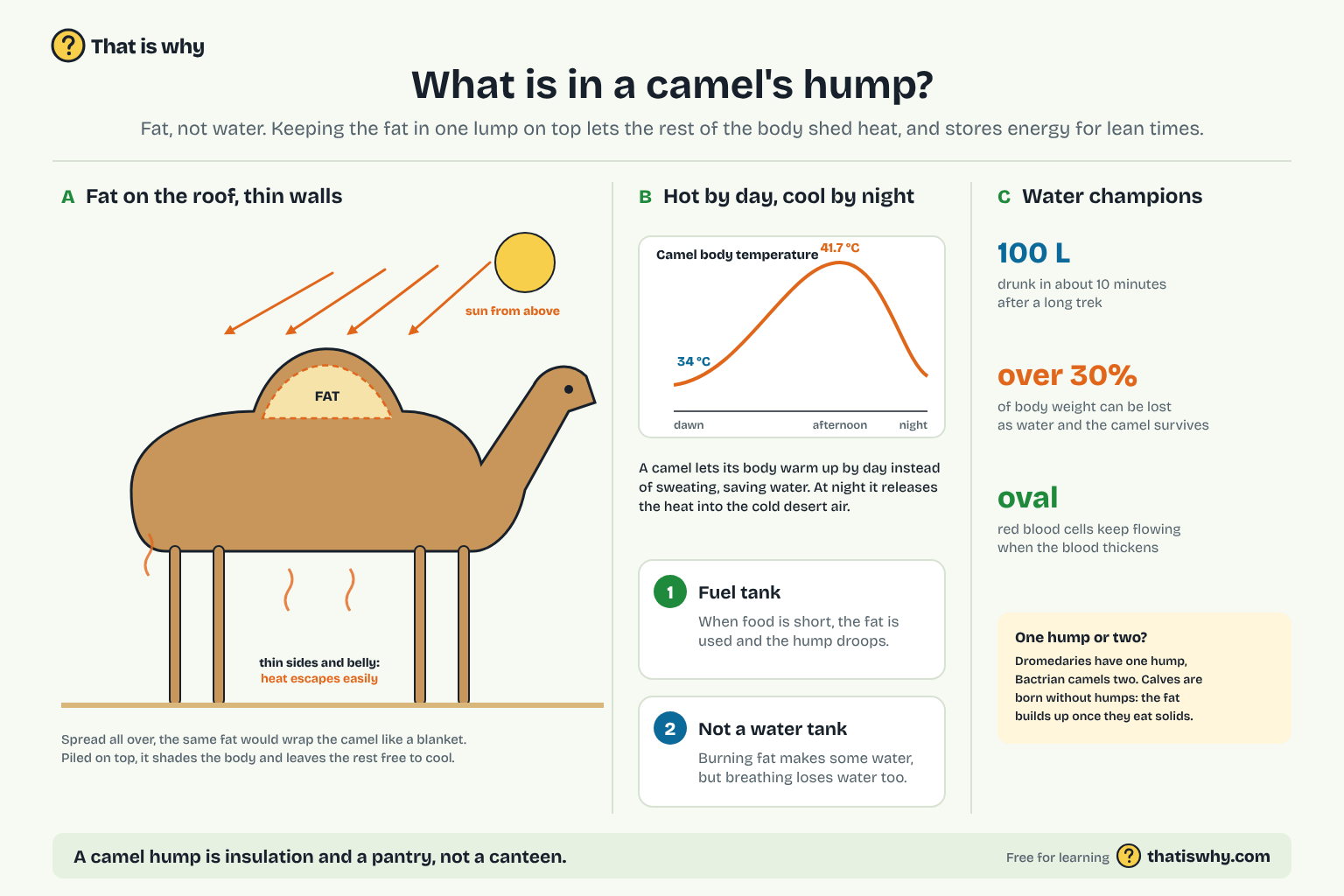
What the diagram shows
A. Fat on the roof, thin walls. A camel's hump is a store of fat (adipose tissue), not water. Fat is good insulation, which is a problem in the desert: spread all over the body, it would wrap the camel like a blanket. Piled in a hump on the back, it faces the sun overhead, while the sides and belly have only a thin layer and can shed heat easily.
B. Hot by day, cool by night. A camel lets its body temperature swing from about 34 °C to 41.7 °C during the day. By storing heat instead of sweating it away, it saves water, and it releases the heat into the cold night air. This is a form of thermoregulation. The hump is also a fuel tank: when food is short, the fat is used and the hump droops. Burning fat does make some water (metabolic water), but breathing to get the oxygen needed loses water too, so the hump is not a water tank.
C. Water champions. After a long trek a camel can drink about 100 liters in roughly 10 minutes, and it can survive losing more than 30% of its body weight as water. Its oval red blood cells keep flowing even when the blood thickens. Dromedaries have one hump and Bactrian camels two; calves are born without humps.
Key numbers
| Fact | Value |
|---|---|
| Hump contents | fat |
| Daily body temperature range | about 34 °C to 41.7 °C |
| Water drunk at once | about 100 L in about 10 minutes |
| Water loss survived | over 30% of body weight |
| Adult dromedary weight | 300 to 690 kg |
Common misconceptions
Myth Camels store water in their humps.
The truth The hump is fat. Camels store water in their blood and body tissues and are very good at not losing it.
Myth Burning hump fat gives a camel plenty of water.
The truth Breaking down fat does release some water, but breathing out to get the oxygen needed also loses water, so it is not a real water supply.
Myth Camels never get hot.
The truth They do. They let their body temperature rise by several degrees during the day instead of sweating, then lose the heat at night.
Questions to use in class
Tap a question to reveal a model answer.
1Why is it better for a desert animal to keep its fat in one lump on top than spread all over?
Fat traps heat. In one lump it shades the back from the sun, while the rest of the body has only a thin layer and can lose heat easily.
2How does letting its body temperature rise during the day save a camel water?
The camel does not need to sweat to stay cool until it reaches a much higher temperature, so it loses far less water. It gets rid of the stored heat at night.
3What happens to the hump when a camel goes without food for a long time?
The fat is used for energy, so the hump shrinks and droops. It firms up again once the camel eats well.
4A 500 kg camel can survive losing over 30% of its body weight as water. How much water is that?
More than 150 kg, or about 150 liters.
Key terms
- Adipose tissue
- Body tissue that stores fat. It is an energy reserve and also a layer of insulation that slows heat loss.
- Thermoregulation
- How an animal keeps its body temperature within a safe range, for example by sweating, panting, flapping ears or seeking shade.
- Metabolic water
- Water produced inside the body when food, especially fat, is broken down for energy.
- Insulation
- A layer that slows the flow of heat, such as fat, fur, feathers or still air.
Sources
- Do camels store water in their humps? Encyclopaedia Britannica
- Dromedary camel facts SeaWorld Parks & Entertainment