Free teaching diagram
Phantom Bottom Diagram: The Seafloor That Wasn't There
A layer of small animals with gas-filled swim bladders echoes sonar so strongly it looks like a seafloor.
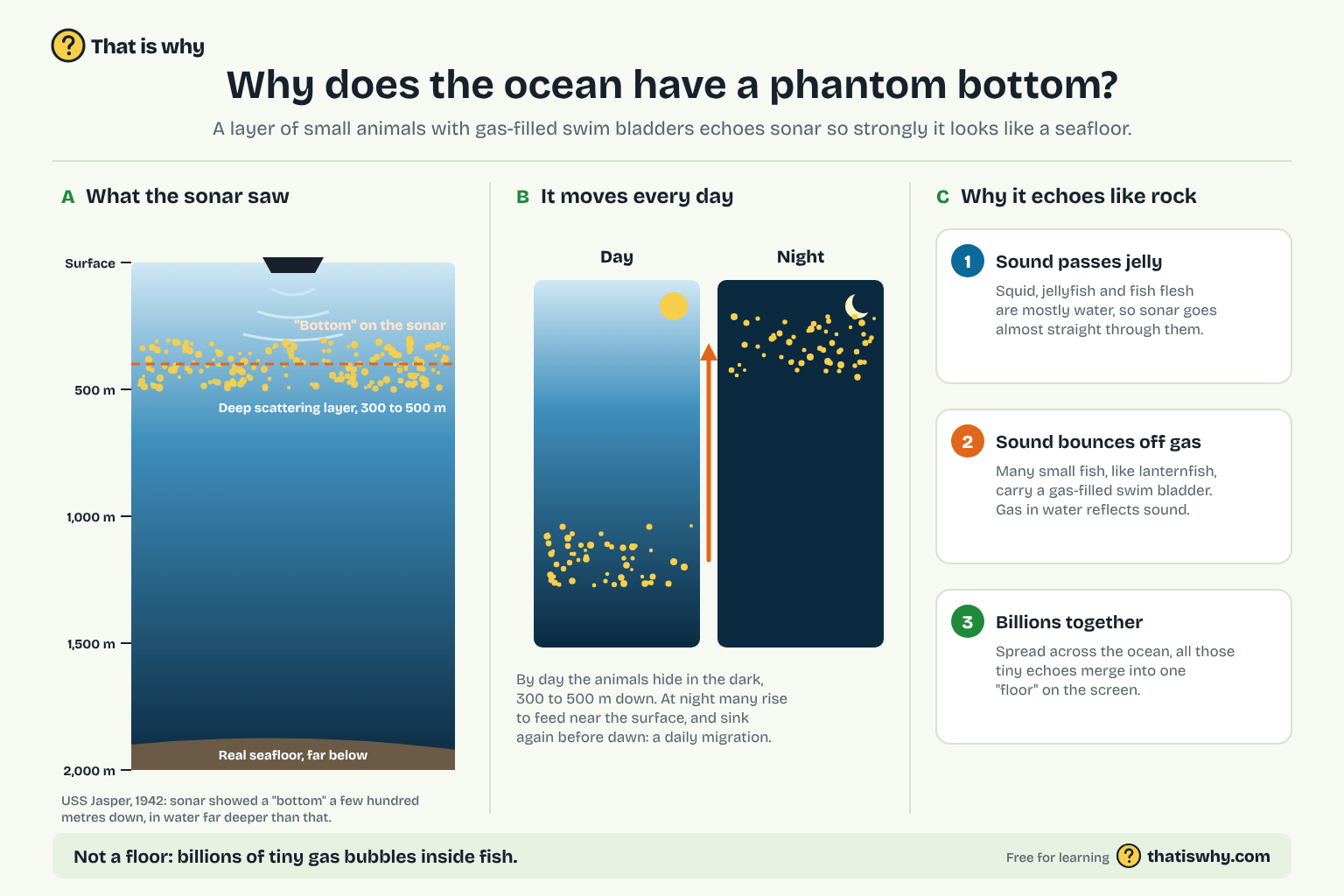
What the diagram shows
A. What the sonar saw. Sonar measures depth by timing echoes. In 1942, scientists testing sonar aboard the USS Jasper off Southern California got a strong echo only a few hundred meters down, in water far deeper than that. It looked like a seafloor, but it was a living layer of animals. Today it is called the deep scattering layer, and it is typically found around 300 to 500 m deep.
B. It moves every day. By day, the animals of the layer stay in the dim twilight zone, where predators can't see them easily. At dusk many rise towards the surface to feed, then sink again before dawn. This diel vertical migration happens across the world's oceans and is often described as the largest daily migration of animals on Earth. It is why the "bottom" on early sonar screens seemed to rise and fall.
C. Why it echoes like rock. Most of an animal's body is water, so sound passes through it almost unchanged. But many small fish in the layer, such as lanternfish, carry a gas-filled swim bladder, and a pocket of gas in water reflects sound strongly. Spread across huge areas, billions of these tiny echoes merge into what looks like a single floor.
Key facts
| Fact | Value |
|---|---|
| Typical depth of the layer | about 300 to 500 m |
| First noticed | 1942, USS Jasper, off Southern California |
| Main echo makers | Small fish with gas-filled swim bladders, such as lanternfish |
| Daily movement | Up towards the surface at night, back down by day |
Common misconceptions
Myth The phantom bottom is a solid wall of fish.
The truth The animals can be far apart. The layer only looks solid on sonar because countless small echoes merge into one band on the screen.
Myth Sonar bounces off any animal.
The truth Bodies made mostly of water, like jellyfish or squid, reflect little sound. Gas-filled swim bladders are what make the strong echo.
Myth The layer stays at the same depth.
The truth It moves every day: many of its animals rise towards the surface at night to feed and sink back down before dawn.
Questions to use in class
Tap a question to reveal a model answer.
1Why did 1940s sonar operators think they had found a seafloor?
Their sonar received a strong echo from a few hundred meters down, which looked like a bottom, even though the real seafloor was far deeper.
2Why does a gas-filled swim bladder reflect sound so well?
Sound travels very differently in gas and in water. Where it meets a sudden change like a gas bubble in water, much of the sound bounces back.
3Why do the animals rise at night and sink by day?
Food is plentiful near the surface, but so are predators that hunt by sight. Feeding in the dark and hiding deep in daylight lowers the risk of being eaten.
4How does this daily migration help move carbon into the deep ocean?
Animals eat near the surface, then swim down and release waste in deeper water. This carries carbon downwards, part of what scientists call the biological pump.
Key terms
- Deep scattering layer
- A layer of small fish, squid, krill and other animals, typically around 300 to 500 m deep by day, that reflects sonar so strongly it can look like a seafloor.
- Sonar
- A way of finding things underwater by sending out pulses of sound and timing the echoes that come back.
- Swim bladder
- A gas-filled pouch inside many bony fish that lets them float at a chosen depth without swimming. Because it holds gas, it shrinks under pressure and swells when pressure drops.
- Lanternfish
- Small deep-sea fish with rows of light organs. Many have gas-filled swim bladders, which is why they echo so strongly on sonar.
- Diel vertical migration
- The daily journey of many ocean animals: they rise towards the surface at night to feed and sink into darker water by day to avoid predators.
- Mesopelagic zone
- The layer of ocean from about 200 to 1,000 m deep, where some sunlight reaches but too little for plants to grow.
- Biological pump
- The way ocean life moves carbon from the surface to the deep, for example when animals that fed near the surface sink and release waste in deeper water.
Sources
- What is the deep scattering layer? NOAA Ocean Exploration
- The mysterious false bottom of the twilight zone Woods Hole Oceanographic Institution