Free teaching diagram
Hatchetfish Diagram: How Belly Lights Make It Vanish
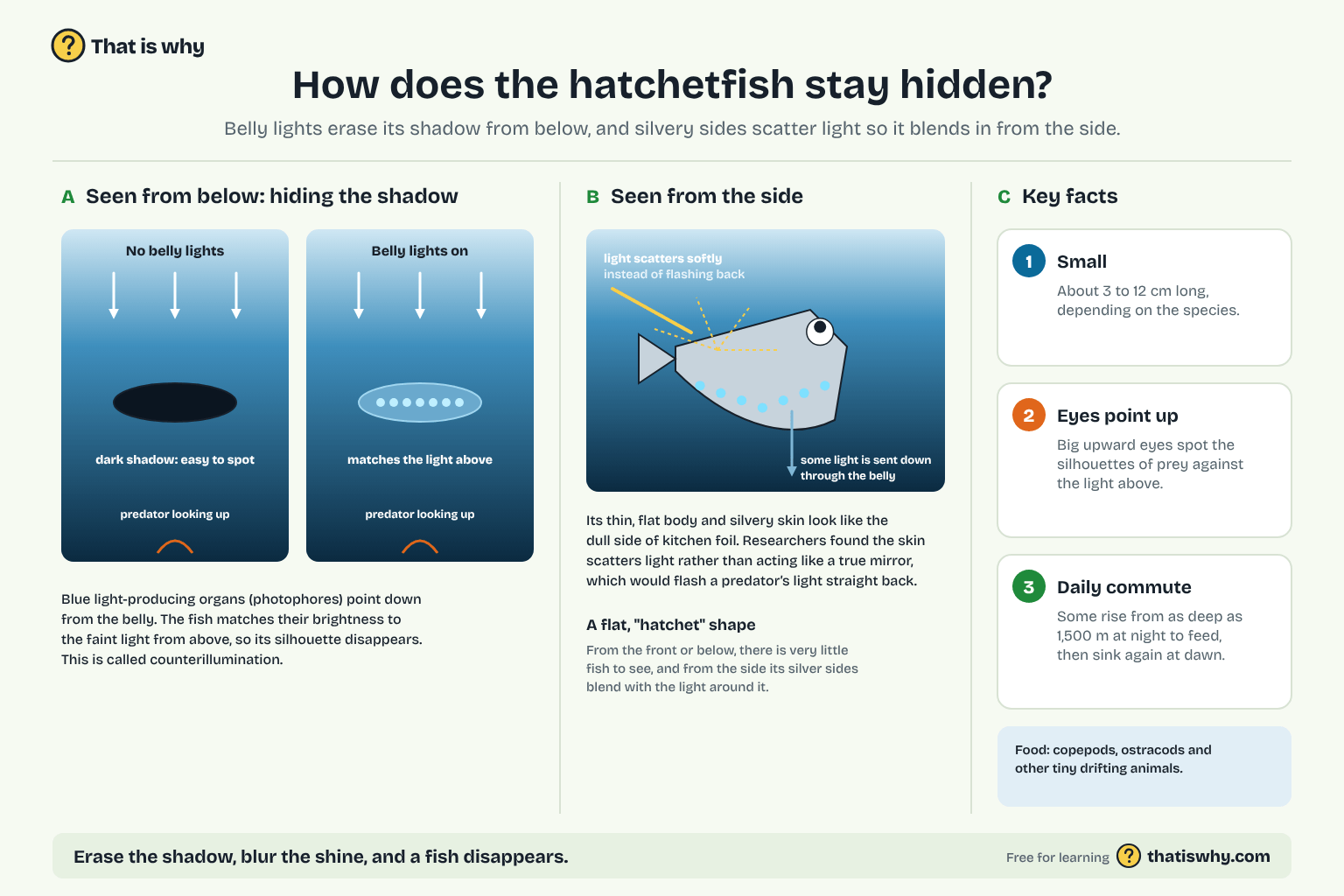
Hatchetfish hide twice over: belly lights erase their shadow, and silvery sides scatter light.
What the diagram shows
A. Seen from below: hiding the shadow. In the twilight zone (the mesopelagic zone), a little sunlight still filters down. To a predator looking up, any fish above it shows as a dark silhouette. Hatchetfish have rows of light organs (photophores) on the belly that point downwards. By matching their brightness to the faint light from above, they erase their own shadow. This is called counterillumination.
B. Seen from the side. A hatchetfish is very thin and flat, like the blade of a hatchet, so there is little fish to see from the front or below. Its silvery skin looks like the dull side of kitchen foil. Researchers found that it scatters light softly rather than acting like a true mirror, which would flash a predator's searchlight straight back. Some of the light hitting the side may even be sent down and out through the belly.
C. Key facts. Hatchetfish are small, about 3 to 12 cm long depending on the species. Their big eyes point upwards to spot the silhouettes of prey against the light above. Some species make a daily vertical migration, rising from as deep as 1,500 m at night to feed on copepods, ostracods and other tiny drifting animals, then sinking again at dawn.
Key numbers
| Fact | Value |
|---|---|
| Length | about 3 to 12 cm |
| Deepest daily starting point | about 1,500 m |
| Camouflage from below | counterillumination with belly photophores |
| Camouflage from the side | thin body and light-scattering silver skin |
Common misconceptions
Myth In the deep sea it is too dark to cast a shadow.
The truth In the twilight zone, faint sunlight still filters down. A fish seen from below shows up as a dark shape unless it hides its silhouette.
Myth Hatchetfish sides work like a perfect mirror.
The truth Researchers found the skin scatters light softly instead. A true mirror would flash a predator's searchlight straight back.
Myth Belly lights are for attracting prey.
The truth In hatchetfish they point downwards and are dimmed or brightened to match the light from above, hiding the fish from predators below.
Questions to use in class
Tap a question to reveal a model answer.
1Why would a fish swimming above you look dark, even in dim blue water?
Its body blocks the light coming down from the surface, so it appears as a dark silhouette against the brighter water above.
2What is counterillumination?
Making light on the underside of the body to match the light coming from above, so the animal's silhouette disappears.
3Why is it useful for hatchetfish eyes to point upwards?
Their prey shows up as silhouettes against the light above, so looking up makes it easier to spot food.
4Why would a mirror-like skin be a problem when predators carry their own lights?
A mirror sends light straight back to its source, so a predator's searchlight would reveal exactly where the fish is.
Key terms
- Counterillumination
- Camouflage in which an animal makes light on its underside to match the light from above, so its silhouette disappears to anything looking up.
- Photophore
- A light-producing organ in an animal's skin. Some dragonfish have photophores under their eyes that shine red.
- Mesopelagic zone
- The layer of ocean from about 200 to 1,000 m deep, where some sunlight reaches but too little for plants to grow.
- Diel vertical migration
- The daily journey of many ocean animals: they rise towards the surface at night to feed and sink into darker water by day to avoid predators.
Sources
- Hatchetfish scatter light to camouflage in the deep sea, Penn physicists report Penn Today, University of Pennsylvania
- About the hatchetfish Woods Hole Oceanographic Institution, Ocean Twilight Zone
- Trawling the depths (Ocean Twilight Zone project) Woods Hole Oceanographic Institution