Free teaching diagram
Gecko Feet Diagram: How Geckos Stick to Walls
Millions of split-tipped hairs grip by shape alone, hold on without effort and let go when the toe peels back.
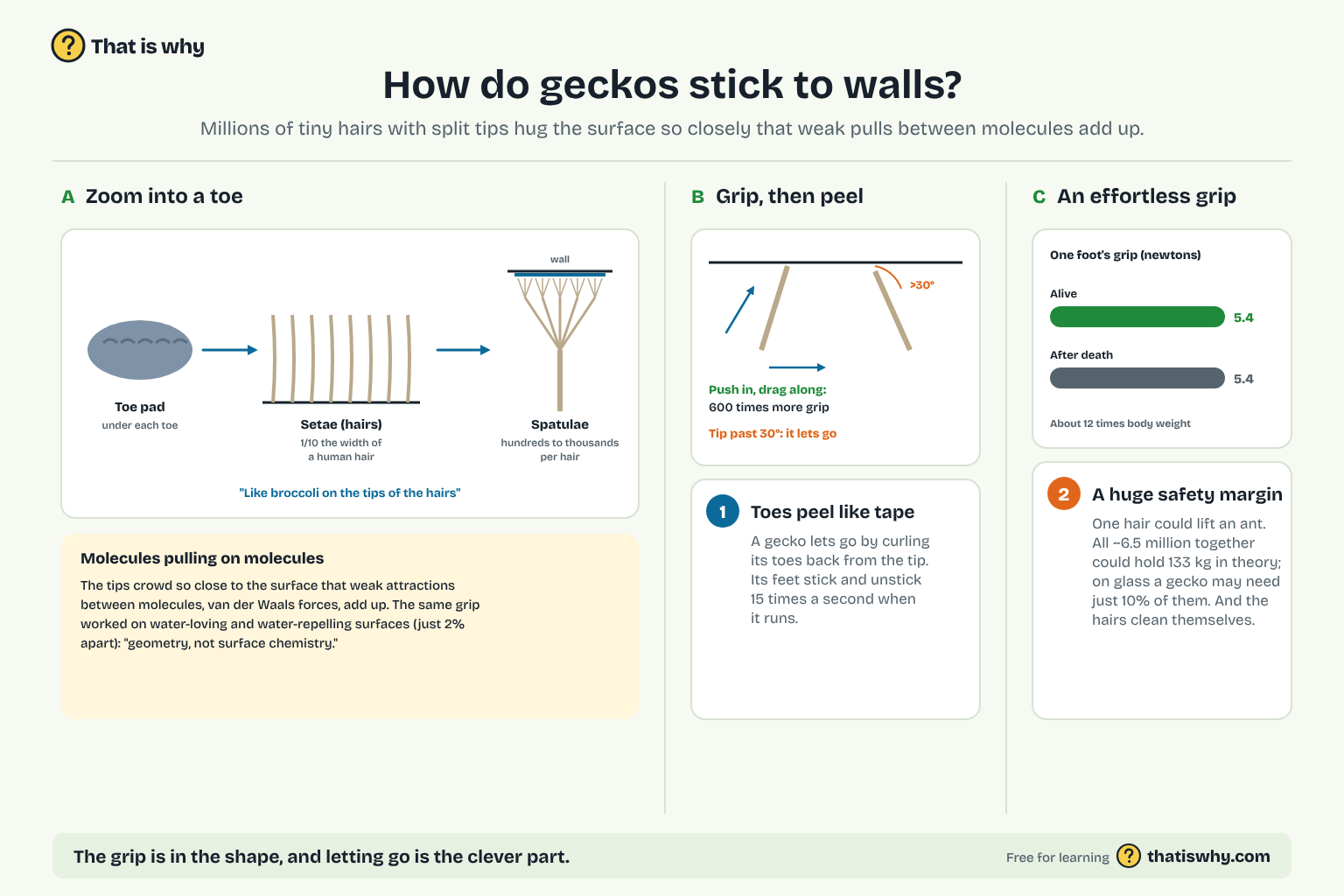
What the diagram shows
A. Zoom into a toe. A gecko's toe pads are covered in setae, hairs one-tenth the width of a human hair. Each one frays into hundreds to thousands of tiny pads called spatulae, "like broccoli on the tips of the hairs." The tips get so close to a surface that weak attractions between molecules, van der Waals forces, add up. The grip worked equally well on water-loving and water-repelling surfaces, just 2% apart, which shows that "geometry, not surface chemistry" is the key. The drawing is simplified, not to scale.
B. Grip, then peel. Pushing a hair in and dragging it slightly along gives it 600 times greater sticking power. Once the hair tips past about 30 degrees, it lets go. A gecko releases by peeling its toes back from the tip, and its feet stick and unstick 15 times a second.
C. An effortless grip. In tokay geckos, one foot gripped with about 5.4 newtons alive and the same after death, about 12 times the animal's body weight, so the grip itself takes no muscle effort. One hair could lift an ant; all of a tokay's roughly 6.5 million setae could hold 133 kg in theory, and on glass a gecko may need just 10% of them. The hairs also clean themselves as the gecko walks. Engineers copy this design (biomimicry) for grippers that could catch space junk.
Key numbers
| Fact | Value |
|---|---|
| Width of a seta | 1/10 of a human hair |
| Spatulae per seta | hundreds to thousands |
| Setae on a tokay gecko | about 6.5 million |
| Extra grip from push and drag | 600 times |
| Release angle | past 30 degrees |
| One foot's grip, alive or dead | about 5.4 newtons |
| Theoretical load, all setae | 133 kg |
Common misconceptions
Myth Geckos have suction cups on their feet.
The truth Geckos can stick to a wall in a vacuum. The grip comes from van der Waals forces between their hairs and the surface.
Myth Gecko feet are covered in glue.
The truth There are no glue glands on the foot and no residue is left behind. The grip is dry.
Myth A gecko has to squeeze hard to hang on.
The truth A foot gripped with the same force, about 5.4 newtons, before and after death, so the grip itself takes no muscle effort.
Questions to use in class
Tap a question to reveal a model answer.
1What are setae and spatulae?
Setae are microscopic hairs on a gecko's toe pads, one-tenth the width of a human hair. Each splits into hundreds to thousands of tiny tips called spatulae.
2What force holds a gecko to the wall?
Van der Waals forces, weak attractions between molecules that add up because the tiny tips get so close to the surface.
3How does a gecko let go?
It peels its toes back from the tip. Once a hair tips past about 30 degrees, it releases.
Key terms
- Seta
- A microscopic hair. On a gecko's toe pads, each seta is about one-tenth the diameter of a human hair, and millions of them together give the gecko its dry grip.
- Spatula
- One of the tiny pads at the tip of a gecko's toe hair. Each hair ends in hundreds to thousands of them, each about ten millionths of an inch across.
- Van der Waals force
- A weak pull that appears when uneven electrical charges around molecules attract one another. Added up over millions of tiny contacts, it lets a gecko's toes grip a wall with no glue.
- Biomimicry
- Copying ideas from living things to solve human problems, such as buildings cooled by airflow inspired by termite mounds.
Sources
- It's not glue, suction or static electricity that keep geckos from falling off the ceiling (Autumn, Full, Fearing and Kenny, Nature 2000) University of California, Berkeley
- Evidence for van der Waals adhesion in gecko setae (Autumn et al., PNAS 2002) Proceedings of the National Academy of Sciences (copy hosted by LSU Health Sciences Center)
- Passively stuck: death does not affect gecko adhesion strength (Stewart and Higham, Biology Letters 2014) University of California, Riverside
- How do gecko lizards unstick their feet when they walk? Scientific American
- Gecko-inspired robot grippers could grab hold of space junk Science News