Free teaching diagram
Termite Mound Diagram: How Termites Air-Condition Their Home
A termite mound breathes with the sun: daily warming and cooling drive air up and down its channels and flush out stale air.
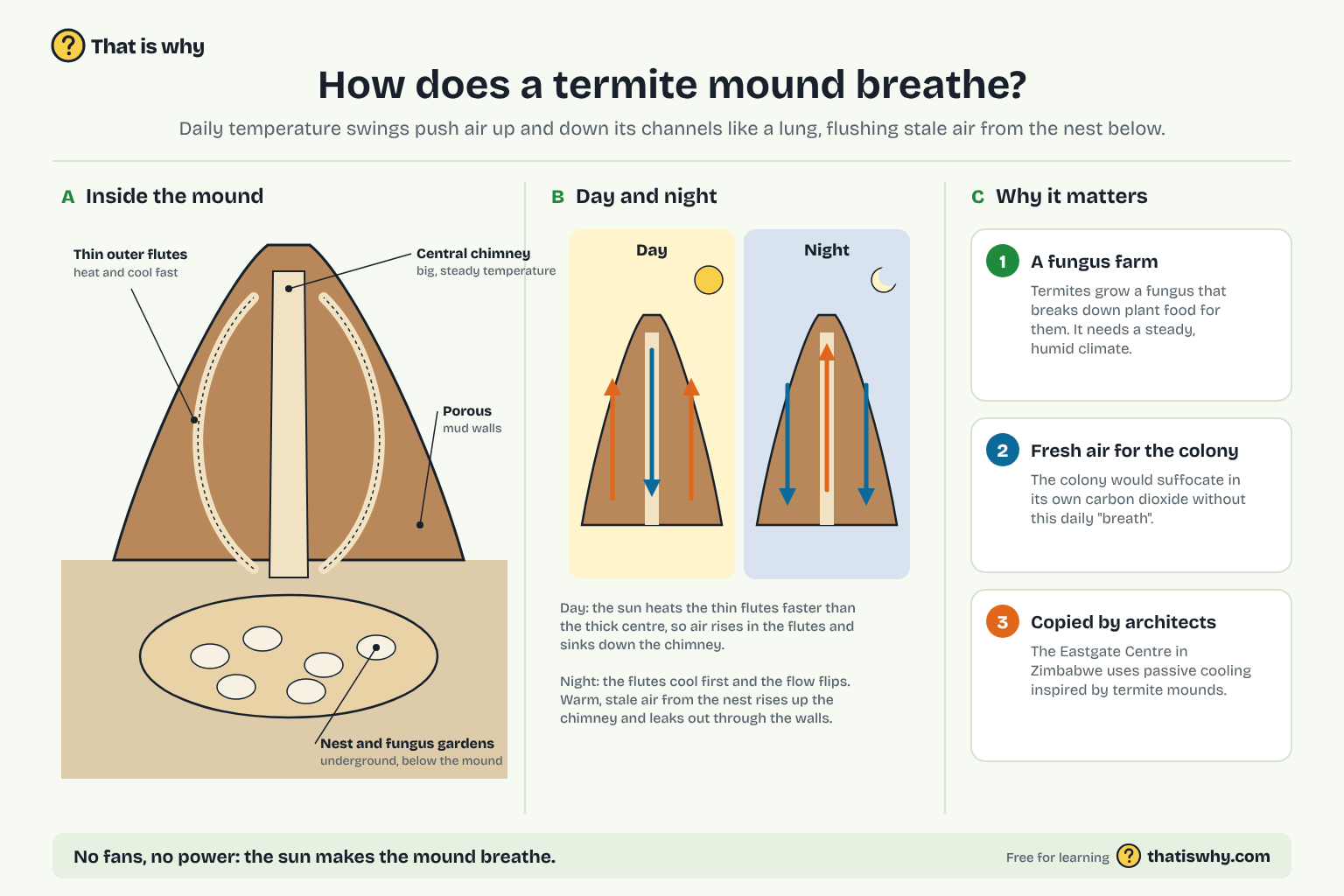
What the diagram shows
A. Inside the mound. The tall tower is mostly a breathing system. A big central chimney runs up the middle. Around it, thin outer flutes sit just under the surface, and the porous mud walls let gases pass through slowly. The colony lives below, in the nest, where termites grow fungus gardens on chewed plant material.
B. Day and night. The mound uses the daily temperature swing as a pump. By day, the sun heats the thin flutes faster than the thick center, so air rises in the flutes and sinks down the chimney (convection). At night the flutes cool first and the flow reverses: warm, stale air from the nest rises up the chimney and carbon dioxide leaks out through the walls. The researchers who measured it compared the mound to a lung that "breathes" once a day.
C. Why it matters. The fungus that digests the termites' food needs steady, humid conditions, and the colony would otherwise build up carbon dioxide. Architects have borrowed the idea (biomimicry): the Eastgate Centre in Harare, Zimbabwe, uses passive cooling inspired by termite mounds.
Day and night at a glance
| Time | Outer flutes | Central chimney | Result |
|---|---|---|---|
| Day | warmer, air rises | cooler, air sinks | air circulates through the mound |
| Night | cooler, air sinks | warmer, air rises | stale air from the nest rises and leaves |
Common misconceptions
Myth Termite mounds are cooled by wind blowing through them.
The truth Wind can help, but studies of mound airflow found that the main driver is the daily cycle of heating and cooling, which pushes air up and down the mound's channels.
Myth The termites live inside the tall tower.
The truth The colony and its fungus gardens are mostly in the nest underneath. The tower above works as the colony's lung.
Myth A termite mound keeps a perfectly fixed temperature, like a thermostat.
The truth What it does best is swap stale air for fresh air. Temperature inside still changes, but the airflow keeps conditions in the nest liveable.
Questions to use in class
Tap a question to reveal a model answer.
1Why do the thin outer flutes warm up faster than the central chimney in the morning?
They have thin walls and face the sun, so they gain heat quickly. The thick, buried center changes temperature much more slowly.
2Warm air rises. Use that to explain which way air moves in the flutes during the day.
The flutes are warmer than the chimney, so the air in them rises, and air sinks down the cooler chimney to replace it.
3What happens to the airflow at night, and why?
The flutes cool faster than the center, so the air in them sinks and air rises up the warmer chimney: the flow reverses.
4Why does the colony need this airflow at all?
Millions of termites and their fungus gardens produce carbon dioxide. Without a way to swap stale air for fresh air, it would build up in the nest.
Key terms
- Convection
- Movement of heat by a flowing liquid or gas: warm air or water rises because it is less dense, and cooler air or water sinks to take its place.
- Fungus garden
- A farm that some termites build inside their nest from chewed plant material. A fungus grows on it and breaks the plants down into food the termites can digest.
- Biomimicry
- Copying ideas from living things to solve human problems, such as buildings cooled by airflow inspired by termite mounds.
Sources
- Termite mounds harness diurnal temperature oscillations for ventilation (King, Ocko & Mahadevan, PNAS 2015) Harvard School of Engineering and Applied Sciences
- Harvard study finds that termite mound functions as lung that sneezes carbon dioxide Harvard Magazine
- 5 ways giant termite mounds can help architects create more efficient and sustainable buildings World Economic Forum