Free teaching diagram
Needle vs Leaf Diagram: Why Some Trees Have Needles
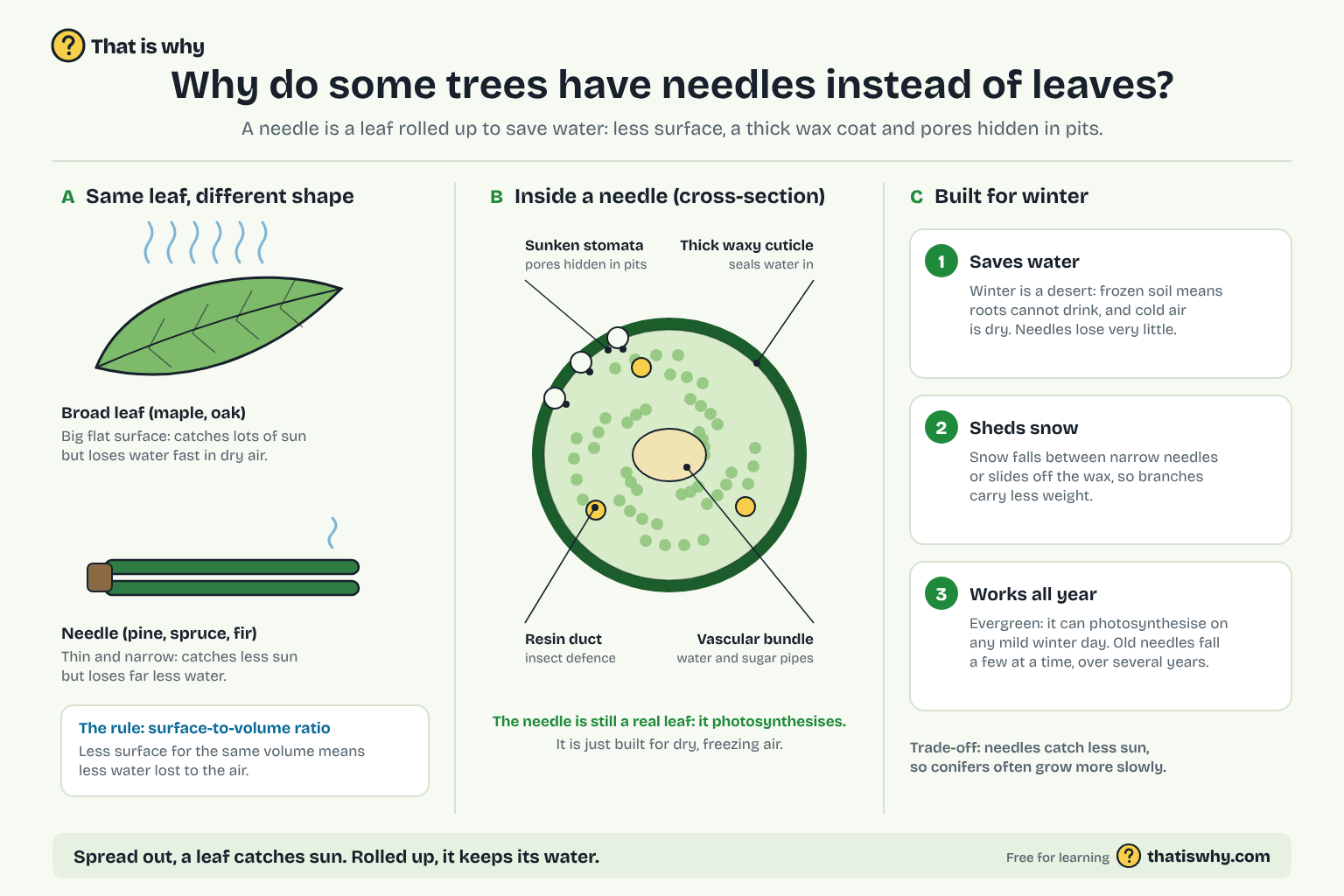
A needle is a leaf rolled up to save water: less surface, a thick wax coat and pores hidden in pits.
What the diagram shows
The diagram reads from left to right, in three panels.
A. Same leaf, different shape. A broad leaf, like a maple's, is a wide, flat sheet. That is ideal for catching sunlight, but every square centimeter of surface also lets water evaporate. A pine needle is narrow and rounded: the same kind of living leaf tissue, packed into a shape with far less surface for its size. This is the surface-to-volume ratio at work: less surface for the same volume means less water lost to the air.
B. Inside a needle. The cross-section shows the needle's water-saving equipment. A thick waxy cuticle seals the outside. The stomata, the pores the leaf breathes through, sit in small pits below the surface, out of the wind. In the middle, a vascular bundle carries water in and sugar out, and resin ducts hold resin that defends against insects. Around them, green cells still do photosynthesis: a needle is a real leaf.
C. Built for winter. In winter the soil freezes, so roots can't drink, and the cold air is dry: winter acts like a desert. Needles lose very little water, they let snow slip off or fall through, and because the tree is evergreen it can photosynthesise on any mild winter day. The price is that needles catch less sunlight, so conifers often grow more slowly.
Broad leaf vs needle at a glance
| Broad leaf | Needle | |
|---|---|---|
| Shape | Wide and flat | Narrow and rounded |
| Surface for its size | Large | Small |
| Wax coat | Thin | Thick |
| Stomata | On the surface | Sunk in pits |
| In winter | Dropped | Kept for several years |
| Best at | Fast growth in warm, wet summers | Surviving cold, dry or windy conditions |
Common misconceptions
Myth Needles aren't real leaves.
The truth They are leaves. They contain chlorophyll and photosynthesise like a maple leaf; they are just narrow, thick-skinned and built to save water.
Myth Evergreen trees never lose their leaves.
The truth They do, just not all at once. Each needle lasts several years and is replaced gradually, which is why there is always a carpet of old needles under a pine.
Myth Broad leaves fall off because of the cold.
The truth The bigger problem is water. In winter the soil freezes, so roots can't take up water, while dry air keeps pulling it out of the leaves.
Questions to use in class
Tap a question to reveal a model answer.
1Why does a flat towel dry faster than a rolled-up one, and how does that relate to leaves?
The flat towel exposes far more surface to the air, so water evaporates faster. A broad leaf is like the flat towel; a needle is like the rolled one, with little surface for water to escape from.
2Why is winter described as a kind of desert for trees?
When the ground freezes, roots can't take up liquid water, and cold air is often dry and windy. Trees can lose water but can't easily replace it.
3What are stomata, and why does a pine needle hide them in pits?
Stomata are tiny pores that let gases in and out, but water vapor escapes through them too. Sunk in pits, they are sheltered from the wind, so less water is lost.
4If needles are so good at saving water, why don't all trees have them?
Narrow needles catch less sunlight, so they make sugar more slowly. Broad leaves grow faster in warm, wet summers. It is a trade-off between growing fast and surviving harsh conditions.
5Name another plant part that is a rolled-up or reduced leaf.
Cactus spines are modified leaves. They help reduce water loss and protect the plant, while the green stem does the photosynthesis.
Key terms
- Surface-to-volume ratio
- How much outside surface something has for each unit of volume inside. A high ratio exchanges heat and water quickly; a low ratio keeps them in.
- Cuticle
- A waxy, waterproof layer on the outside of leaves and needles that slows water loss. Conifer needles have a particularly thick one.
- Stomata
- Tiny pores on leaves that open to let in carbon dioxide and let out water vapor and oxygen. Pine needles keep theirs sunk in pits, away from drying wind.
- Transpiration
- The loss of water vapor from a plant, mostly through its stomata. It also pulls water up the xylem from the roots.
- Photosynthesis
- The process plants use to turn sunlight, water and carbon dioxide into sugar, releasing oxygen. It takes place mainly in leaves and needles.
- Conifer
- A cone-bearing tree, such as a pine, spruce or fir. Most conifers have needle- or scale-shaped leaves and are evergreen.
- Evergreen
- A plant that keeps green leaves all year, shedding and replacing them a few at a time instead of all at once in autumn.
- Resin
- A thick, sticky substance made by many trees, especially conifers, and stored in resin ducts. It seals wounds and traps insects. Unlike sap, it does not dissolve in water.
Sources
- Winter adaptations of trees Michigan Technological University
- Conifer adaptations College of Saint Benedict & Saint John's University