Free teaching diagram
Tree Sap Diagram: Xylem, Phloem and Resin Explained
Sap is a tree's transport fluid: water rises in the xylem and sugar travels in the phloem. Resin is something else.
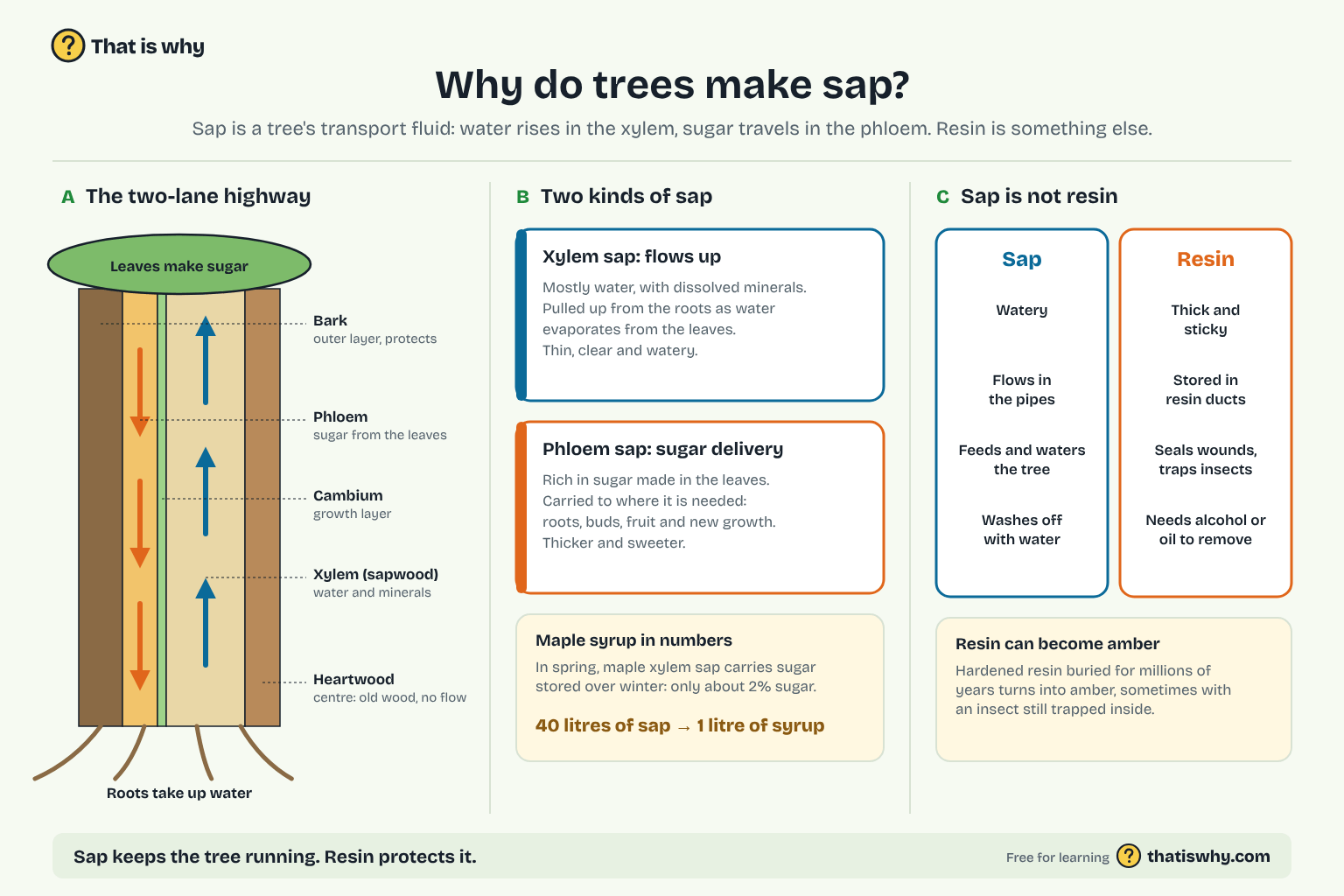
What the diagram shows
A. The two-lane highway. The diagram shows a slice of trunk from the outside (left) to the center (right). Under the protective bark is the phloem, which carries sugar made in the leaves. Next comes the thin cambium, the growth layer that adds new wood and phloem every year. Then the xylem, or sapwood, carries water and minerals up from the roots. At the center, the heartwood is old wood that no longer carries anything but keeps the tree strong. Blue arrows show water going up; orange arrows show sugar traveling from the leaves.
B. Two kinds of sap. Xylem sap is thin and watery: mostly water with dissolved minerals, pulled up as water evaporates from the leaves. Phloem sap is thicker and sweeter, carrying sugar to roots, buds, fruit and new growth. Maples are a special case: in spring, their xylem sap carries sugar the tree stored over winter, but it is still only about 2% sugar. That is why about 40 liters of maple sap boil down to 1 liter of syrup.
C. Sap is not resin. Resin is a different substance altogether. It is thick and sticky, stored in resin ducts rather than flowing through the pipes, and it seals wounds and traps insects. Sap washes off with water; resin needs alcohol or oil. Over millions of years, buried resin can harden into amber.
Sap vs resin at a glance
| Sap | Resin | |
|---|---|---|
| Texture | Watery | Thick and sticky |
| Where it is | Flowing in xylem and phloem | Stored in resin ducts |
| Job | Moves water and food | Seals wounds, defends against insects |
| Washes off with water? | Yes | No |
| Can become | Maple syrup (from maple sap) | Amber, turpentine |
Common misconceptions
Myth The sticky stuff on your car from a pine tree is sap.
The truth It is usually resin. Sap is watery and washes off with water; resin is thick, sticky and needs alcohol or oil to remove.
Myth All sap is sweet.
The truth Xylem sap is mostly water and minerals. Phloem sap carries sugar, and maples are unusual because their spring xylem sap carries sugar the tree stored over winter.
Myth Tree trunks are solid, lifeless wood.
The truth Only the heartwood is no longer active. The outer rings of sapwood carry water, the phloem carries sugar, and the cambium keeps growing new layers.
Questions to use in class
Tap a question to reveal a model answer.
1Which way does water move in the xylem, and what pulls it?
Up, from the roots to the leaves. As water evaporates from the leaves (transpiration), it pulls more water up behind it.
2What does the phloem carry, and where to?
Sugar made in the leaves by photosynthesis, carried to the parts that need it: roots, buds, fruit and new growth.
3Maple sap is about 2% sugar. Why does it take about 40 liters to make 1 liter of syrup?
Almost all of the sap is water. Boiling drives off most of that water until the sugar is concentrated enough to be syrup.
4Give two differences between sap and resin.
Sap is watery and flows in the xylem and phloem to feed and water the tree; resin is thick and sticky, stored in resin ducts, and used to seal wounds and trap insects. Sap washes off with water; resin doesn't.
5How can an insect end up inside amber?
It gets trapped in sticky resin oozing from a tree. Over millions of years, buried resin hardens and fossilises into amber, with the insect still inside.
Key terms
- Xylem
- The tissue that carries water and dissolved minerals up from the roots to the leaves. In a tree trunk, the living xylem is the sapwood.
- Phloem
- The tissue that carries sugar made in the leaves to the rest of the plant, such as roots, buds and fruit. In a trunk it lies just under the bark.
- Cambium
- A thin layer of dividing cells between the bark and the wood. It makes new xylem on the inside and new phloem on the outside, so the trunk grows wider.
- Heartwood
- The older wood at the center of a trunk. It no longer carries water but gives the tree strength.
- Transpiration
- The loss of water vapor from a plant, mostly through its stomata. It also pulls water up the xylem from the roots.
- Photosynthesis
- The process plants use to turn sunlight, water and carbon dioxide into sugar, releasing oxygen. It takes place mainly in leaves and needles.
- Resin
- A thick, sticky substance made by many trees, especially conifers, and stored in resin ducts. It seals wounds and traps insects. Unlike sap, it does not dissolve in water.
- Amber
- Fossilised tree resin that has hardened over millions of years. Insects and other small creatures are sometimes preserved inside.
Sources
- Sweet signs of spring (sap-to-syrup ratio) U.S. National Park Service