Free teaching diagram
Tree Height Diagram: Why Trees Grow Tall and Then Stop
Trees race upward for light, the leaves pull water up a sticky chain, and gravity sets a ceiling of about 122 to 130 meters.
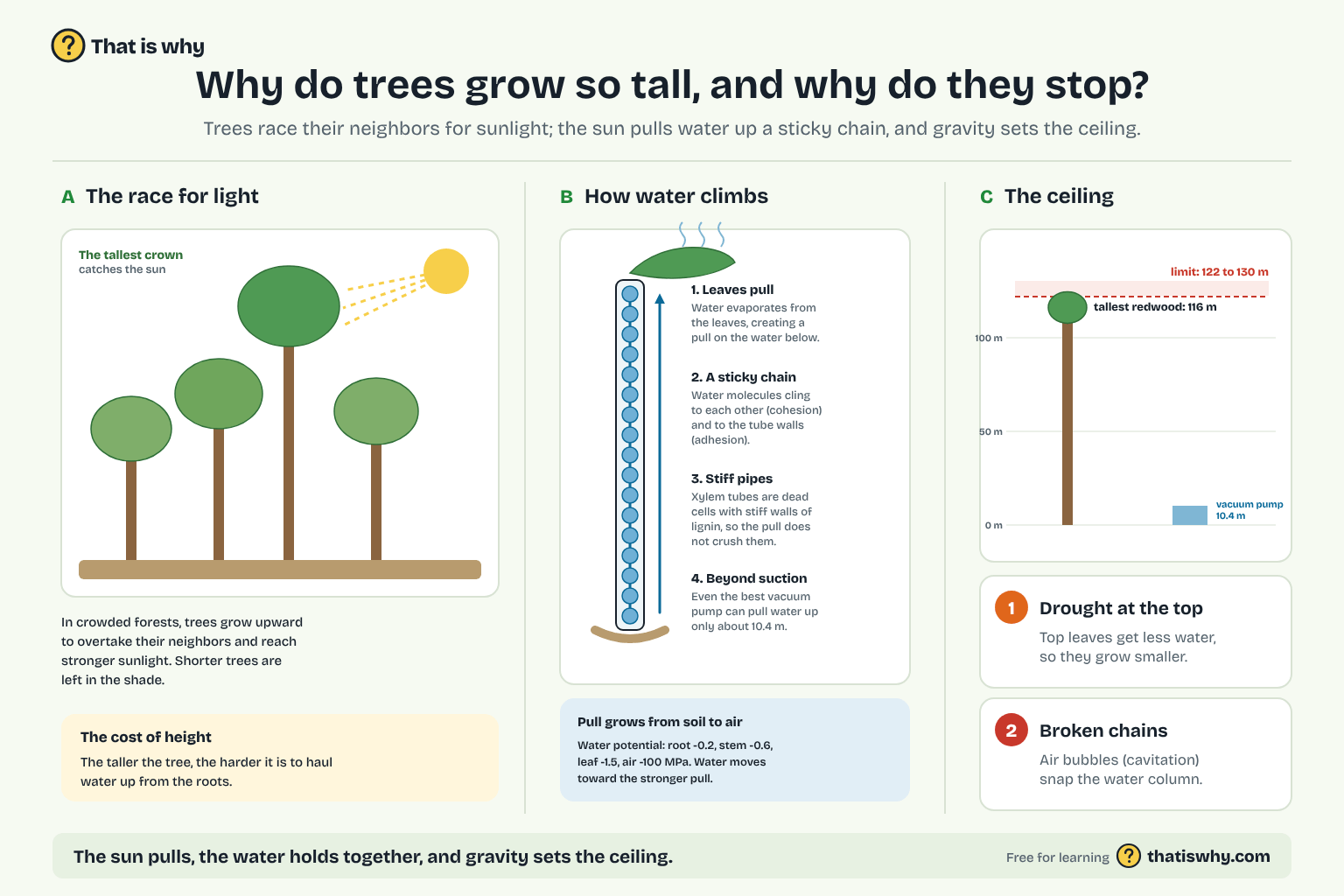
What the diagram shows
A. The race for light. In crowded forests, trees grow upward to overtake their neighbors and reach stronger sunlight, leaving shorter trees in the shade. The cost: the taller the tree, the harder it is to haul water up from the roots.
B. How water climbs. Water evaporates from the leaves, a process called transpiration, and creates a pull on the water below. Water molecules cling to each other and to the walls of the xylem tubes, so the whole column is drawn up, as described by the cohesion-tension theory. Xylem tubes are dead cells with stiff walls of lignin. Suction from below could not do the job: even the best vacuum pump can pull water up only about 10.4 m. The pull grows from soil to air, with water potential of about -0.2 MPa in the root, -0.6 MPa in the stem, -1.5 MPa in the leaf and -100 MPa in the air.
C. The ceiling. Researchers who climbed northern California's redwoods, including what was then the tallest known tree at 112.7 m, estimated a maximum tree height of 122 to 130 m. The tallest redwood today is about 116 m. Higher up, the leaves get less water and grow smaller, and air bubbles, called cavitation, can snap the water column.
Key numbers
| Fact | Value |
|---|---|
| Predicted maximum tree height | 122 to 130 m |
| Tallest redwood | about 116 m |
| Highest a vacuum pump can pull water | about 10.4 m |
| Water potential, root to air | about -0.2 to -100 MPa |
Common misconceptions
Myth Trees push water up from the roots like a pump.
The truth The pull comes from the top: water evaporating from the leaves draws the water column up, and even the best vacuum pump could only lift water about 10.4 m.
Myth A tree could keep growing taller forever.
The truth The predicted limit is about 122 to 130 m, because water gets harder to lift and top leaves run short of it.
Myth Trees grow tall just because they can.
The truth In crowded forests, trees grow upward to overtake their neighbors and reach stronger sunlight.
Questions to use in class
Tap a question to reveal a model answer.
1Why do trees grow tall?
In crowded forests, trees grow upward to overtake their neighbors and reach stronger sunlight.
2How does water get to the top of a tall tree?
Water evaporates from the leaves and pulls on the water below; water molecules cling to each other and to the xylem walls, so the column is drawn up.
3How tall can trees grow?
Scientists estimate a limit of about 122 to 130 m. The tallest redwood is about 116 m.
4Why do trees stop growing taller?
Top leaves get less water and grow smaller, and air bubbles (cavitation) can snap the water column.
Key terms
- Cohesion-tension theory
- How water climbs a tree: water evaporating from the leaves pulls on the water below, and because water molecules cling to each other (cohesion), the whole column is drawn up through the xylem.
- Transpiration
- The loss of water vapor from a plant, mostly through its stomata. It also pulls water up the xylem from the roots.
- Xylem
- The tissue that carries water and dissolved minerals up from the roots to the leaves. In a tree trunk, the living xylem is the sapwood.
- Cavitation
- When a gas bubble forms in a plant's water pipes and breaks the continuous column of water. The taller the tree, the stronger the pull needed to lift water, and the more cavitation happens.
Sources
- How tall can trees grow? Live Science
- The limits to tree height (Koch et al., Nature 2004) Northern Arizona University
- Height limit predicted for tallest trees Nature News
- Cohesion-Tension Theory LibreTexts Biology