Free teaching diagram
Leaf Shapes Diagram: Why Leaves Look So Different
Leaf shape is a compromise: size, lobes and teeth change how a leaf handles heat, water and light.
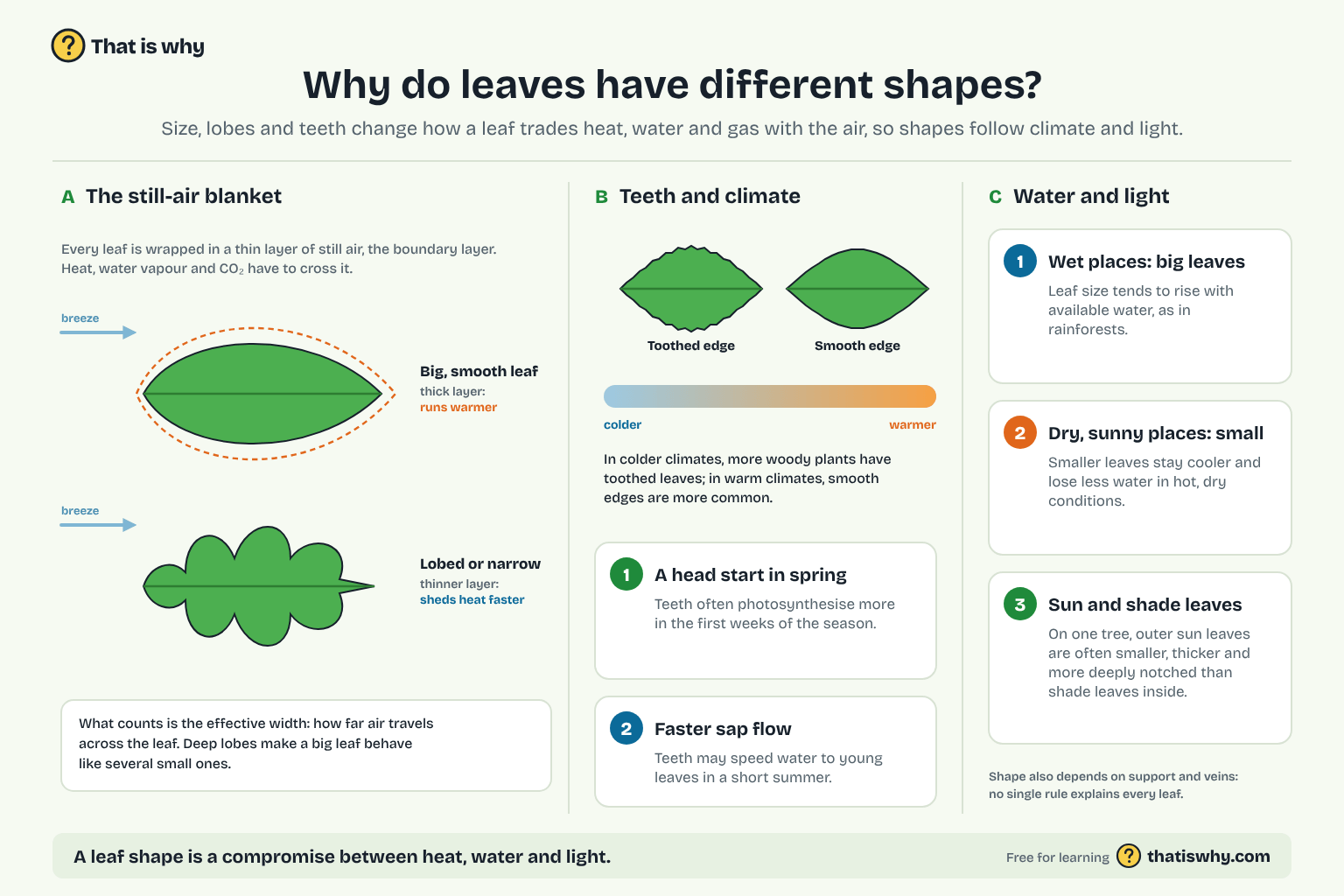
What the diagram shows
A. The still-air blanket. Every leaf is wrapped in a thin layer of still air, the boundary layer. Heat, water vapor and carbon dioxide all have to cross it. Air moves smoothly over a big, unbroken leaf, so the layer is thick and the leaf runs warmer in the sun. Lobes, narrow blades and leaflets break the leaf into smaller sections, so air only travels a short way across each part. Scientists call this the effective width: a deeply lobed leaf can shed heat like several small leaves.
B. Teeth and climate. Among woody flowering plants, toothed leaf edges (leaf margins) are more common in colder climates, and smooth edges in warmer ones. The pattern is reliable enough that scientists use fossil leaves to estimate ancient temperatures. Teeth often photosynthesise more in the first weeks of the growing season, and they may speed water and nutrients to young leaves, which helps where summers are short.
C. Water and light. Leaf size tends to rise with available water, which is why big leaves are common in rainforests. In hot, dry places, small leaves stay cooler and lose less water. Even on one tree, outer sun leaves are often smaller, thicker and more deeply notched than the shade leaves inside, which may also let more light reach the inner canopy. Support and vein layout matter too: no single rule explains every leaf.
Shapes at a glance
| Leaf feature | Where it is common | Likely advantage |
|---|---|---|
| Big, smooth-edged | warm, wet places | catches lots of light where water is plentiful |
| Small or narrow | hot, dry, sunny places | stays cooler, loses less water |
| Lobed | sunny outer canopy, temperate forests | thinner boundary layer, lets light through |
| Toothed edge | colder climates | early-season photosynthesis and sap flow |
Common misconceptions
Myth Leaf shapes are just decoration and don't do anything.
The truth Shape affects how fast a leaf loses heat and water and how much light it catches, so it is linked to climate and to where the leaf grows on the tree.
Myth Every leaf on a tree has the same shape.
The truth Leaves in the sunny outer canopy are often smaller, thicker and more notched than shade leaves deeper inside the same tree.
Myth One rule explains every leaf shape.
The truth Heat, water, light, support and the way veins are laid out all play a part, and scientists still debate how much each matters.
Questions to use in class
Tap a question to reveal a model answer.
1What is the boundary layer, and why does it matter to a leaf?
It is a thin layer of still air against the leaf's surface. Heat, water vapor and carbon dioxide have to cross it, so a thick layer slows cooling and gas exchange.
2Why can a deeply lobed leaf stay cooler in full sun than an unlobed leaf of the same area?
Air only travels a short way across each lobe, so the boundary layer stays thin and heat escapes faster. The leaf behaves like several small leaves.
3Fossil leaves with toothed edges are common in one rock layer. What might that suggest about the climate when they grew?
A colder climate, because toothed leaves are more common among woody plants in colder places. Scientists use this to estimate past temperatures.
4Why might big leaves be common in rainforests but rare in deserts?
Big leaves run warmer and lose more water. That costs little where water is plentiful, but too much where it is scarce.
Key terms
- Boundary layer
- The thin layer of still air (or water) right against a surface. Around a leaf, it slows the escape of heat and water vapor and the entry of carbon dioxide.
- Leaf margin
- The edge of a leaf. It can be smooth (entire), toothed or lobed; toothed margins are more common among woody plants in colder climates.
- Lobed leaf
- A leaf with deep indentations that divide it into rounded or pointed sections, like an oak or maple leaf. Lobes make a big leaf behave like several smaller ones.
- Transpiration
- The loss of water vapor from a plant, mostly through its stomata. It also pulls water up the xylem from the roots.
- Photosynthesis
- The process plants use to turn sunlight, water and carbon dioxide into sugar, releasing oxygen. It takes place mainly in leaves and needles.
Sources
- Climate reconstruction from leaf size and shape: new developments and challenges (Royer, 2012) The Paleontological Society Papers
- Causes of ecological gradients in leaf margin entirety (Givnish & Kriebel, 2017) American Journal of Botany
- Leaf lab: sun and shade leaves College of Saint Benedict & Saint John's University
- Why do toothed leaves correlate with cold climates? Gas exchange at leaf margins provides new insights (Royer & Wilf, 2006) Penn State University