Free teaching diagram
Mistletoe Diagram: How a Half-Parasite Lives on Trees
Planted by a bird, plugged into the branch, or fired like a cannon: three steps of a half-parasite's life.
The detailed teaching diagram
What the diagram shows
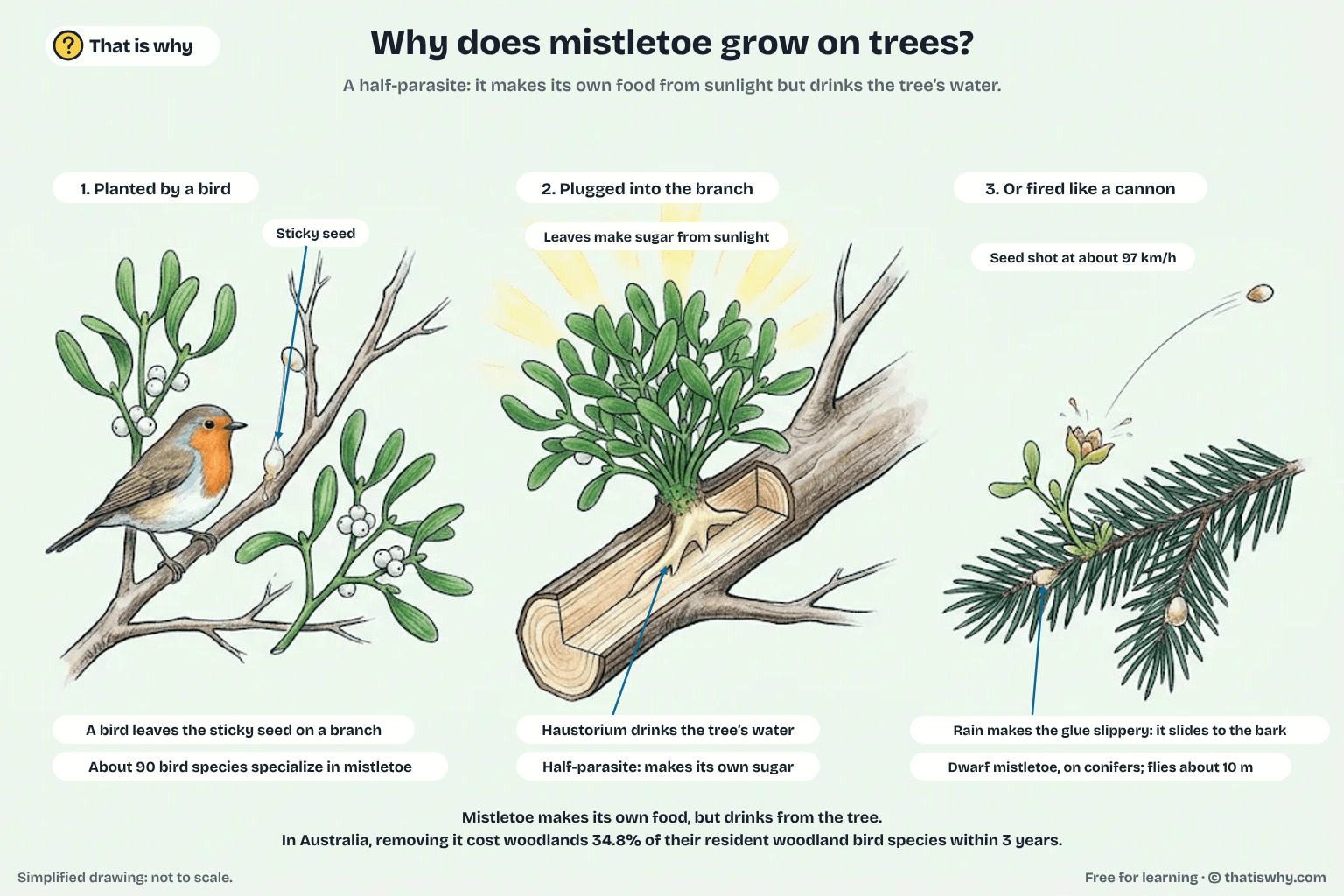
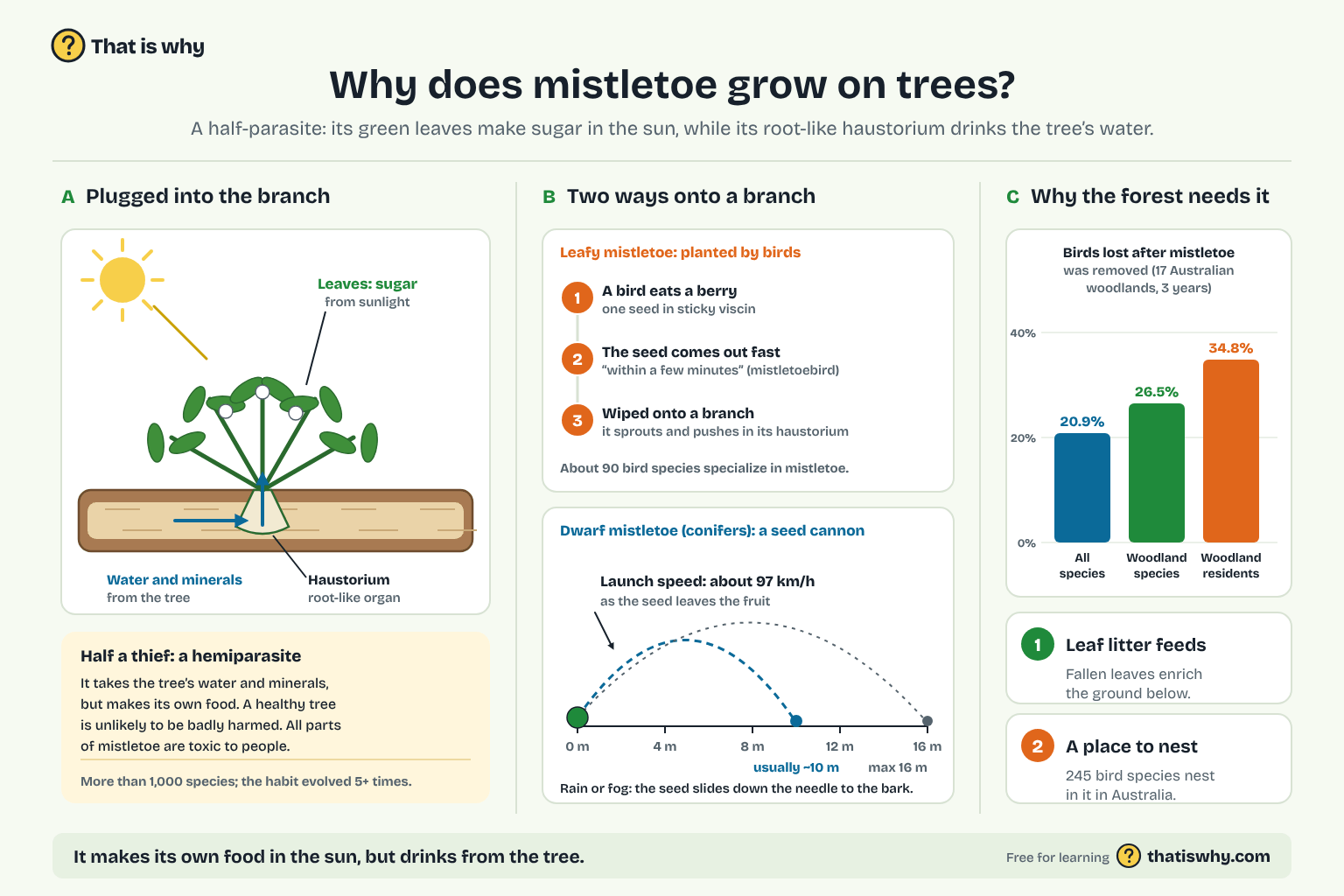
1. Planted by a bird. Most mistletoe berries hold one seed wrapped in sticky viscin. Birds eat the berries and leave the seeds on branches, and about 90 bird species are mistletoe specialists.
2. Plugged into the branch. The seed sprouts and pushes a root-like haustorium into the tree's tissues to draw off water and minerals. Its green leaves still make sugar by photosynthesis, which makes mistletoe a hemiparasite, or half-parasite.
3. Or fired like a cannon. Dwarf mistletoes, which grow only on conifers, shoot their seeds at about 97 km/h. In rain or fog, the sticky coating turns slippery, and the seed slides down the needle to the bark.
Key numbers
| Fact | Value |
|---|---|
| Mistletoe species | more than 1,000 |
| Times the branch-dwelling lifestyle evolved | at least 5 |
| Bird species that specialize in mistletoe | about 90 |
| Dwarf mistletoe seed speed | about 97 km/h (60 mph) |
| Dwarf mistletoe seed distance | usually about 10 m, at most 16 m |
| Resident woodland bird species lost without mistletoe (3 years) | 34.8% |
Common misconceptions
Myth Mistletoe kills the trees it grows on.
The truth A healthy tree is unlikely to be significantly harmed, though a tree carrying many plants can be stressed.
Myth Mistletoe can't make its own food.
The truth Leafy mistletoes have chlorophyll and photosynthesize. What they take from the tree is mostly water and minerals.
Myth Mistletoe is useless to wildlife.
The truth In Australia, woodlands that lost their mistletoe lost 34.8% of their resident woodland bird species within 3 years.
Questions to use in class
Tap a question to reveal a model answer.
1Why is mistletoe called a half-parasite?
It takes water and minerals from the tree through its haustoria, but its green leaves make its own food by photosynthesis.
2How does mistletoe get onto a branch?
Birds eat the berries and leave the sticky seeds on branches, usually in their droppings.
3How does dwarf mistletoe spread without birds?
Its fruit fires the seed at about 97 km/h, usually about 10 m. In rain or fog the sticky coating turns slippery and the seed slides to the bark.
4Why did birds disappear when mistletoe was removed?
The researchers think fallen mistletoe leaves enrich the ground, feeding the life that woodland birds depend on.
Key terms
- Hemiparasite
- A plant that takes some of what it needs, usually water and minerals, from a living host but still makes its own food by photosynthesis. Leafy mistletoes are hemiparasites.
- Haustorium
- The attachment organ a parasitic plant pushes into its host to draw out water and nutrients. Dodder grows them along the coils it wraps around a stem.
- Viscin
- The sticky layer around a mistletoe seed. It glues the seed to a branch after a bird drops or wipes it off, and in dwarf mistletoe it turns slippery when wet so the seed can slide down onto the bark.
- Photosynthesis
- The process plants use to turn sunlight, water and carbon dioxide into sugar, releasing oxygen. It takes place mainly in leaves and needles.
- Seed dispersal
- How plants move their seeds away from the parent: by wind, water, animals or, in a few plants such as the sandbox tree, by throwing them.
Sources
- Marvelous, misunderstood mistletoe Knowable Magazine (Annual Reviews)
- Mistletoe as a keystone resource: an experimental test (Watson & Herring, Proceedings of the Royal Society B 2012) Charles Sturt University
- Beneath the Mistletoe (Deborah J. Benoit) University of Vermont Extension
- What Is Mistletoe? (Robby Brockman) NC State Extension, North Carolina State University
- Dwarf Mistletoe Basics (Jim Worrall) Forest Pathology