Free teaching diagram
Maple Seed Diagram: Why Helicopter Seeds Spin
A wobbly start, a steady spin with a tiny tornado on the front edge, then a long ride on the wind.
The detailed teaching diagram
What the diagram shows
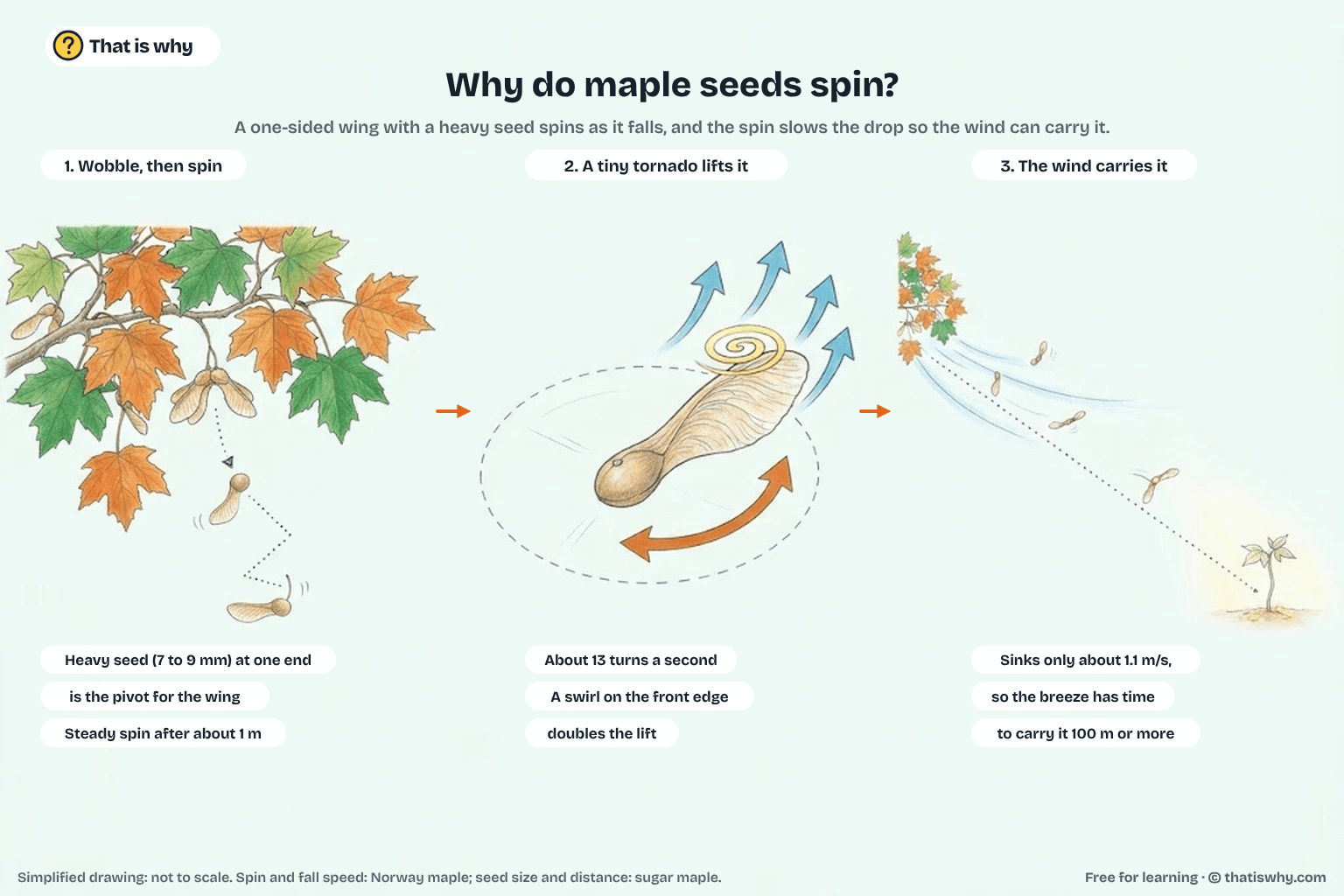
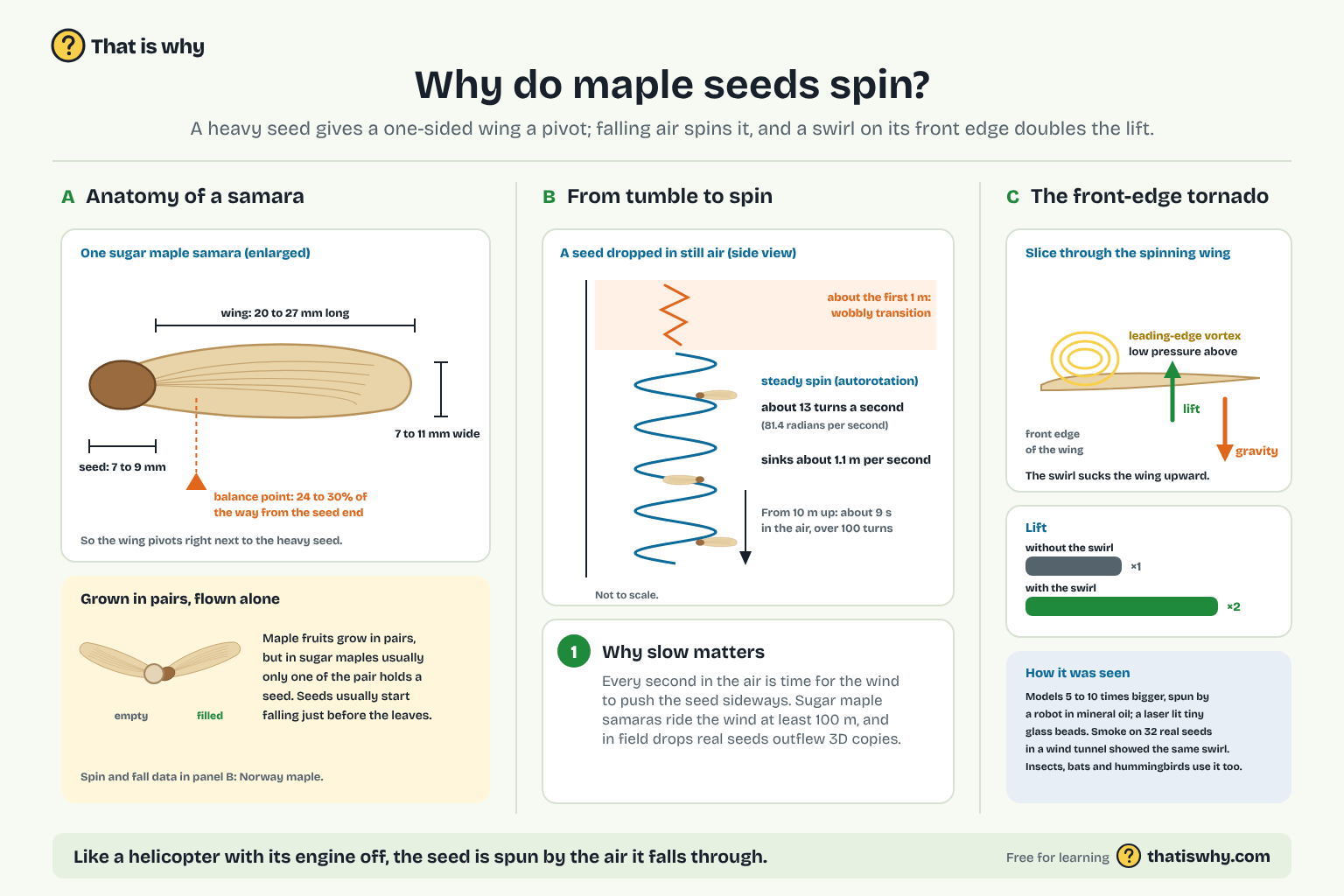
1. Wobble, then spin. A maple seed is a samara: a seed with a papery wing. Its heavy seed, 7 to 9 millimeters long, sits at one end, and the balance point lies 24 to 30 percent of the way along from that end. After about the first meter of wobbling, the wing settles into a steady spin around the seed. This spinning, driven only by the air rushing past, is autorotation.
2. A tiny tornado lifts it. The seed turns about 13 times a second. A tornado-like swirl of air, the leading-edge vortex, sits on top of the wing's front edge, lowers the pressure above it and doubles the lift. Insects, bats and hummingbirds use the same swirl when they hover, a case of convergent evolution.
3. The wind carries it. Sinking only about 1.1 meters per second, the seed gives the breeze time to push it sideways. This is seed dispersal: sugar maple samaras can be carried at least 100 meters by the wind.
Key numbers
| Fact | Value |
|---|---|
| Sugar maple seed length | 7 to 9 mm |
| Sugar maple wing size | 20 to 27 mm long, 7 to 11 mm wide |
| Balance point (Norway maple) | 24 to 30% of the length from the seed end |
| Wobbly start before steady spin | about 1 m |
| Spin rate in still air (Norway maple) | about 13 turns a second (81.4 rad/s) |
| Fall speed in still air (Norway maple) | about 1.1 m/s |
| Lift from the leading-edge vortex | double, compared with seeds without the swirl |
| Distance carried by the wind (sugar maple) | at least 100 m |
Common misconceptions
Myth The wind is what makes maple seeds spin.
The truth They spin even in perfectly still air. The air rushing past a falling seed is enough to turn its wing.
Myth A maple seed is basically a tiny parachute.
The truth A spinning maple wing makes real lift, and the leading-edge vortex on its front edge doubles that lift compared with seeds without that swirl.
Myth Every maple helicopter carries two seeds.
The truth Maple fruits grow in pairs, but in sugar maples usually only one half of the pair is filled with a seed.
Questions to use in class
Tap a question to reveal a model answer.
1Why do maple seeds spin?
A maple seed is a single wing with a heavy seed at one end. The seed gives the wing a pivot, and the air rushing past as it falls turns the wing like a helicopter rotor.
2How fast does a maple seed spin?
Norway maple seeds dropped in still air turned about 13 times a second, or 81.4 radians per second, while sinking about 1.1 meters per second.
3What is the leading-edge vortex on a maple seed?
It is a tiny, tornado-like swirl of air sitting on top of the wing's front edge. It lowers the pressure above the wing and doubles the lift compared with seeds without that swirl.
4How far can a maple seed travel?
The USDA Forest Service reports that the large papery wings of sugar maple let a samara be carried at least 100 meters by the wind.
Key terms
- Samara
- A dry fruit with a flat, papery wing attached to its seed, like the spinning 'helicopters' of maple trees. The wing helps the wind carry the seed away from its parent.
- Autorotation
- Spinning that is driven only by air flowing past a falling wing or rotor, with no engine. A helicopter whose engine fails can glide down this way, and maple seeds autorotate every time they fall.
- Leading-edge vortex
- A small, tornado-like swirl of air that sits on top of a wing's front edge. It lowers the pressure above the wing and boosts lift, for spinning maple seeds and for hovering insects, bats and hummingbirds.
- Seed dispersal
- How plants move their seeds away from the parent: by wind, water, animals or, in a few plants such as the sandbox tree, by throwing them.
- Convergent evolution
- When unrelated living things evolve similar features on their own, by different routes. Octopuses and humans evolved big, clever brains separately, after more than 600 million years apart.
Sources
- Maple Seeds and Animals Exploit the Same Trick to Fly California Institute of Technology (Caltech)
- Wind dispersal of natural and biomimetic maple samaras (Nave et al., 2020) arXiv (Virginia Tech)
- Sugar Maple (Silvics of North America) USDA Forest Service