Free teaching diagram
Sandbox Tree Diagram: How Its Fruit Explodes
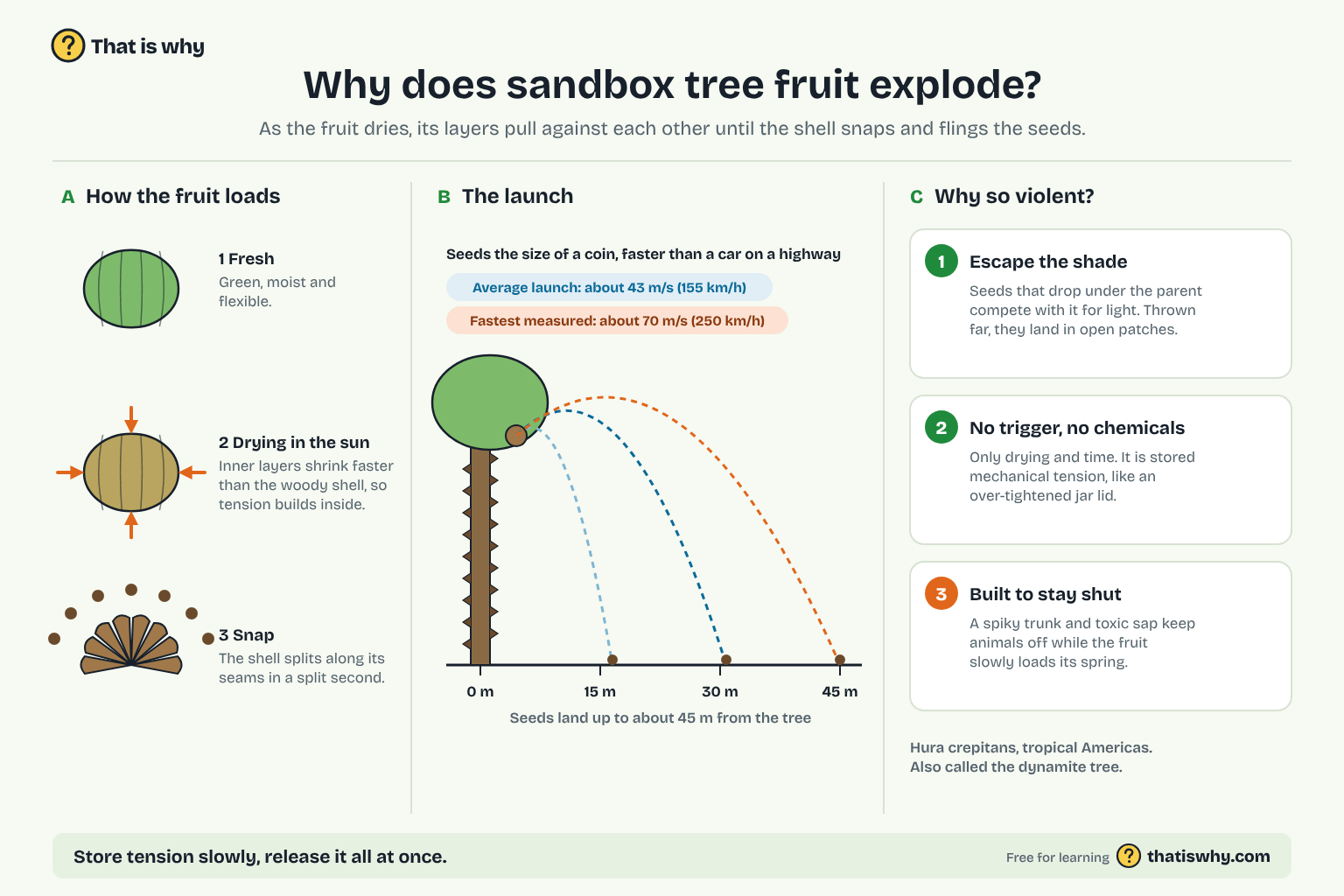
As the fruit dries, its layers pull against each other until the shell snaps and flings the seeds up to about 45 m.
What the diagram shows
A. How the fruit loads. The sandbox tree's fruit is a hard, segmented capsule shaped like a tiny pumpkin, roughly 5 to 8 cm across. (1) When fresh, it is green, moist and flexible. (2) As it dries in the sun, its inner layers shrink faster than the stiff, woody outer shell. They pull against each other, and tension builds up inside, like a spring being wound. (3) When the shell can no longer hold the strain, it snaps open along its seams in a split second, with a bang often compared to a gunshot. Botanists call a fruit splitting open dehiscence; this is the explosive kind.
B. The launch. The seeds are flat, hard and about the size of a coin. Field measurements recorded launch speeds averaging about 43 m/s, with the fastest up to 70 m/s (about 250 km/h), and the longest throws landing around 45 m from the tree. A more recent filmed study measured slower launches, about 13 m/s, so speeds vary a lot from fruit to fruit.
C. Why so violent? Seeds that drop under their parent compete with it for light. Throwing them far gives them a chance to land in open, sunny patches. Nothing has to trigger the release, and no chemical reaction is involved: it is stored mechanical energy. Meanwhile the tree protects itself with a spiky trunk and toxic, milky sap (latex), which keep animals away while the fruit loads.
Key numbers
| Measurement | Value |
|---|---|
| Average launch speed (field measurements) | about 43 m/s (155 km/h) |
| Fastest launch speed reported | about 70 m/s (250 km/h) |
| Longest distance reported | about 45 m |
| Scientific name | Hura crepitans |
Common misconceptions
Myth The fruit explodes because of a chemical reaction.
The truth No chemistry is involved. The energy is mechanical tension that builds up as the fruit's tissues dry and shrink at different rates.
Myth Something has to trigger it, like a touch or an animal.
The truth There is no trigger. Sun and time dry the fruit until the shell can no longer hold the strain, and it splits by itself.
Myth The explosion is how the tree defends itself.
The truth Its defenses are the spiky trunk and toxic sap. The explosion is how it spreads its seeds, far from the parent's shade.
Questions to use in class
Tap a question to reveal a model answer.
1Where does the energy that launches the seeds come from?
From drying. The inner layers of the fruit shrink faster than the stiff outer shell, so tension builds up like a loaded spring until the shell splits.
2Why is it useful for a tree to throw its seeds far away?
Seeds that fall right under the parent have to compete with it, and with each other, for light, water and space. Seeds that land farther away have a better chance of growing.
3A seed leaves at 43 m/s. Roughly how fast is that in km/h?
Multiply by 3.6: 43 × 3.6 ≈ 155 km/h, faster than a car on a motorway.
4Name two other ways plants spread their seeds.
Any two of: wind (dandelion, maple), water (coconut), animals eating fruit and dropping the seeds (berries), or hooks that stick to fur (burdock).
Key terms
- Seed dispersal
- How plants move their seeds away from the parent: by wind, water, animals or, in a few plants such as the sandbox tree, by throwing them.
- Dehiscence
- The splitting open of a ripe fruit or seed pod along built-in seams. In explosive dehiscence the split happens suddenly and flings out the seeds.
- Latex
- A milky fluid made by some plants, such as rubber trees, the sandbox tree and the manchineel, often as a defense. Some latex, like the manchineel's, is toxic and can blister skin and damage the eyes.
Sources
- Putting a new spin on the flight of jabillo seeds (Ribera, Desai and Whitaker) Integrative and Comparative Biology
- Hura crepitans (sandbox tree) Wikipedia