Free teaching diagram
Chili Pepper Diagram: Why Chili Peppers Are Spicy
Capsaicin sets off mammals' heat alarm, not birds', and it also fights a fungus that kills the seeds.
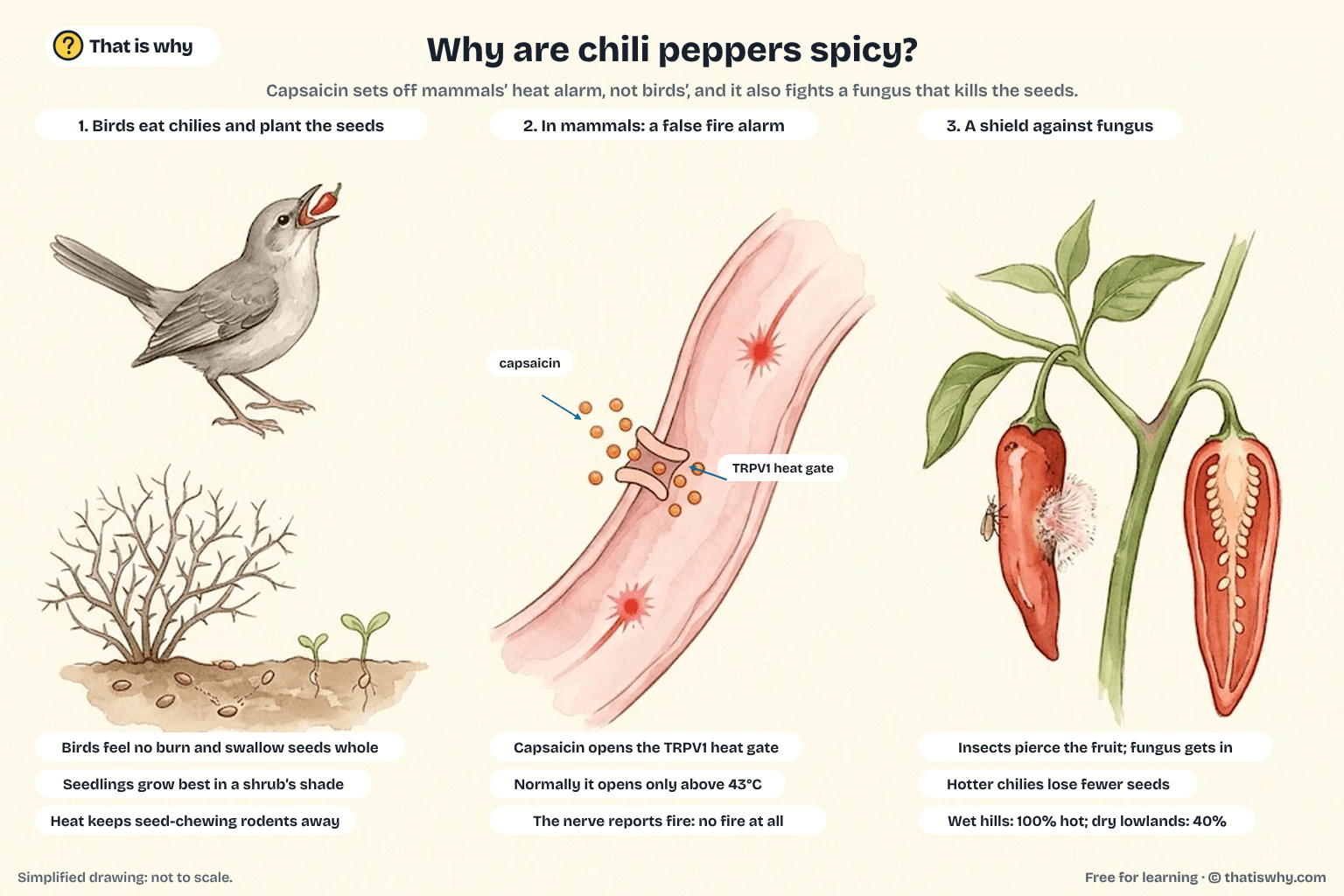
The detailed teaching diagram
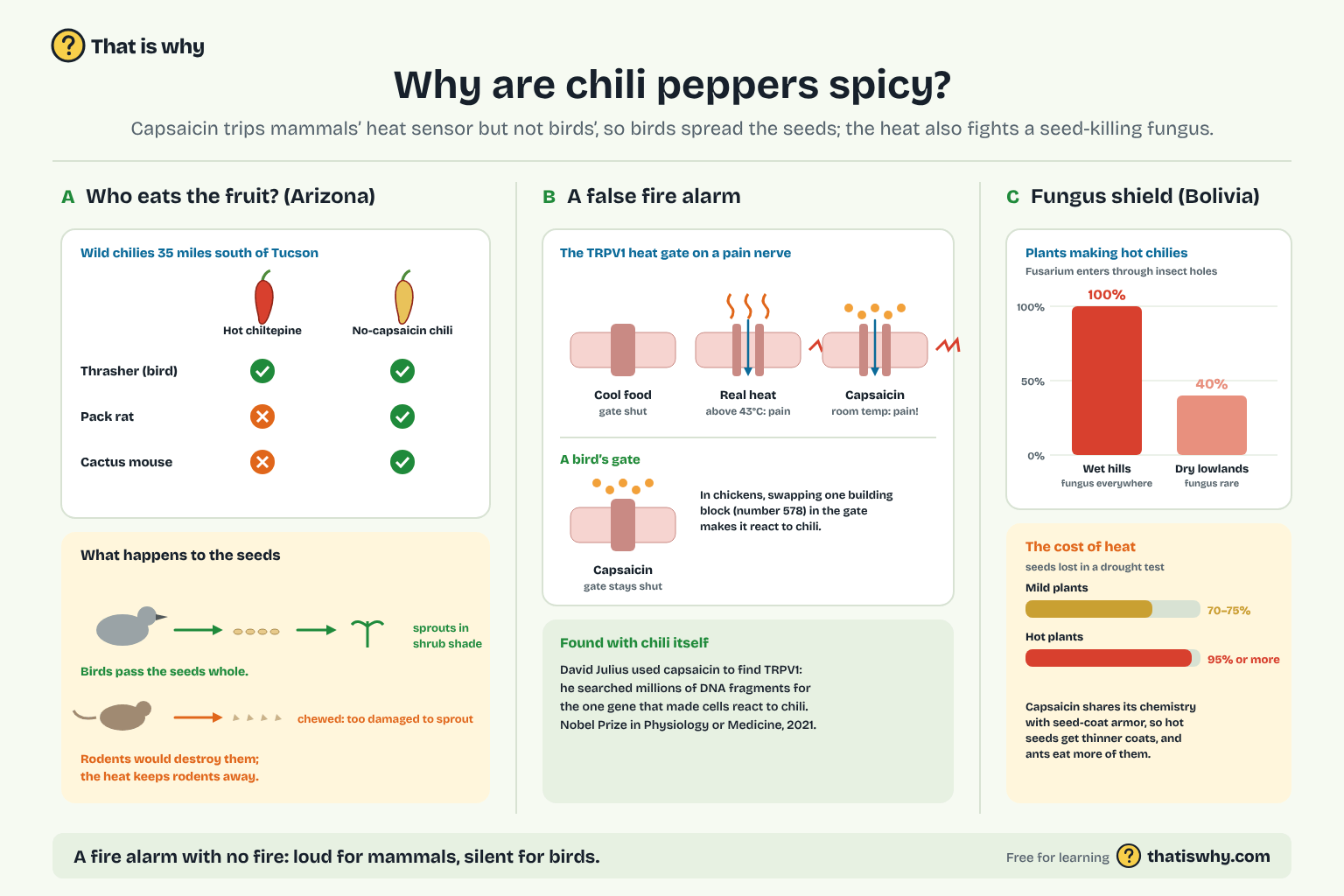
What the diagram shows
1. Birds eat chilies and plant the seeds. In the Arizona desert, curve-billed thrashers were the only animals eating wild chiltepine chilies. They passed the seeds whole, often under shrubs, where young peppers grew best, a kind of seed dispersal. Pack rats and cactus mice, which chew seeds until they can't sprout, left the hot fruit alone.
2. In mammals, a false fire alarm. Pain nerves carry a heat gate called TRPV1 that normally opens only above about 43°C. Capsaicin, the chemical that makes chilies hot, opens it at room temperature, so the brain gets a burning signal with no real heat. A bird's TRPV1 barely reacts to capsaicin.
3. A shield against fungus. In Bolivia, a fungus called Fusarium gets into chilies through holes made by insects, and hotter chilies lose fewer seeds to it. Where fungus is everywhere, all the plants are hot; where it's rare, many are mild, because heat costs the plant seeds. A defense that repels some eaters while sparing others is called directed deterrence.
Key numbers
| Fact | Value |
|---|---|
| Temperature that normally opens TRPV1 | above 43°C (about 109°F) |
| Position in chicken TRPV1 that controls chili sensitivity | 578 |
| Hot plants in Bolivia's wet hills | 100% |
| Hot plants in Bolivia's dry lowlands | 40% |
| Seed production lost in drought, mild plants | 70 to 75% |
| Seed production lost in drought, hot plants | 95% or more |
Common misconceptions
Myth Birds feel the burn but put up with it.
The truth Their TRPV1 sensor barely responds to capsaicin, so a bird swallowing a chili gets little alarm to ignore.
Myth Spicy food actually burns your tongue.
The truth Capsaicin tricks a heat sensor into firing at room temperature. The pain is a real nerve signal, but nothing in your mouth is hot.
Myth Wild chili peppers are always hot.
The truth In Bolivia, many wild plants are mild. In the dry lowlands only 40 percent of plants made hot fruit, because heat is costly where fungus is rare.
Questions to use in class
Tap a question to reveal a model answer.
1Why do chili peppers burn?
They contain capsaicin, which opens the TRPV1 heat sensor on pain nerves at room temperature. Normally that sensor opens only above about 43 degrees Celsius, so the brain gets a burning signal with no real heat.
2Why can birds eat hot peppers?
A bird's version of TRPV1 barely responds to capsaicin. In chickens, changing a single building block of the protein, at position 578, makes it sensitive to chili.
3Why would a plant want birds to eat its fruit?
In Arizona, birds passed chili seeds whole and dropped them under shrubs, where seedlings grew best, while rodents chewed the seeds until they could not sprout.
4Why aren't all chili peppers hot?
Heat is costly. In a drought test, hot plants lost 95 percent or more of their seed production, against 70 to 75 percent for mild plants, so mild plants do better where seed-killing fungus is rare.
Key terms
- Capsaicin
- The chemical that makes chili peppers hot. It tricks the heat-pain sensor TRPV1 in mammals into firing at normal temperatures, so the mouth feels a burn that isn't there; birds barely sense it.
- TRPV1
- A channel protein on pain nerves that opens when things get painfully hot, above about 43 °C (109 °F). Capsaicin from chili peppers makes it open at room temperature, which is why chilies feel hot.
- Directed deterrence
- A fruit defense aimed at some eaters and not others: it repels animals that would destroy the seeds while sparing the ones that spread them, as chili heat repels rodents but not birds.
- Seed dispersal
- How plants move their seeds away from the parent: by wind, water, animals or, in a few plants such as the sandbox tree, by throwing them.
Sources
- For peppers, 'hot' quite literally the spice of life, UF research shows (Tewksbury and Nabhan, Nature 2001) University of Florida
- New research reveals why chili peppers are hot (Tewksbury et al., PNAS 2008) University of Florida
- Why Chilies Are Hot (UW Department of Biology E-news, Spring 2009) University of Washington
- A single TRPV1 amino acid controls species sensitivity to capsaicin (Chu, Cohen and Chuang, Scientific Reports 2020) Scientific Reports, via PubMed Central
- The Nobel Prize in Physiology or Medicine 2021: press release The Nobel Assembly at Karolinska Institutet