Free teaching diagram
Tree Bark Diagram: Why Some Trees Peel Their Bark
Under the dead outer cork, living layers keep growing; beech stretches, oak cracks and sycamore sheds.
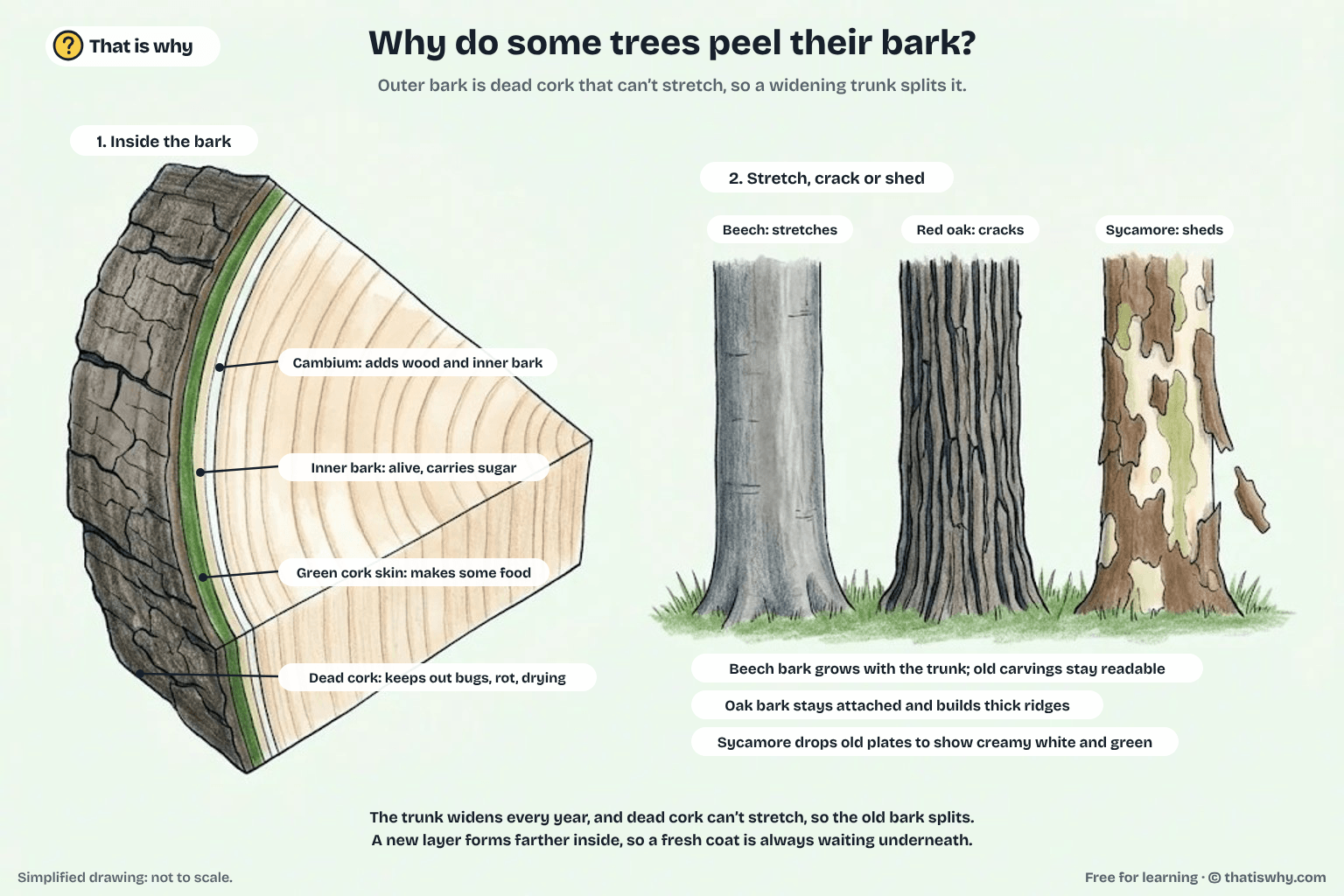
The detailed teaching diagram
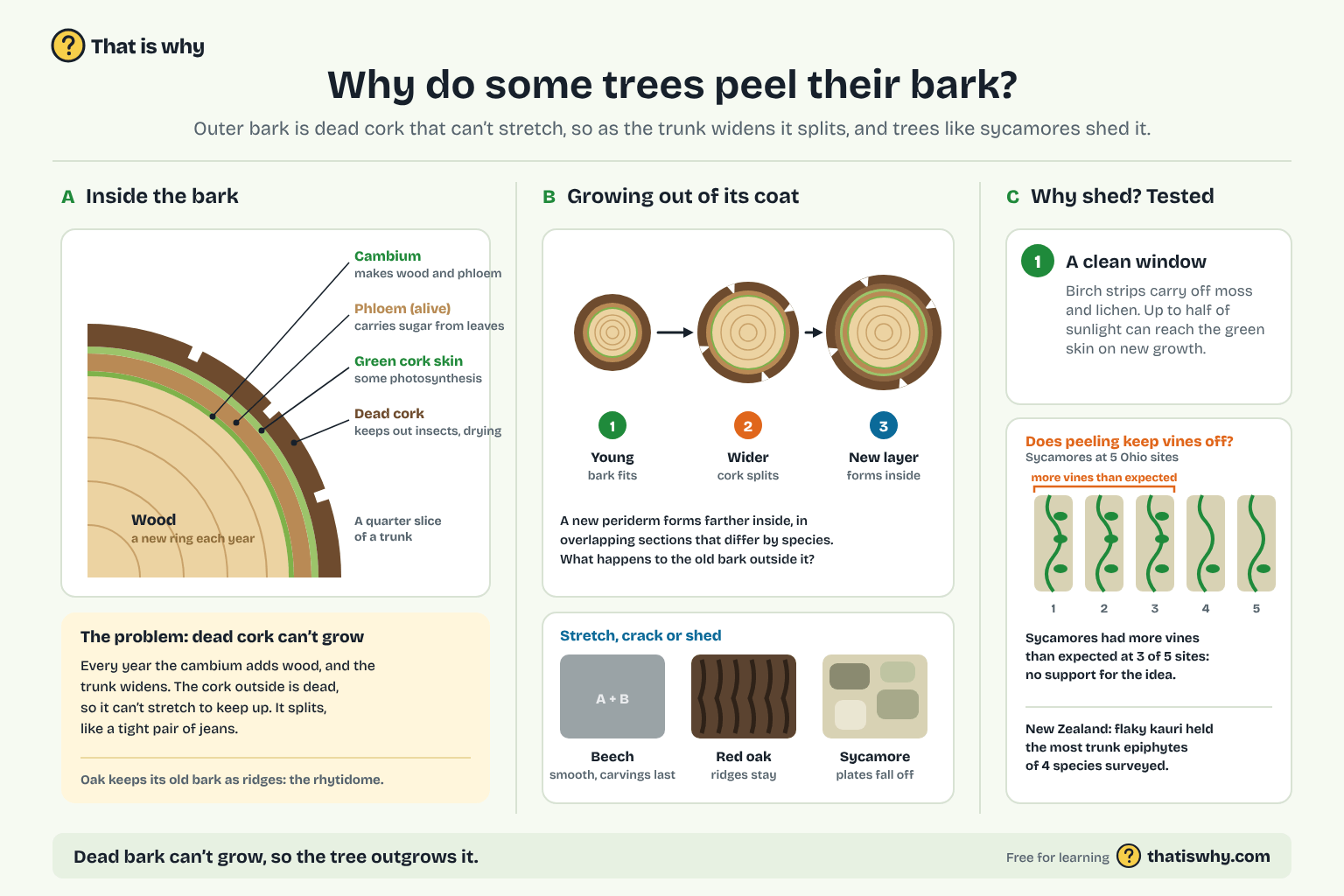
What the diagram shows
1. Inside the bark. Bark is everything outside the wood, and it comes in layers. The cambium adds a ring of wood inside and a layer of phloem, the living inner bark that carries sugar, outside. Farther out, the periderm has a green cork skin that can do a little photosynthesis, a cork cambium that makes new cells, and cork cells that die and keep out infection, insects and drying.
2. Stretch, crack or shed. As the trunk widens, the dead cork can't stretch, so it splits and a new periderm forms farther inside. A beech keeps smooth, unbroken bark, a northern red oak builds thick ridges, and a sycamore lets its old plates fall to show creamy white and green bark.
The test. Birch strips carry off shading moss and lichen and keep the lenticels clear. But peeling isn't mainly a vine shield: in southwestern Ohio, sycamores had more climbing vines than expected at 3 of 5 sites, and in New Zealand, kauri trunks held the most epiphytes of four species.
Key numbers
| Fact | Value |
|---|---|
| Sunlight reaching the green cork skin on new growth | up to half |
| Ohio sites where sycamores had more vines than expected | 3 of 5 |
| Kauri trees with trunk epiphytes | 44% of 48 |
| Height searched on kauri trunks | 0.5 to 3 m |
Common misconceptions
Myth Peeling bark means the tree is sick.
The truth On a sycamore, shedding is usually no cause for concern and can mean the tree is healthy and growing fast. Bark falling off the lower trunk can point to health problems.
Myth Bark is just a dead shell.
The truth The outer cork is dead, but the inner bark is alive: its phloem carries sugar, and the green cork skin can even make some food.
Myth Peeling keeps a trunk free of climbing vines.
The truth In Ohio, sycamores had more vines than expected at 3 of 5 sites, mostly poison ivy.
Questions to use in class
Tap a question to reveal a model answer.
1Why does outer bark split as a tree grows?
Outer bark is dead cork, so it can't grow. As the cambium adds wood, the trunk widens and the dead cork cracks.
2Which layer of bark is alive?
The inner bark, or phloem, which carries sugar from the leaves, along with the thin cambium and the cork cambium.
3How do beech, oak and sycamore deal with a growing trunk?
Beech bark stays smooth and unbroken, oak bark cracks into thick ridges, and sycamore sheds old plates.
4What are lenticels?
Thin lines on the bark that let gases move between the inner and outer bark. Peeling keeps them from becoming blocked.
Key terms
- Periderm
- The protective outer layers of bark: a green inner cork skin, a cork cambium that makes new cells, and outer cork cells that die soon after they form. As a trunk grows wider, the old periderm splits and a new one forms farther inside.
- Cambium
- A thin layer of dividing cells between the bark and the wood. It makes new xylem on the inside and new phloem on the outside, so the trunk grows wider.
- Phloem
- The tissue that carries sugar made in the leaves to the rest of the plant, such as roots, buds and fruit. In a trunk it lies just under the bark.
- Lenticel
- A small breathing spot in bark, often seen as a thin horizontal line. Lenticels let gases pass between the inner and outer bark.
- Epiphyte
- A plant or small organism, such as a moss, lichen or alga, that grows on the surface of another plant without rooting in the soil. On a tree trunk, a thick coat of epiphytes can shade the bark.
Sources
- Getting to Know Bark (Michael Wojtech) Northern Woodlands
- Nature's exfoliation – for trees Charlotte Urban Institute, UNC Charlotte
- Sycamores (Ryan Pankau, The Garden Scoop) Illinois Extension, University of Illinois
- Exfoliating Bark Does Not Protect Platanus occidentalis from Root-Climbing Lianas (Milks, Hibbard & Rooney, Northeastern Naturalist 2017) Eagle Hill Institute, Northeastern Naturalist
- Do host bark traits influence trunk epiphyte communities? (Wyse & Burns, New Zealand Journal of Ecology 2011) New Zealand Ecological Society