Free teaching diagram
Bristlecone Pine Diagram: Why They Live 5,000 Years
Root laid bare, slice dies, one strip lives on: how a bristlecone outlasts its own losses.
The detailed teaching diagram
What the diagram shows
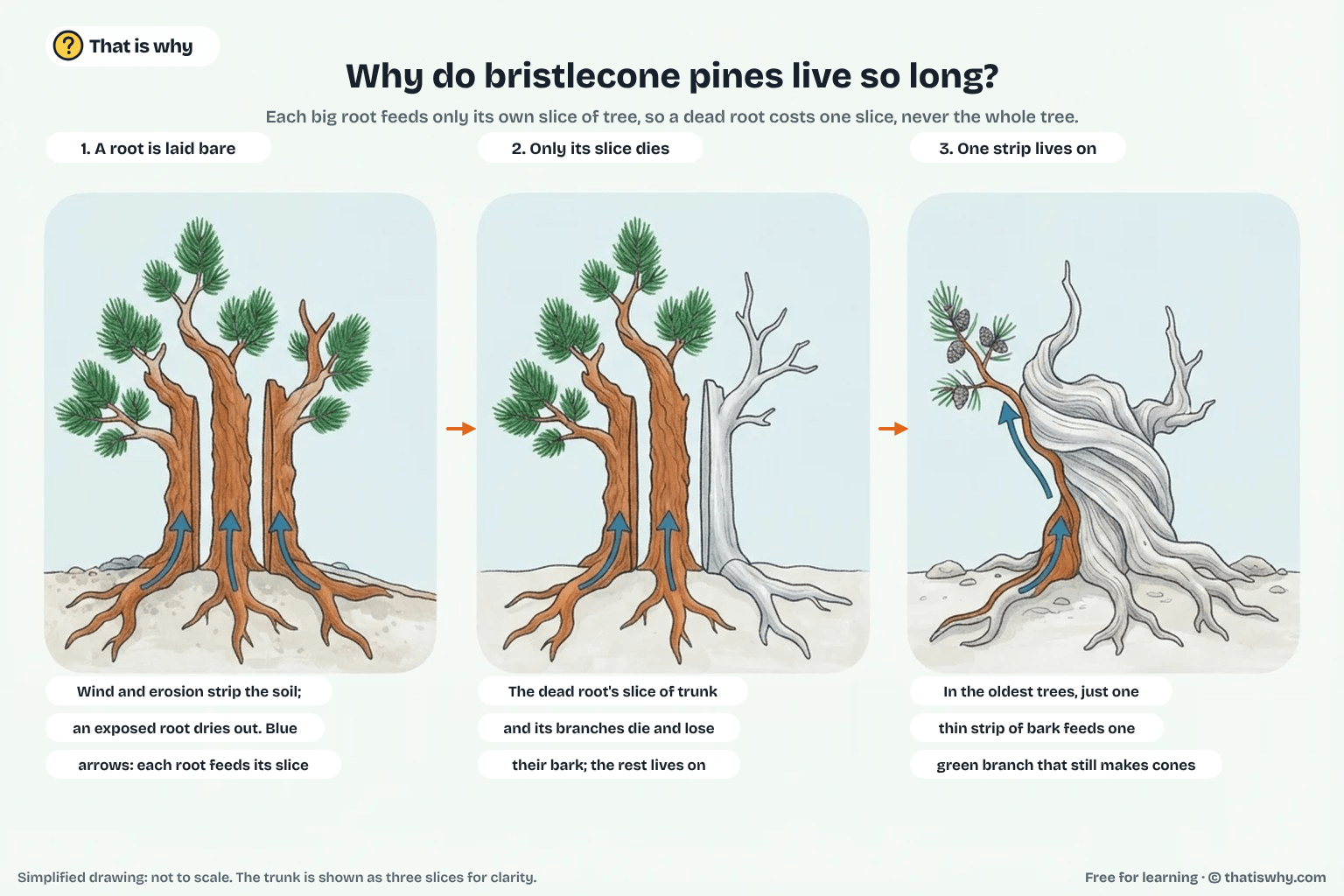
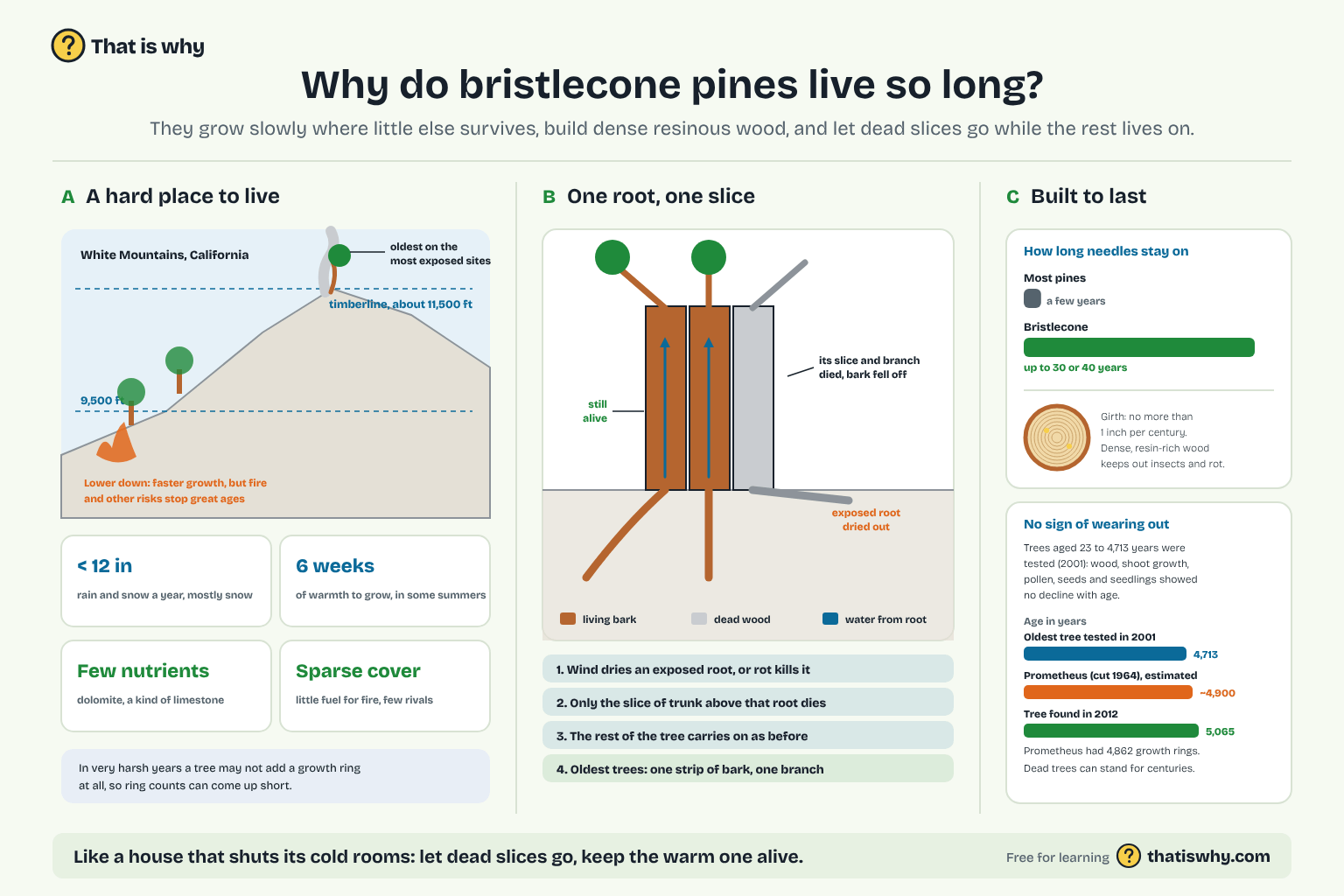
1. A root is laid bare. A bristlecone's trunk works in slices, each fed by its own big root, a layout called sectored architecture. On windy, eroding ridges, the soil washes away and a root ends up exposed.
2. Only its slice dies. The exposed root dries out, and the slice of trunk and branches above it dies and loses its bark. The other slices carry on as before, sealed in dense resin-rich wood that resists insects and rot.
3. One strip lives on. In the oldest trees, a single thin strip of living bark can feed one green branch that still makes cones. Tree-ring science, or dendrochronology, shows how old these trees get, and tests on them found no sign of senescence, the slow breakdown of a body with age.
Key numbers
| Fact | Value |
|---|---|
| Oldest known bristlecone (found 2012) | 5,065 years |
| Prometheus (cut 1964) | 4,862 rings, estimated 4,900 years |
| Trunk growth | no more than 1 inch of girth per century |
| Needle lifespan | up to 30 or 40 years |
| Rain and snow a year (White Mountains) | less than 12 inches |
| Where the oldest grow (White Mountains) | 9,500 ft to timberline at about 11,500 ft |
Common misconceptions
Myth A tree that looks dead must be dead.
The truth An old bristlecone can be mostly bare wood and still be alive, with a single strip of living bark keeping one branch green.
Myth You can count the rings to get a bristlecone's exact age.
The truth In harsh years these trees may not add a ring at all. Prometheus had 4,862 rings, but its age was estimated at 4,900 years.
Myth Old bristlecones are slowly dying of old age.
The truth Tests on trees aged 23 to 4,713 years found no decline with age in their wood, shoot growth, pollen, seeds or seedlings.
Questions to use in class
Tap a question to reveal a model answer.
1Why do bristlecone pines live so long?
They grow very slowly in harsh, dry mountain spots where little else survives, so there is little fuel for fire and few rivals. Their dense, resin-rich wood resists insects and rot, and each big root feeds only its own slice of tree, so a dead root never kills the whole tree.
2How can a bristlecone pine be mostly dead and still alive?
When a major root dies, only the slice of trunk above it dies. In the oldest trees, a thin strip of living bark can be all that is left, feeding a single green branch.
3How old is the oldest bristlecone pine?
According to the National Park Service, a bristlecone found in 2012 in the White Mountains of California proved to be 5,065 years old.
4How long do bristlecone pine needles last?
Up to 30 or 40 years, while most pines replace their needles every few years.
Key terms
- Sectored architecture
- A tree body built in separate slices, each fed by its own big root. When one root dies, only the slice of trunk and branches above it dies, and the rest of the tree keeps living.
- Dendrochronology
- The science of dating events and reading past climates from the yearly growth rings of trees. Bristlecone pines are prized for it because their rings stretch back thousands of years.
- Senescence
- The slow breakdown of a living body's functions as it gets older. Tests on Great Basin bristlecone pines up to 4,713 years old found no sign of it.
- Resin
- A thick, sticky substance made by many trees, especially conifers, and stored in resin ducts. It seals wounds and traps insects. Unlike sap, it does not dissolve in water.
- Conifer
- A cone-bearing tree, such as a pine, spruce or fir. Most conifers have needle- or scale-shaped leaves and are evergreen.
Sources
- A Tree's Secret to Living Long, part 1 (Peter Tyson) NOVA Online, PBS/WGBH
- A Tree's Secret to Living Long, part 2 (Peter Tyson) NOVA Online, PBS/WGBH
- Identifying Bristlecone Pines National Park Service, Great Basin National Park
- The Prometheus Story National Park Service, Great Basin National Park
- Bristlecone Pine National Park Service, Bryce Canyon National Park
- Does bristlecone pine senesce? (Lanner & Connor, Experimental Gerontology 2001) USDA Forest Service Research