Free teaching diagram
Hydrothermal Vent Diagram: Why Vents Are Full of Life
Seawater heated by magma feeds bacteria that make food from chemicals, and tubeworms keep those bacteria inside their bodies.
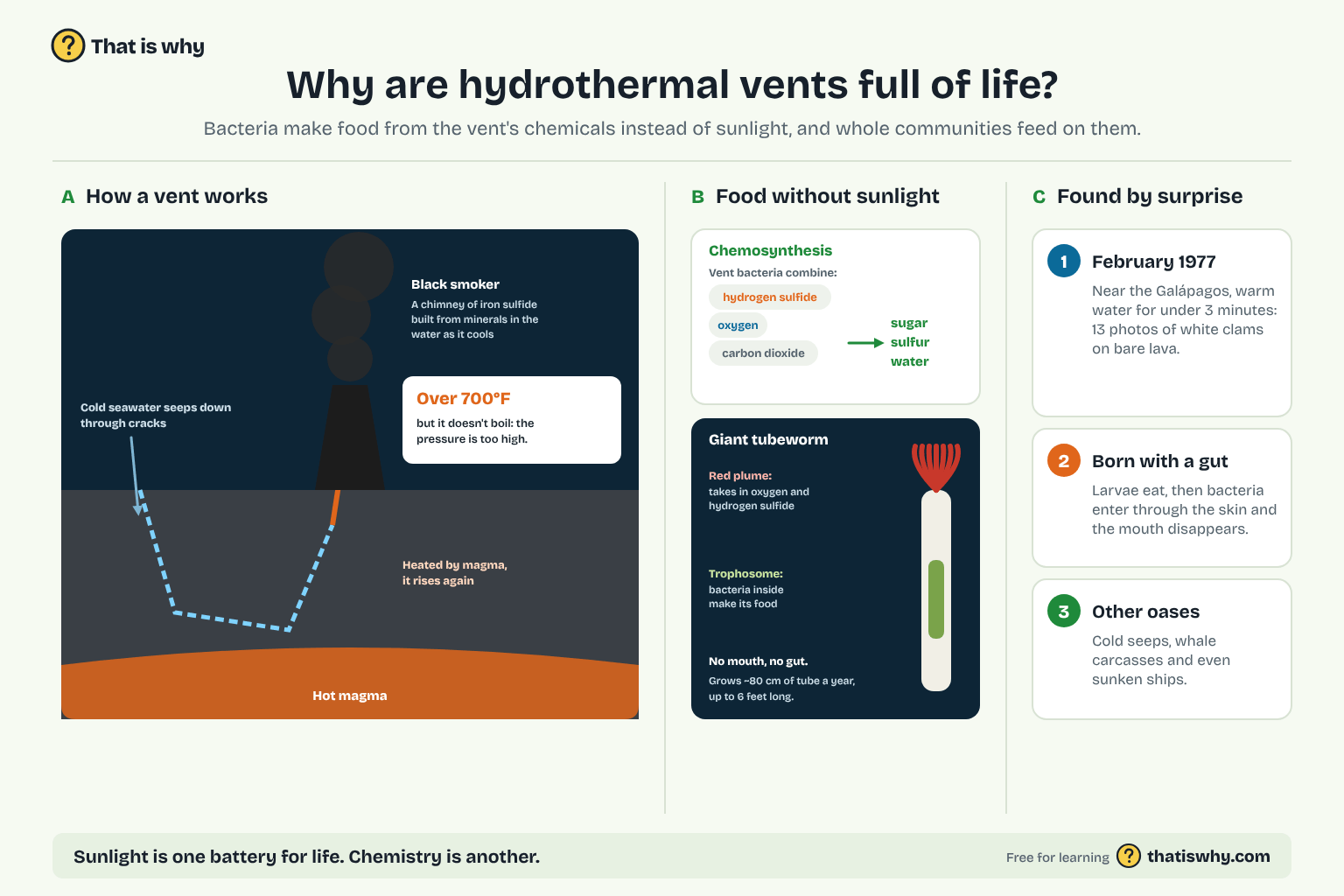
What the diagram shows
A. How a vent works. Cold seawater seeps down through cracks in the ocean crust, is heated by magma, and rises again. At a hydrothermal vent it can reach over 700 degrees Fahrenheit without boiling, because the pressure is so high. As the mineral-rich water cools, the minerals harden into chimneys; black smokers are chimneys of iron sulfide. The drawing is simplified, not to scale.
B. Food without sunlight. Vent bacteria combine hydrogen sulfide, oxygen and carbon dioxide and make sugar, sulfur and water: chemosynthesis. The giant tubeworm has no mouth or gut. Its red plume takes in oxygen and hydrogen sulfide and passes them to bacteria living inside it, in an organ called the trophosome. These bacteria are endosymbionts. The worm grows about 80 cm of tube a year and can reach 6 feet.
C. Found by surprise. In February 1977, near the Galápagos Islands, a camera sled crossed warm water for under three minutes and took 13 photos of white clams on bare lava. Tubeworm larvae are born with a gut and eat like ordinary animals, until bacteria enter through their skin and the mouth disappears. Similar communities live at cold seeps, on whale carcasses and even on sunken ships.
Key numbers
| Fact | Value |
|---|---|
| Vent water temperature | over 700°F |
| Tubeworm growth | about 80 cm of tube a year |
| Tubeworm length | up to 6 feet |
| Warm-water signal in 1977 | under 3 minutes, 13 photos |
| Depth of Alvin's first dive | 2.5 km |
Common misconceptions
Myth Vent animals swim in boiling water.
The truth Vent fluid can top 700 degrees Fahrenheit but does not boil because of the pressure, and the animals live where it mixes into near-freezing seawater.
Myth Giant tubeworms eat bacteria.
The truth Adult tubeworms have no digestive system. Bacteria living inside them make the food.
Questions to use in class
Tap a question to reveal a model answer.
1Where does the food at a vent come from?
From bacteria that combine hydrogen sulfide, oxygen and carbon dioxide to make sugar, a process called chemosynthesis.
2How does a giant tubeworm eat without a mouth?
Its red plume takes in oxygen and hydrogen sulfide and passes them to bacteria living in an organ called the trophosome, which make its food.
3Why doesn't vent water boil?
The pressure at those depths is so high that water can pass 700 degrees Fahrenheit without boiling.
Key terms
- Hydrothermal vent
- A crack in the seafloor where water heated by volcanic rock gushes out, loaded with dissolved minerals. Black smokers are vents whose fluid looks like dark smoke.
- Chemosynthesis
- Making food from the energy in chemicals, such as hydrogen sulfide, instead of from sunlight. Bacteria at deep-sea vents use it to feed whole communities.
- Trophosome
- A special organ inside the giant tubeworm that houses the bacteria that feed it. The bacteria get in through the skin of the young worm, and the trophosome forms around them.
- Endosymbiont
- An organism that lives inside the cells or body of another, to the benefit of both. Green algae living inside spotted salamander embryo cells are the first known case in an animal with a backbone.
Sources
- Benchmarks: February 17, 1977: Hydrothermal vents are discovered (Timothy Oleson) Earth Magazine (American Geosciences Institute)
- What is the difference between photosynthesis and chemosynthesis? NOAA Ocean Exploration
- What is a hydrothermal vent? NOAA Ocean Service
- Life at Vents and Seeps Woods Hole Oceanographic Institution
- Giant deep-sea tubeworm's meal ticket comes in as a skin infection (Nussbaumer, Fisher and Bright, Nature) Penn State Eberly College of Science