Free teaching diagram
Vampire Squid Diagram: How It Eats Marine Snow
One long sticky filament, a slow shower of marine snow, and a squid that barely moves in water few predators can stand.
The detailed teaching diagram
What the diagram shows
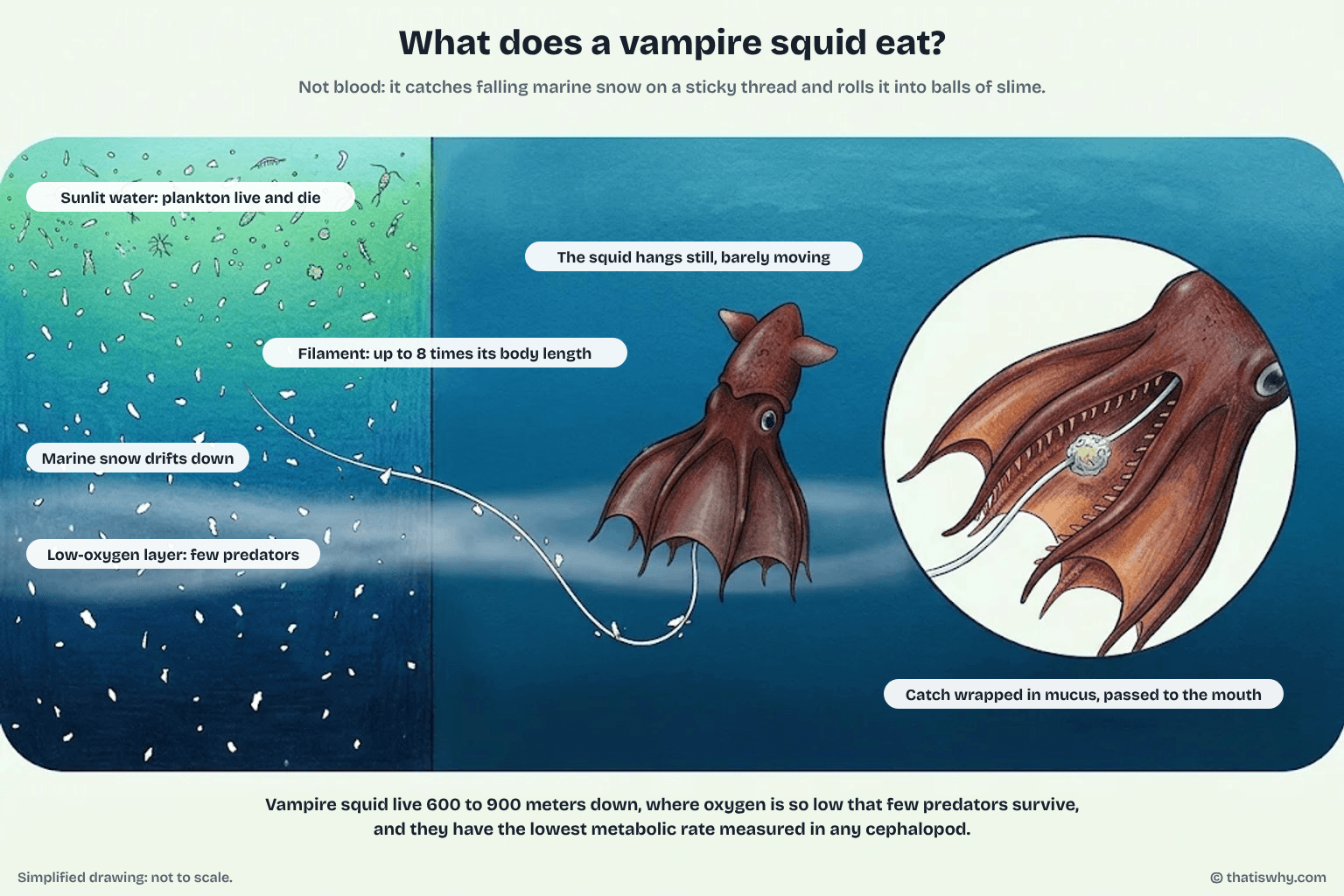
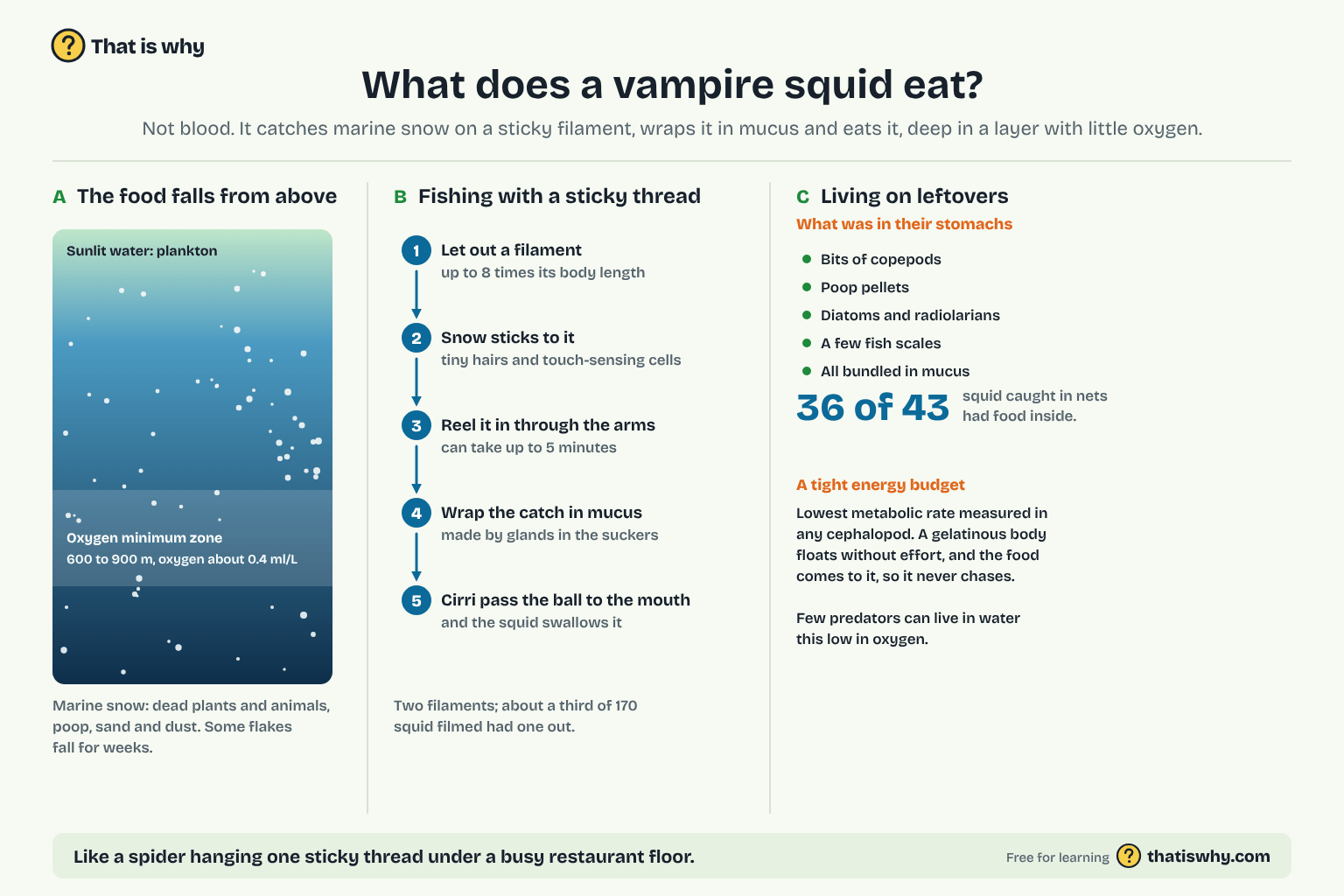
A. The food falls from above. Near the surface, sunlit water is full of plankton that live, eat and die. Their remains, along with droppings, sand, soot and dust, sink as marine snow, and some flakes fall for weeks. Between about 600 and 900 meters down in Monterey Bay, the vampire squid lives inside an oxygen minimum zone, where oxygen falls below about half a milliliter per liter; the squid were found at around 0.4.
B. Fishing with a sticky thread. The vampire squid has two retractile filaments. It lets one out up to eight times its body length, and marine snow sticks to its tiny hairs, which are packed with touch-sensing cells. The squid reels the filament in through its arms, which can take up to five minutes, wraps the catch in mucus from glands in its suckers, and its fingerlike cirri pass the ball to its mouth. About a third of the 170 vampire squid filmed by MBARI had a filament out.
C. Living on leftovers. Of 43 vampire squid caught in nets, 36 had food inside: bits of copepods, poop pellets, diatoms, radiolarians and a few fish scales, mostly bundled in mucus. That makes it a detritivore, an animal that eats dead and decaying material. It has the lowest metabolic rate measured in any cephalopod, and its gelatinous body floats without effort, so it never has to chase its food.
Key numbers
| Fact | Value |
|---|---|
| Filament length | up to 8 times its body length |
| Time to reel in a filament | up to 5 minutes |
| Vampire squid filmed (1992 to 2012) | 170 |
| Share seen with a filament out | about a third |
| Netted squid with food inside | 36 of 43 |
| Depth in Monterey Bay | 600 to 900 m |
| Oxygen where they live | about 0.4 ml per liter |
Common misconceptions
Myth The vampire squid drinks blood.
The truth It eats marine snow, drifting leftovers from the water above, not blood or live prey.
Myth It chases its food.
The truth It hangs almost still and lets the food fall onto a sticky filament up to eight times its body length.
Myth It lives where other animals thrive.
The truth It lives 600 to 900 meters down in an oxygen minimum zone, where few predators can survive.
Questions to use in class
Tap a question to reveal a model answer.
1What is marine snow made of?
Dead plants and animals, poop, sand, soot and dust drifting down from the water above.
2How does the vampire squid catch marine snow?
It lets out a long sticky filament, reels it in through its arms and wraps the catch in mucus from its suckers.
3Why can it survive on such poor food?
It has the lowest metabolic rate measured in any cephalopod and floats without effort, so it needs very little energy.
4Why live in water with so little oxygen?
Few predators can survive there, while marine snow keeps falling through it.
Key terms
- Marine snow
- A slow shower of dead plants and animals, droppings and other bits, sinking from the sunlit surface to the deep sea. It is food for many deep-sea animals, and what is not eaten settles as a soft ooze on the seafloor.
- Detritivore
- An animal that eats detritus: dead and decaying bits of plants and animals, droppings and other organic waste, instead of hunting live prey. The vampire squid is one.
- Oxygen minimum zone
- A layer of the ocean, usually hundreds of meters down, where dissolved oxygen falls below about 0.5 milliliters per liter of water. Few animals can live there, so it is a refuge for those that can.
- Bioluminescence
- Light made by a living thing through a chemical reaction. Most deep-sea bioluminescence is blue, the color that travels furthest in water.
Sources
- Vampire squid: detritivores in the oxygen minimum zone (Hoving and Robison, Proceedings of the Royal Society B 2012) PubMed Central (US National Library of Medicine)
- MBARI researchers discover what vampire squids eat (it's not what you think) Monterey Bay Aquarium Research Institute (MBARI)
- Vampyroteuthis infernalis Animal Diversity Web, University of Michigan
- Introducing Vampyroteuthis infernalis, the vampire squid from Hell The Cephalopod Page
- Vampire Squid Aquarium of the Pacific
- What is marine snow? NOAA National Ocean Service