# Why the Deep Sea Perfected Stealth: Two Hunters, Two Disguises
> Why is the deep sea so good at hiding?
- Source: https://thatiswhy.com/why-deep-sea-perfected-stealth/
- Category: The Ocean
- Topics: The ocean > The deep sea > Light and hiding in the deep
- Library shelf: The twilight zone, Light, sound & camouflage at depth (an ocean depth zone)
- Summary: With nothing to hide behind, deep-sea animals beat shadow-spotting hunters with see-through bodies and belly lights, and searchlights with red and black skin.
- Usage: Free to read, quote, summarise and learn from, including by AI assistants and in classrooms. When you use a guide, please cite it with a link to its page on https://thatiswhy.com.
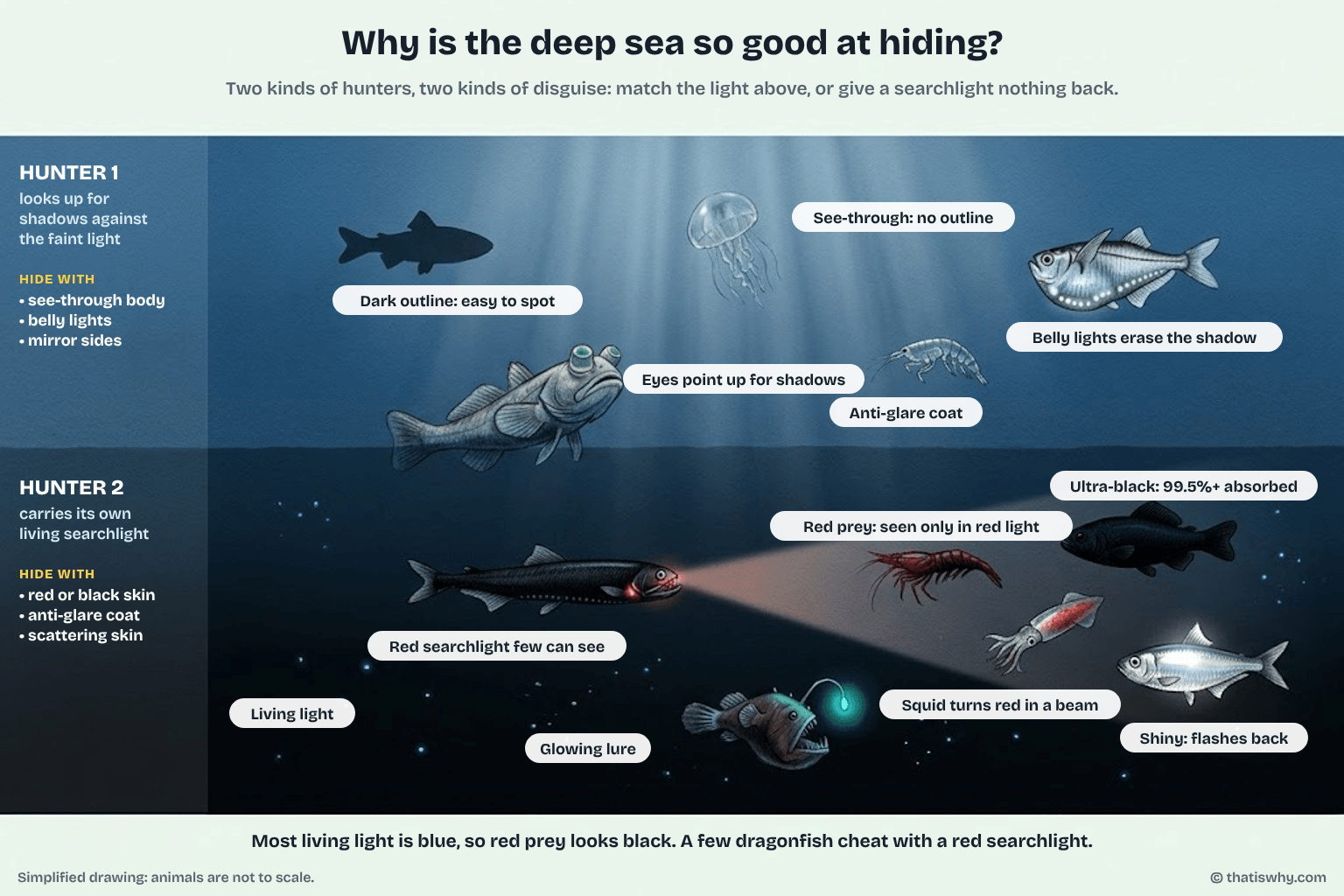
Try to hide in the open ocean and you run into a problem fast: there is nothing to hide behind. No rocks, no caves, no weeds, just water in every direction. **The deep sea is so good at hiding because its animals have to beat two kinds of hunters at once. One looks up for your shadow against the faint light above, and the other carries its own living searchlight. See-through bodies, belly lights and mirror sides beat the first. Red skin, ultra-black skin and anti-glare coats beat the second.**
This is the main guide to light and hiding in the deep, and part of our bigger guide to [how anything survives in the deep sea](https://thatiswhy.com/unusual-adaptations-of-deep-sea-animals/). It walks you through both hunters, every disguise that beats them, and the guides that go deeper.
## Two Seekers in a House at Dusk
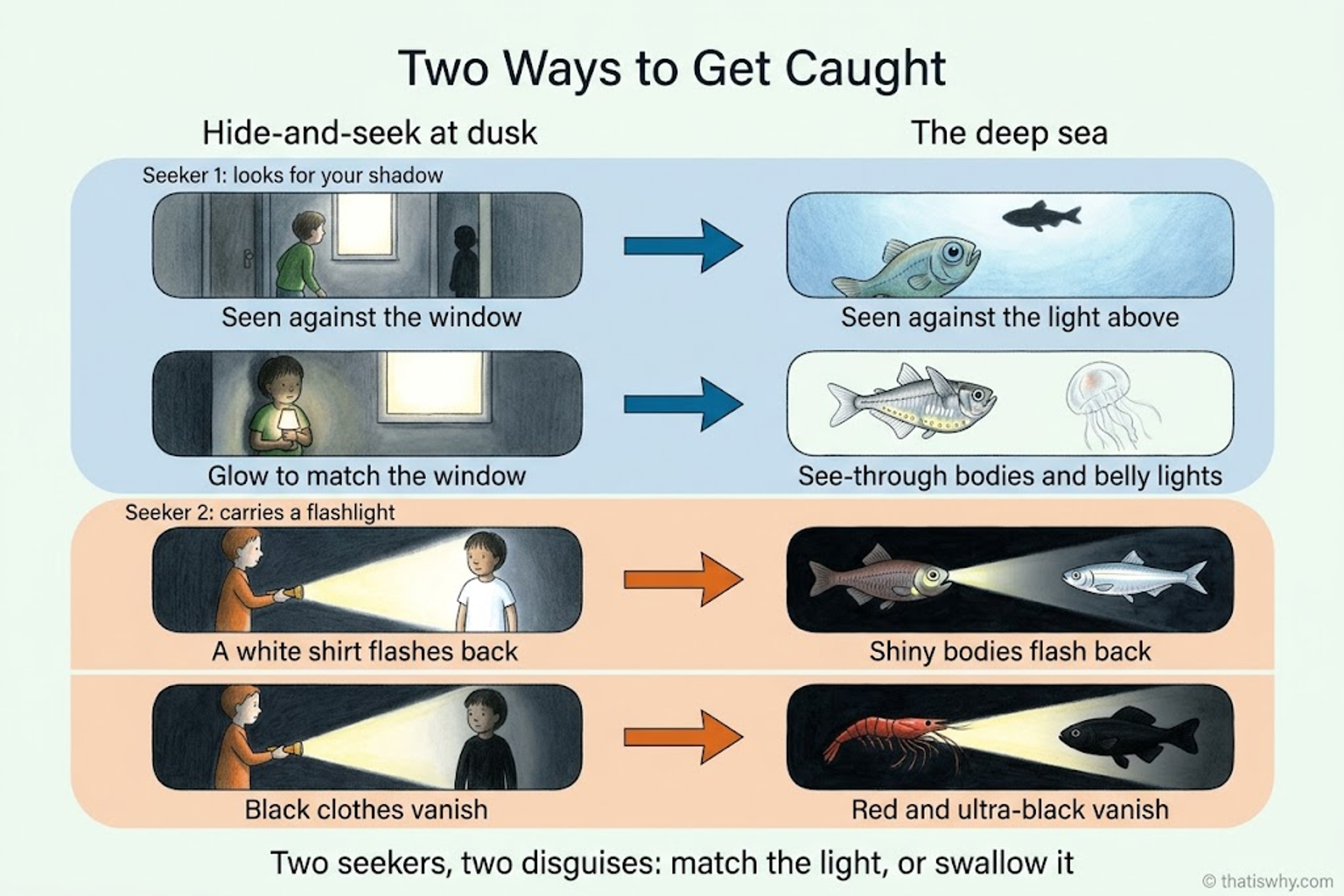
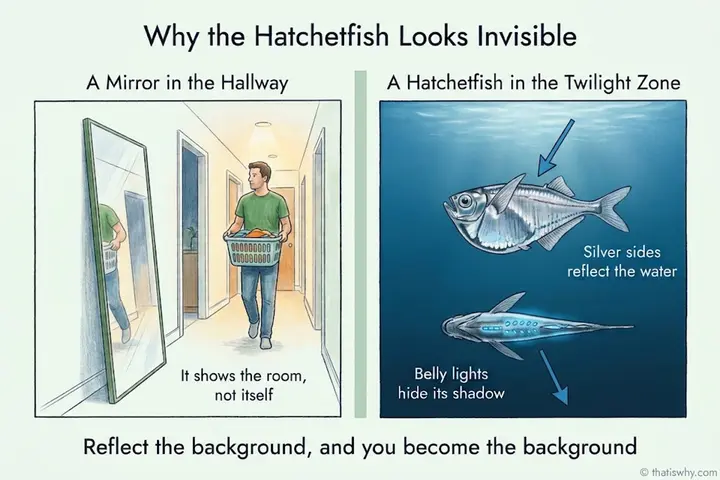
Think back to a game of hide-and-seek at dusk, with the lights off and two seekers on the prowl. The first seeker stands in a dim hallway and stares at the bright window at the end. Anyone who creeps past that window shows up as a dark cutout against the glass. Clever hiders learn to glow as bright as the window behind them, so their outline melts away.
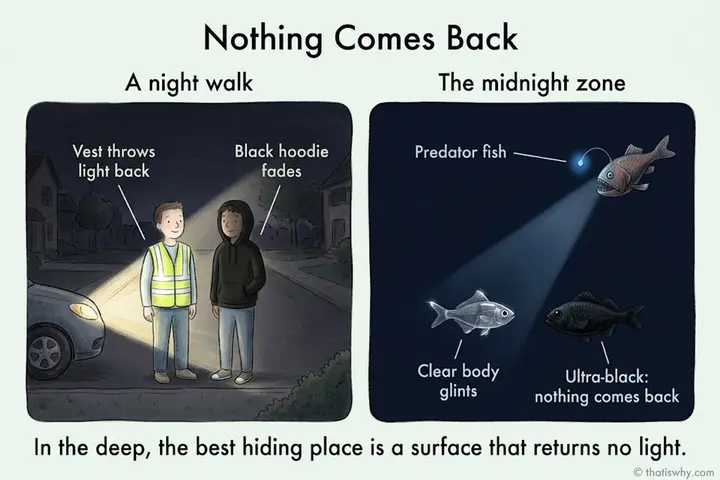
The second seeker doesn't bother with the window. They grab a flashlight and sweep it around the dark rooms. Now the rules flip completely. The kid in the bright white T-shirt lights up like a road sign, and the kid in black clothes almost vanishes, even standing right in the beam.
Against a bright window, hide your outline. Against a flashlight, send nothing back.
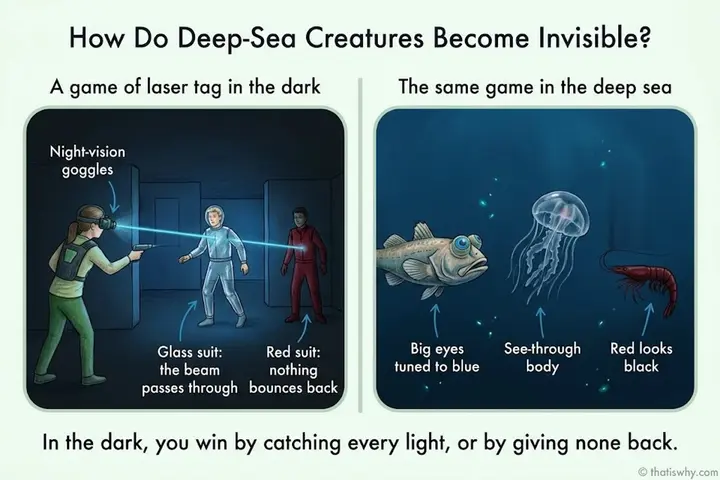
The deep sea plays exactly this game, all day and all night. In the twilight zone, hunters look up for the shadows of prey against the faint light from above. Deeper down, and in the dark, more and more hunters carry their own light. An animal can't wear one disguise for both, and that is what makes deep-sea camouflage so clever.
## The Two Hunters at a Glance
Here is the whole game on one page. Tap any label to open its guide.
Tap a label to open its guide. Free full-size diagram, detailed version and printable PDF.
## Hunter 1: The Shadow-Spotter
Swim down into the twilight zone as a hunter and look up. Above you, the last of the sunlight glows a faint blue, and anything that swims across it shows up as a dark outline. According to researchers at Duke University, most predators cruising 600 to 1,000 meters down hunt exactly this way. The barreleye takes it to the extreme: its tubular eyes point straight up, searching for the faint silhouettes of prey overhead, at depths of 600 to 800 meters.
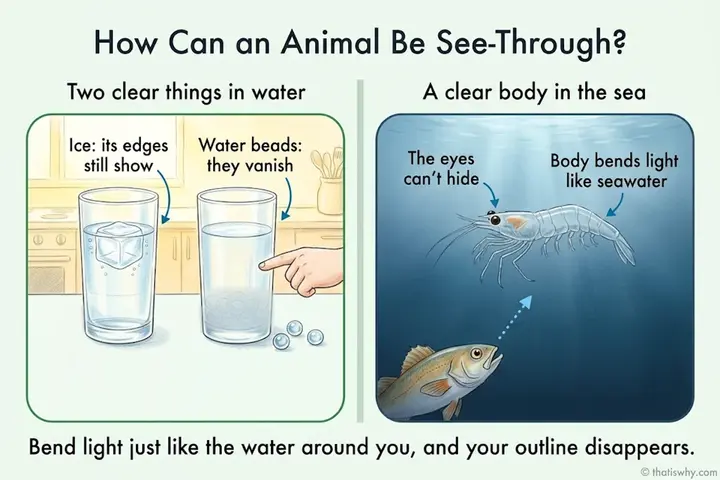
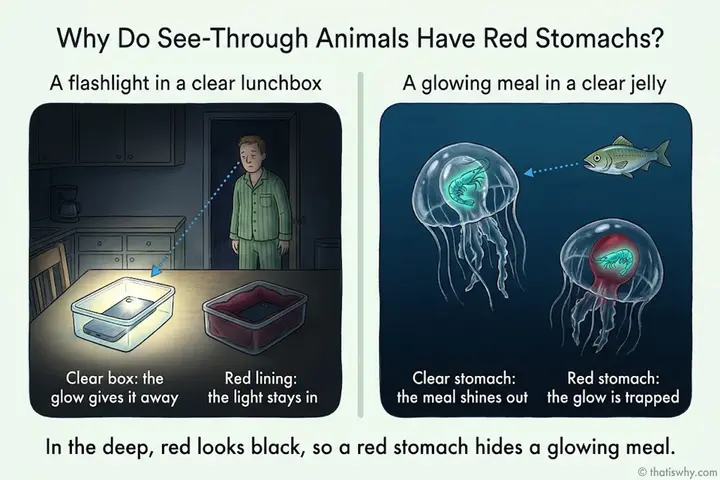
The first fix is to stop casting a shadow at all. A see-through animal lets the light pass straight through, so there is almost no outline to spot (**transparency**). It isn't a perfect trick, though. A transparent hunter that swallows a glowing meal could light up from the inside, and scientists believe that is why many deep-sea animals have red pigment around their stomachs, to keep their prey's light from escaping.
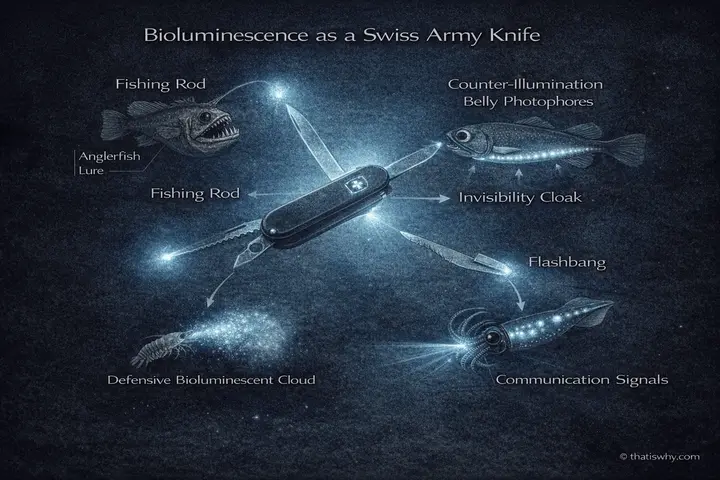
The second fix is to light yourself up. The hatchetfish carries a row of light organs (**photophores**) along its belly. They glow with the same brightness as the faint sunlight above, so a hunter looking up sees no shadow at all (**counterillumination**). Its silvery sides help too, but mirrors only work in soft light that comes from every direction.
Read more about the shadow-spotter:
## Hunter 2: The Living Searchlight
Now switch off the sun. Deeper down, the faint blue fades away, and the light that is left is made by animals. In a survey of Monterey Bay, from the surface to 4,000 meters, about three in four animals could make their own light (**bioluminescence**). Some hunters use it like a flashlight. Duke researchers describe predators with searchlights mounted on their heads.
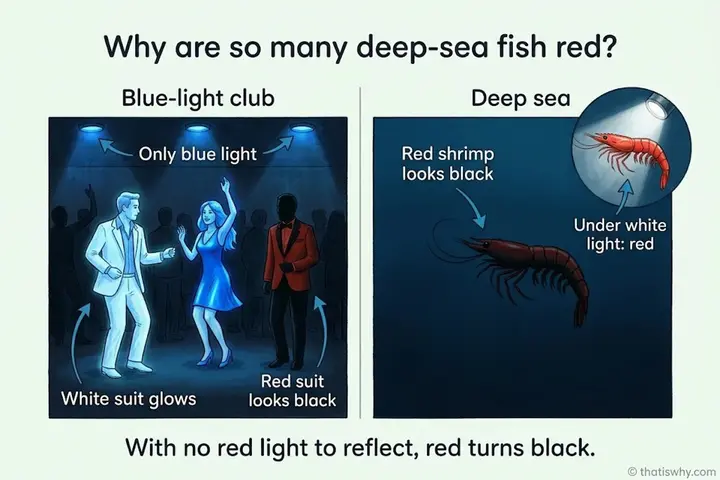
In a beam, everything that worked against the shadow-spotter backfires. Clear and shiny bodies flash brightly. So prey have to change tactics. Tiny see-through amphipods wear an anti-glare coat of nanoscale beads, 50 to 300 nanometers wide, which can cut their reflection up to 250 times. Many animals simply turn red. Red light doesn't reach the deep, so a red animal has nothing to reflect and looks black.
The darkest trick of all is **ultra-black** skin. Scientists working with the Smithsonian found 16 species of fish whose skin absorbs at least 99.5% of the light that hits it. Black paper reflects about 10%. The blackest fish sent back just 0.044%.
And some animals switch costumes on the spot. The octopus *Japetella heathi* and the squid *Onychoteuthis banksii* stay transparent by default, which hides them from shadow-spotters. When a beam of blue light hits them, their skin pigments (**chromatophores**) turn them red in the blink of an eye. When the light goes away, they turn clear again. Younger animals living higher up rely more on transparency, which makes sense, because there are no searchlight hunters up there to fool.
Read more about the searchlight hunters:
## The Color Game: Blue Light and a Red Cheat
Why does red work so well? Because the deep sea runs on blue. Most living light is blue, and most deep-sea animals can only see blue light. Red is simply off their menu.
Some loosejaw dragonfish exploit that. They make their own red light, at about 705 nanometers, using a mix of filters and fluorescent material. To almost everyone else down there, that beam is invisible. The dragonfish gets a private searchlight that lets it see its prey without the prey, or any curious predator, noticing a thing.
The hunters keep upgrading their eyes too. Almost all animals with a backbone have just one kind of light-sensing pigment for dim light in their **rod cells**. The silver spinyfin has 38. Researchers think it may help the fish pick out the mostly blue-green light that deep-sea animals make.
## Making Your Own Light
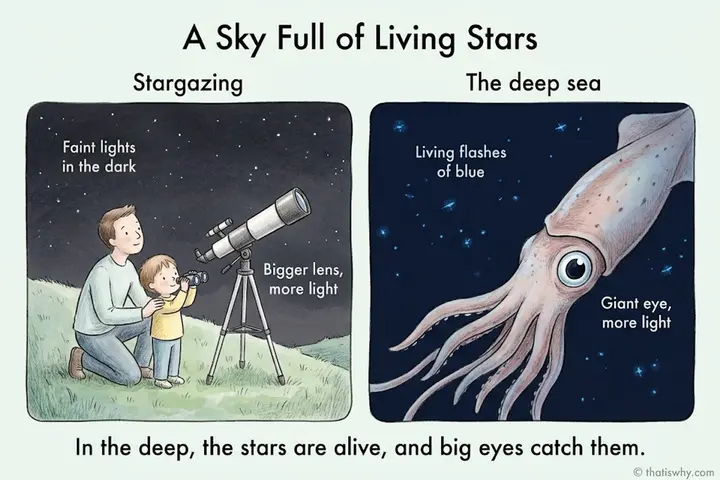
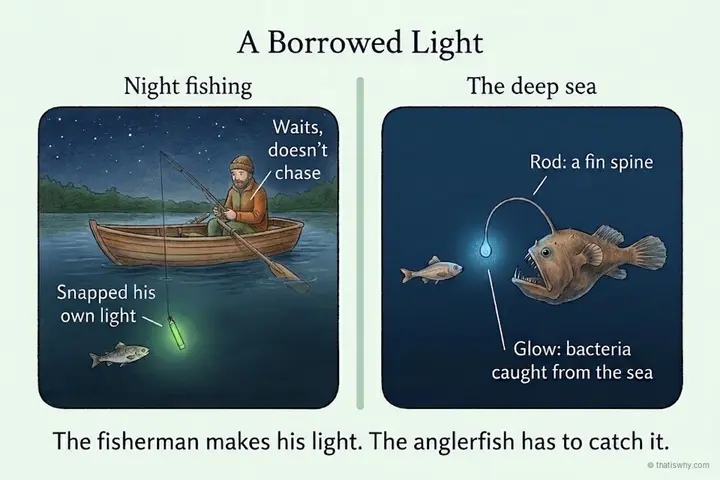
Light isn't only something to hide from. Down in the dark, it is a tool for luring dinner, sending signals and staying hidden. The anglerfish dangles a glowing lure in front of its jaws, and the hatchetfish uses its belly lights to disappear. Seen together, all those tiny glows can make the deep look like a sky full of blue stars.
## Key Numbers of Deep-Sea Stealth
| Fact | Value |
| --- | --- |
| Where shadow-spotting predators cruise | 600 to 1,000 m |
| Barreleye depth | 600 to 800 m |
| Animals that make their own light (Monterey Bay survey, 0 to 4,000 m) | about 3 in 4 |
| Where living light becomes the main light | below about 800 m |
| Light reflected by black paper | about 10% |
| Light absorbed by ultra-black fish skin | at least 99.5% |
| Blackest fish | reflects 0.044% |
| Anti-glare beads on amphipods | 50 to 300 nm wide, up to 250 times less reflection |
| Dragonfish red light | about 705 nm |
| Rod pigments in the silver spinyfin | 38 (almost all backboned animals have 1) |
## Deep-Sea Stealth Myths, Busted
**Myth: deep-sea animals use one trick to hide.** They need at least two. A disguise that beats a shadow-spotter, like being see-through, can make you flash in a searchlight.
**Myth: red is an easy color to spot.** In the deep it is one of the hardest. Most light down there is blue, and most animals can only see blue, so red looks black.
**Myth: transparent animals are completely invisible.** Against the light above, almost. In a searchlight beam, clear bodies can flash, which is why some octopuses and squid switch to red the moment a beam hits them.
For the rest of the deep-sea story, from crushing pressure to whale falls, head back to [how anything survives in the deep sea](https://thatiswhy.com/unusual-adaptations-of-deep-sea-animals/), or dive into [how life copes with that much pressure](https://thatiswhy.com/why-life-can-exist-in-depths-of-ocean/).
## Sources
- [Squid and octopus can switch camouflage in the blink of an eye (Zylinski & Johnsen, 2011)](https://today.duke.edu/2011/11/squidblink), Duke University
- [Hatchetfish scatter light to camouflage in the deep sea, Penn physicists report](https://penntoday.upenn.edu/features/hatchetfish-scatter-light-to-camouflage-in-the-deep-sea-penn-physicists-report), Penn Today
- [Midwater ocean creatures use nanotech camouflage](https://www.today.duke.edu/2016/11/midwater-ocean-creatures-use-nanotech-camouflage), Duke University
- [Barreleye fish with see-through head](https://www.mbari.org/?p=86197), MBARI
- [A flash in the gut](https://www.whoi.edu/ocean-learning-hub/multimedia/a-flash-in-the-gut/), Woods Hole Oceanographic Institution
- [Scientists find first ultra-black color in deep-sea fishes](https://ocean.si.edu/ocean-life/fish/scientists-find-first-ultra-black-color-deep-sea-fishes), Smithsonian Ocean
- [Why are so many deep-sea animals red in color?](https://oceanexplorer.noaa.gov/facts/red-color.html), NOAA Ocean Exploration
- [Malacosteid fish and red luminescence](https://biolum.eemb.ucsb.edu/organism/dragon.html), The Bioluminescence Web Page (UC Santa Barbara)
- [Deep-sea fish can detect colour in the dark](https://www.news.uwa.edu.au/2019051011384/international/deep-sea-fish-can-detect-colour-dark), The University of Western Australia
- [Three quarters of deep-sea animals make their own light (on Martini & Haddock, Scientific Reports 2017)](https://phys.org/news/2017-04-quarters-deep-sea-animals.pdf), MBARI (via Phys.org)