Free teaching diagram
Zombie Ant Fungus Diagram: How Ophiocordyceps Takes Over an Ant
The zombie ant fungus fills the body and works the muscles, leaves the brain alone, and parks the ant about 25 cm up before raining spores below.
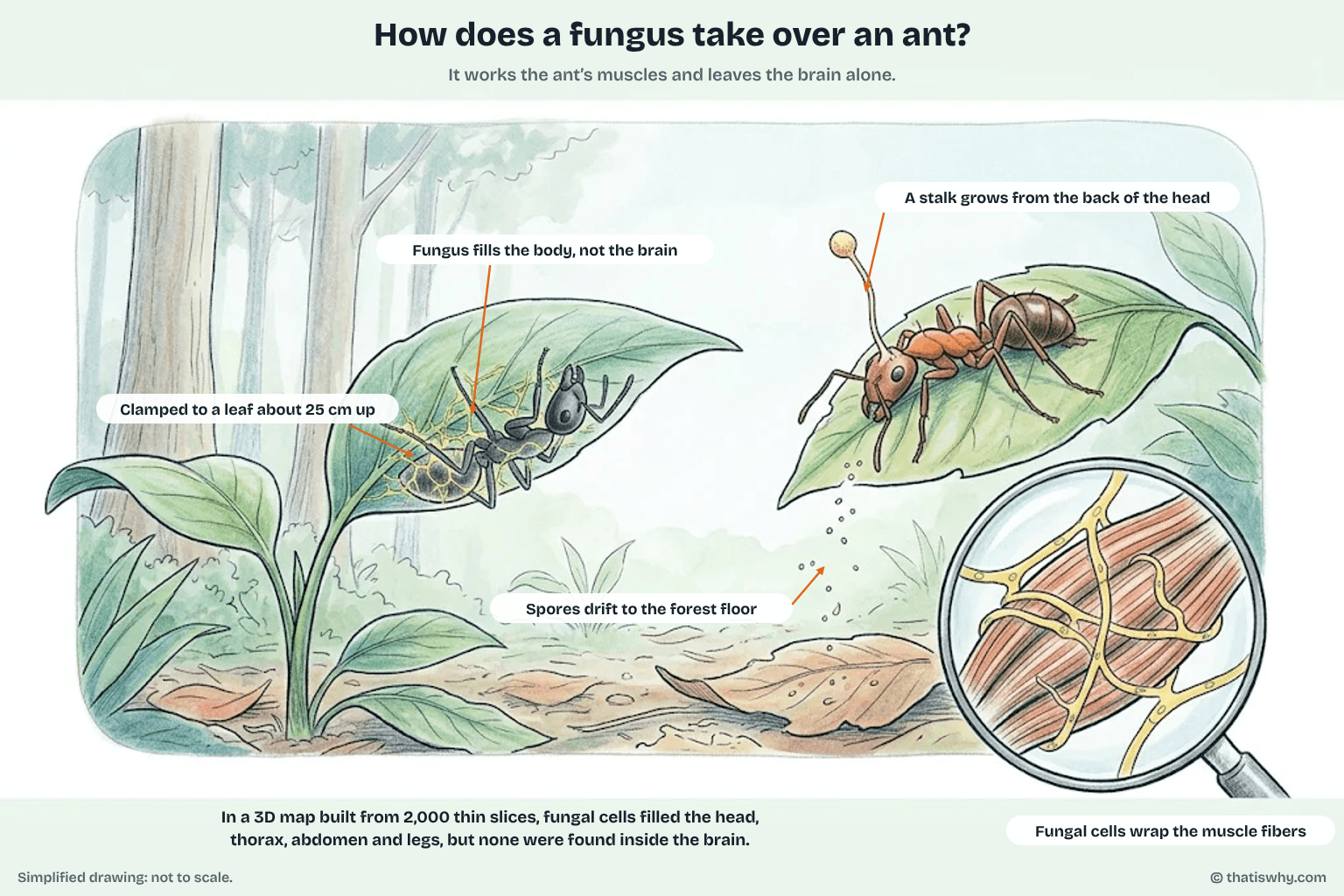
The detailed teaching diagram
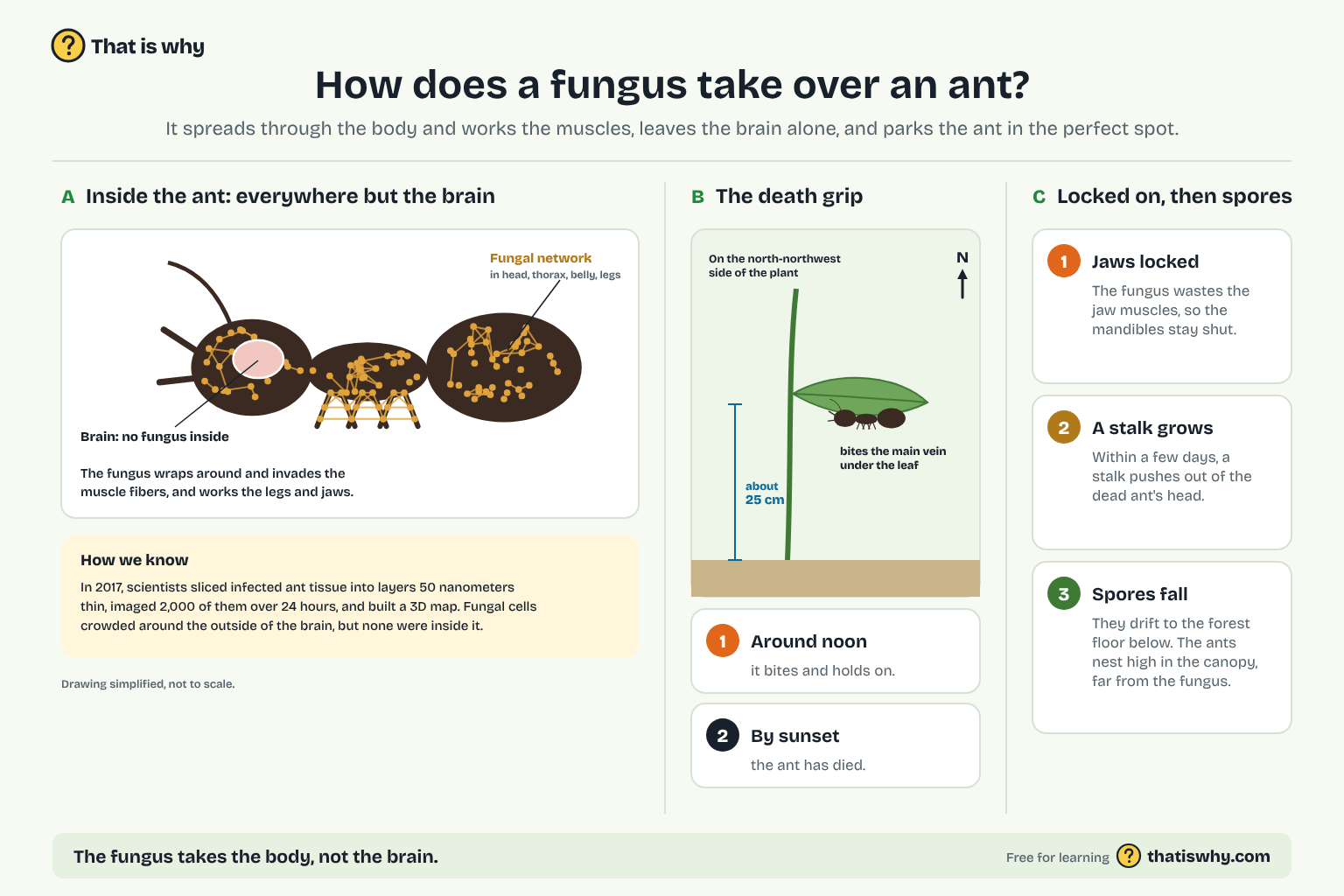
What the diagram shows
A. Inside the ant: everywhere but the brain. In 2017, scientists sliced infected ant tissue into layers 50 nanometers thin, imaged 2,000 of them over 24 hours and built a 3D map. Fungal cells of Ophiocordyceps unilateralis were in the head, thorax, abdomen and legs, linked into a network that surrounds and invades the muscle fibers. They crowded around the outside of the brain, but none were inside it. The fungus works the ant's legs and jaws. The drawing is simplified and not to scale.
B. The death grip. The infected ant climbs into the vegetation and, around noon, bites the main vein on the underside of a leaf, about 25 cm above the ground, on the north-northwest side of the plant. It dies by sunset.
C. Locked on, then spores. The fungus wastes away the jaw muscles, so the mandibles stay shut. Within a few days, a stalk pushes out of the dead ant's head, and its spores drift to the forest floor below. The ants nest high in the canopy, and when infected ants were moved higher up or down to the ground, the fungus failed to develop properly.
Key numbers
| Fact | Value |
|---|---|
| Thickness of each imaged slice | 50 nanometers |
| Slices imaged | 2,000, over 24 hours |
| Fungus found inside the brain | none |
| Height of the death grip | about 25 cm above the ground |
| Side of the plant | north-northwest |
| Time of the bite | around noon |
| Time of death | by sunset |
| Stalk appears | within a few days |
Common misconceptions
Myth The zombie ant fungus eats the ant's brain.
The truth In a 2017 study, fungal cells filled the ant's body, but none were found inside the brain.
Myth The fungus controls the ant's mind.
The truth It surrounds and invades the muscle fibers and works the legs and jaws; the brain is left in place.
Myth The spores rain down on the ant nest.
The truth These ants nest high in the canopy, far from where the fungus breeds. Spores drift down from the dead ant on its low leaf, onto passersby on the forest floor.
Questions to use in class
Tap a question to reveal a model answer.
1Does the zombie ant fungus go into the brain?
No. A 3D map of infected ants showed fungal cells in the head, thorax, abdomen and legs, crowded around the outside of the brain but not inside it.
2Where do zombie ants die?
About 25 cm above the ground, on the north-northwest side of plants, biting the main vein under a leaf.
3When do zombie ants bite and die?
They bite around noon and die by sunset.
4Why can't the ant let go?
The fungus wastes away the jaw muscles, so the mandibles can only stay closed.
Key terms
- Ophiocordyceps
- A group of fungi that infect carpenter ants, spread through their bodies and muscles while leaving the brain untouched, and make them die clamped to a leaf where the fungus can release its spores.
- Mandible
- An insect's jaw. Zombie ants clamp their mandibles onto a leaf vein, and the fungus wastes the jaw muscles so the jaws stay shut.
- Spore
- A tiny cell that a fungus releases to spread and start new growth. The zombie ant fungus drops its spores from a stalk on the dead ant's head onto the ground below.
Sources
- Zombie ant brains left intact by fungal parasite (Fredericksen et al., PNAS 2017) Penn State University
- Zombie ant fungus controls its host without invading the brain National Geographic
- How zombie ants lose their minds (Hughes et al., BMC Ecology 2011) Live Science
- Fungi turn ants into zombies (Andersen et al., The American Naturalist 2009) Ecological Society of America
- Parasite causes zombie ants to die in an ideal spot (Andersen et al., The American Naturalist 2009) EurekAlert! (University of Chicago Press Journals)