Free teaching diagram
Moth and Light Diagram: Why Moths Circle Lamps
Orbit, stall, flip: three ways a nearby bulb hijacks a moth's flight.
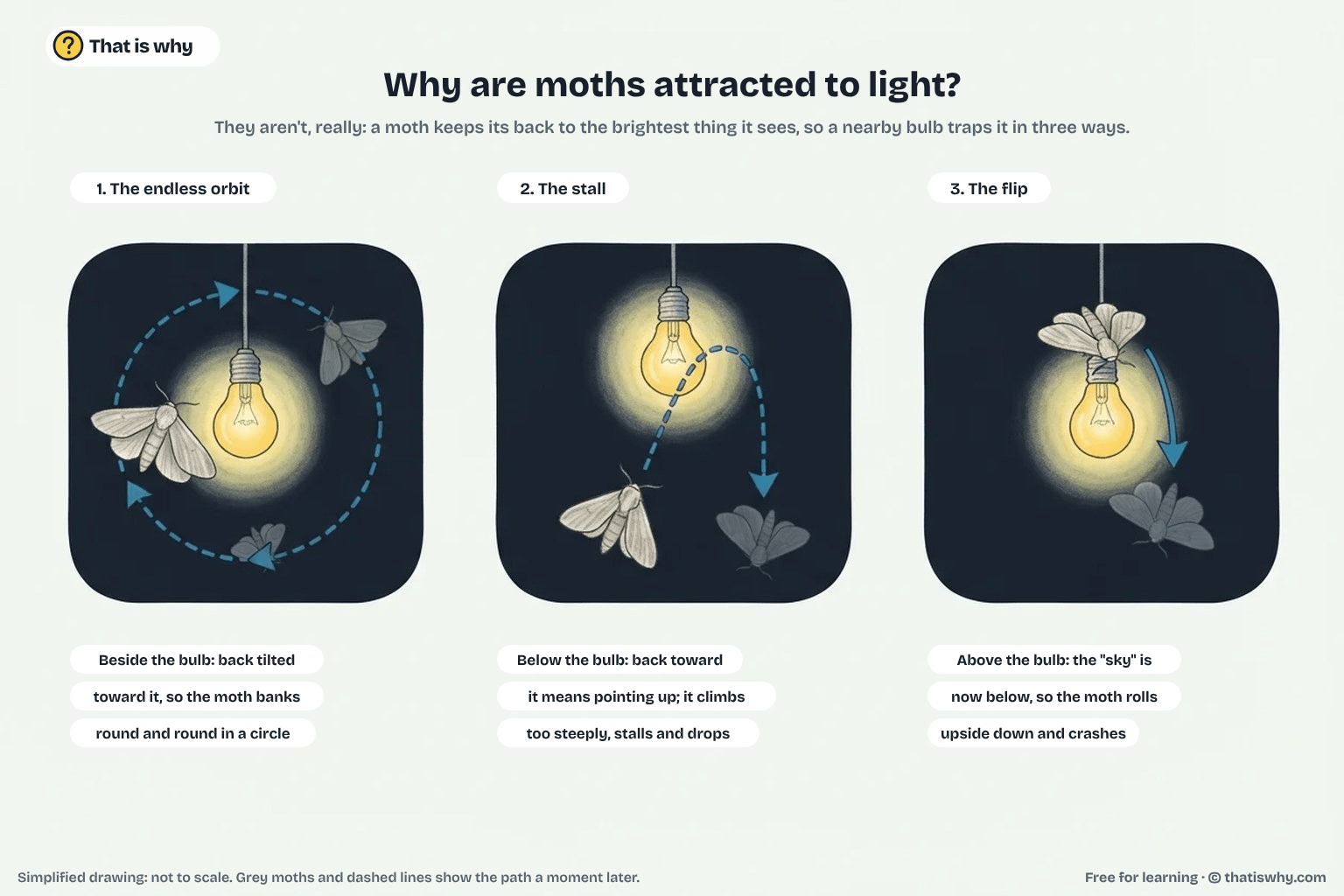
The detailed teaching diagram
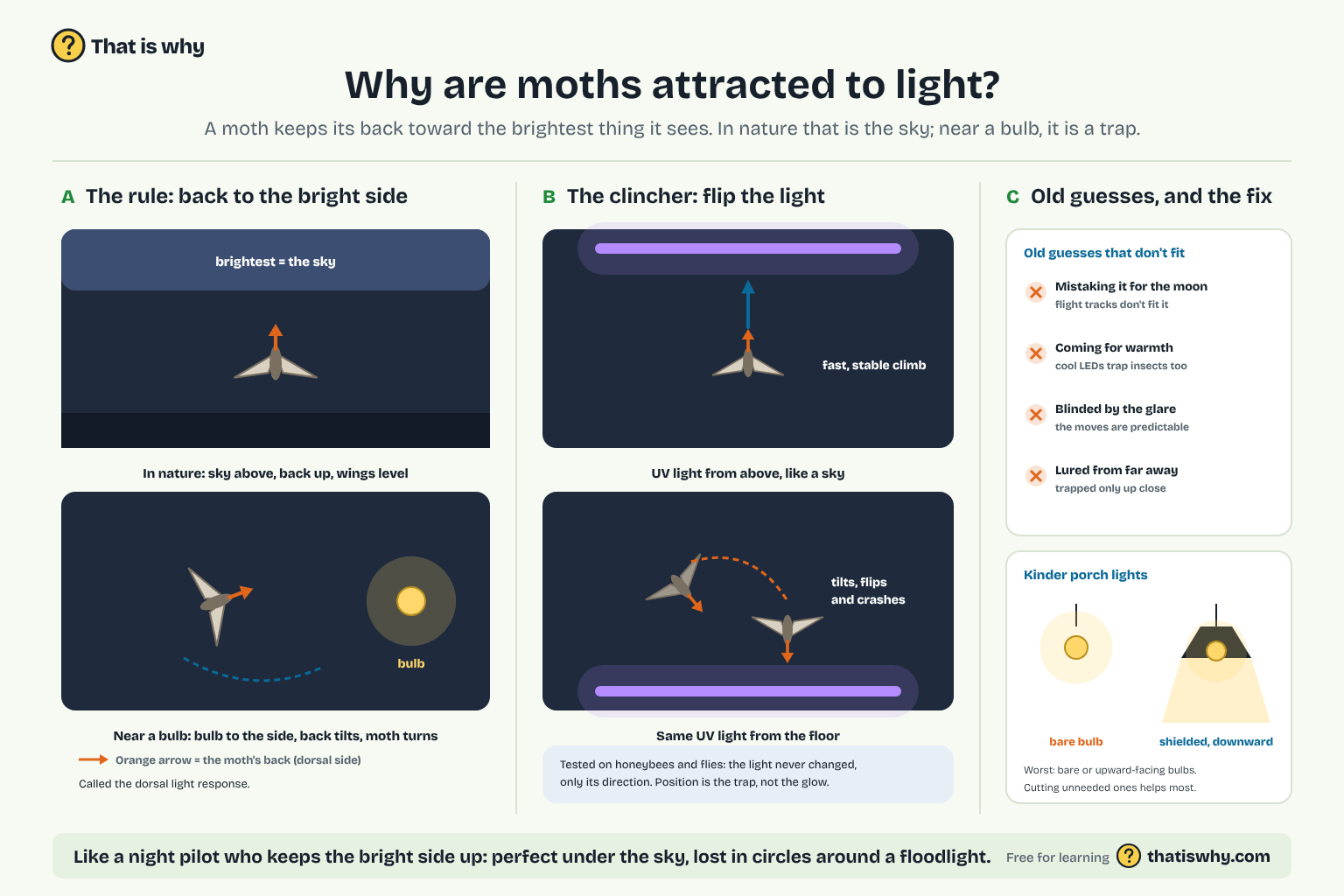
What the diagram shows
1. The endless orbit. A flying moth keeps its back toward the brightest thing it sees, a habit called the dorsal light response. Beside a bulb, that tilts its wings toward the light, and tilted wings mean a turn, so it circles.
2. The stall. Below a bulb, keeping its back to the light means pointing its body upward. The moth climbs steeper and steeper until it stalls and drops.
3. The flip. Above a bulb, the bright "sky" is suddenly below, so the moth rolls upside down and crashes. Bare and upward-facing lamps, a big part of light pollution, set this trap most often.
Key numbers
| Fact | Value |
|---|---|
| Ways a nearby light traps an insect | 3 (orbit, stall, flip) |
| Where the study was published | Nature Communications, 2024 |
| Where flights were filmed | Monteverde, Costa Rica, and a motion-capture lab |
| Insects used in the light-direction test | honeybees and flies |
| Housefly flight speed | hundreds of body lengths per second |
Common misconceptions
Myth Moths are drawn to light from far away.
The truth Researchers at Imperial College London found insects aren't attracted to light from far away; they get trapped when they fly close to it.
Myth Moths mistake a lamp for the moon.
The truth The new 3D flight tracks don't fit the moon idea. The insects simply keep their backs toward the brightest light they see.
Myth Moths come to lamps for the warmth.
The truth LED lights give off almost no heat and still trap huge numbers of insects.
Questions to use in class
Tap a question to reveal a model answer.
1Why do moths fly around lights?
A flying moth keeps its back toward the brightest thing it sees, which in nature is the sky. Beside a bulb, that tilts its back toward the light, so it banks into an endless circle.
2Why do moths crash into lights?
Below a bulb, keeping its back to the light points the moth upward until it stalls. Above a bulb, the brightest thing is below it, so the moth flips upside down and crashes.
3How did scientists prove it?
A team led by Sam Fabian and Yash Sondhi filmed insect flights in 3D around lights. When honeybees and flies had ultraviolet light shining down from above, they climbed in a stable way; with the same light glowing up from the floor, they tilted, flipped over and crashed.
4What kind of outdoor light is kindest to moths?
The researchers say the worst is an upward-facing or bare bulb. Cutting unnecessary, unshielded, upward-facing lights would help.
Key terms
- Dorsal light response
- The reflex that makes a flying insect turn its back (its dorsal side) toward the brightest part of its view. In nature that is the sky, so it keeps the insect level; a nearby lamp hijacks it.
- Light pollution
- Artificial light that spills into the night where it isn't needed, from streetlamps, houses, arenas and vehicles. It can disorient and trap flying insects.
Sources
- Why flying insects gather at artificial light (Fabian, Sondhi, Allen, Theobald and Lin, Nature Communications 2024) Nature Communications (abstract via RePEc IDEAS)
- Why flying insects gather at artificial light (preprint, full text) bioRxiv
- Flying insects become disorientated and trapped by artificial light Imperial College London
- Millennia-old mystery about insects and light at night gets new explanation Florida International University
- Why Insects Are Lured to Lights in the Night Scientific American