Free teaching diagram
Ant Colony Diagram: How Ants Work Together Like One Brain
No ant gives orders: each counts how often it meets nestmates, and the colony decides.
The detailed teaching diagram
What the diagram shows
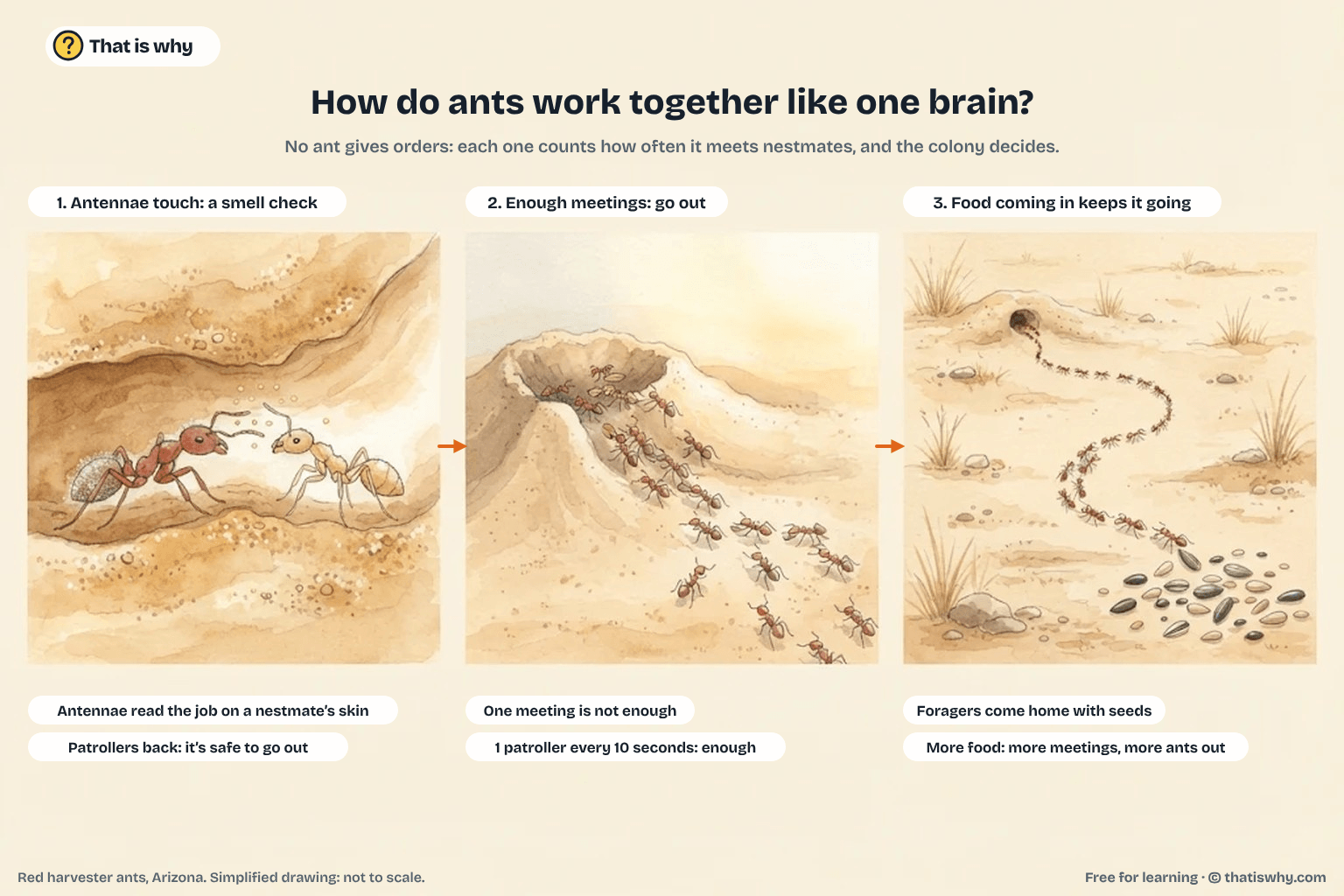
1. Antennae touch: a smell check. Most ants can't see, so they smell with their antennae. Each red harvester ant carries a film of cuticular hydrocarbons on its skin, and the mix differs slightly from job to job, so an ant can tell what a nestmate has been doing.
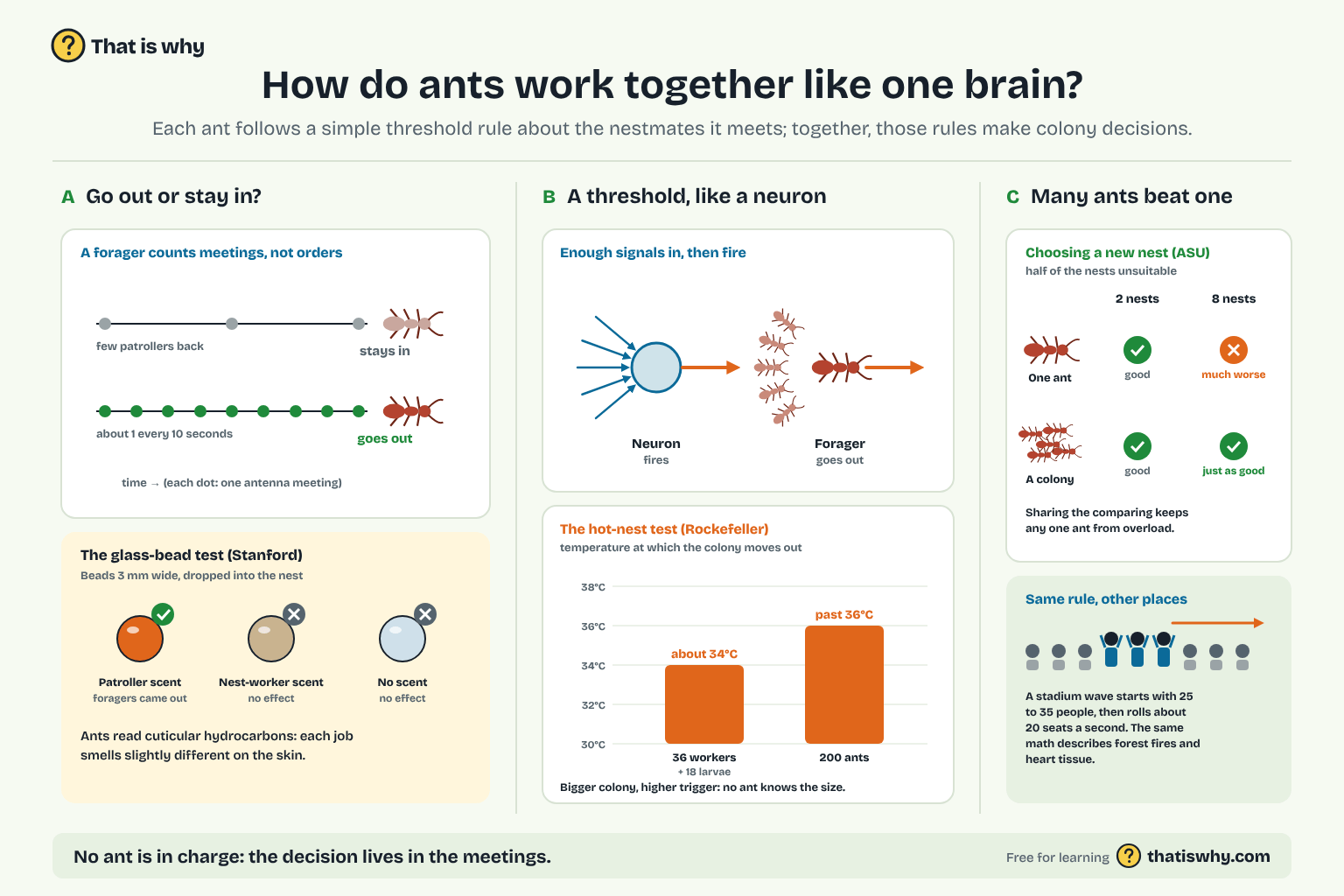
2. Enough meetings: go out. Early each morning, patrollers scout around the nest. One meeting with a returning patroller isn't enough to send a forager out, but a series of them is, about one every 10 seconds. A forager works like a neuron that fires once enough signals arrive.
3. Food coming in keeps it going. Foragers that come home quickly with seeds trigger more meetings, so more ants head out. No ant is in charge: the decision emerges from thousands of these small reactions, a kind of swarm intelligence.
Key numbers
| Fact | Value |
|---|---|
| Workers in a mature red harvester ant colony | 10,000 to 12,000 |
| Meeting rate that sends foragers out | about 1 patroller every 10 seconds |
| Width of the scented glass beads | 3 mm |
| Evacuation trigger, 36 workers and 18 larvae | about 34°C |
| Evacuation trigger, 200 ants | past 36°C |
| Nest choices in the overload test | 2 or 8 |
Common misconceptions
Myth The queen tells the colony what to do.
The truth A red harvester ant queen can live 20 years and produce thousands of new workers each year, but egg-laying is her only job. Decisions come from workers reacting to the ants around them.
Myth Ants give each other instructions when they meet.
The truth They read each other's scent with their antennae, and each ant responds to how often it meets ants doing a certain job.
Myth A colony is smart because every ant is smart.
The truth A single ant makes much worse choices when the options pile up. The colony's smarts come from how the ants are connected.
Questions to use in class
Tap a question to reveal a model answer.
1How do ants decide when to go out for food?
A red harvester ant forager waits until it has met enough returning patrollers or food-carrying foragers. About one patroller every 10 seconds is enough to send foragers out.
2Why is an ant colony compared to a brain?
Both have no central control. A neuron fires when enough signals arrive, and an ant acts when it meets enough nestmates, so many simple units add up to a decision.
3What did the glass-bead experiment show?
Glass beads 3 millimeters wide, coated with the scent of patroller ants, were enough to send foragers out, while beads with nest-worker scent or no scent were not.
4Are many ants better at choosing than one?
Yes. When choosing among eight possible nests, single ants made much worse choices than with two, while whole colonies did equally well with two or eight.
Key terms
- Emergence
- When a group shows an ability that none of its members has on its own, such as an ant colony deciding when to leave a hot nest although no single ant knows the colony's size.
- Cuticular hydrocarbons
- A thin film of simple hydrogen-and-carbon molecules on an insect's outer skin. In red harvester ants the mix differs slightly from job to job, so ants can smell what task a nestmate does.
- Swarm intelligence
- Smart group behavior that emerges when many simple individuals follow local rules, with no leader in charge.
Sources
- Ant colonies behave like neural networks when making decisions The Rockefeller University
- Where ant colonies keep their brains (Nicholas Weiler with Deborah Gordon) Wu Tsai Neurosciences Institute, Stanford University
- Cuticular Hydrocarbons Inform Task Decisions (Mark Shwartz) Stanford University News Service
- New research shows ants share decision-making to lessen 'information overload' Arizona State University, ASU News
- Doing the Wave (Ivars Peterson) Science News