Free teaching diagram
V Formation Diagram: Why Birds Fly in a V
Air off a wing, where to fly, and taking turns: the three parts of the V.
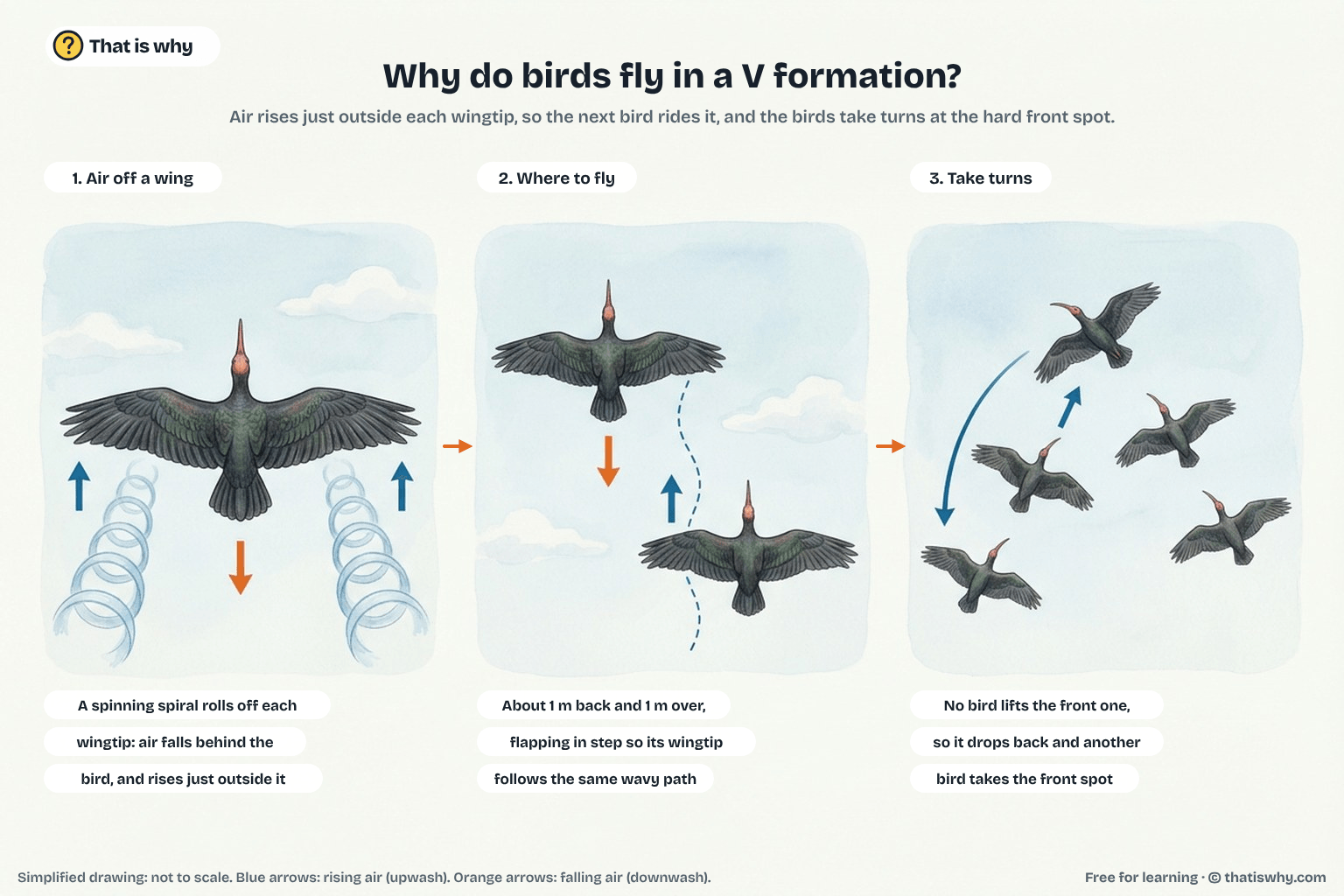
The detailed teaching diagram
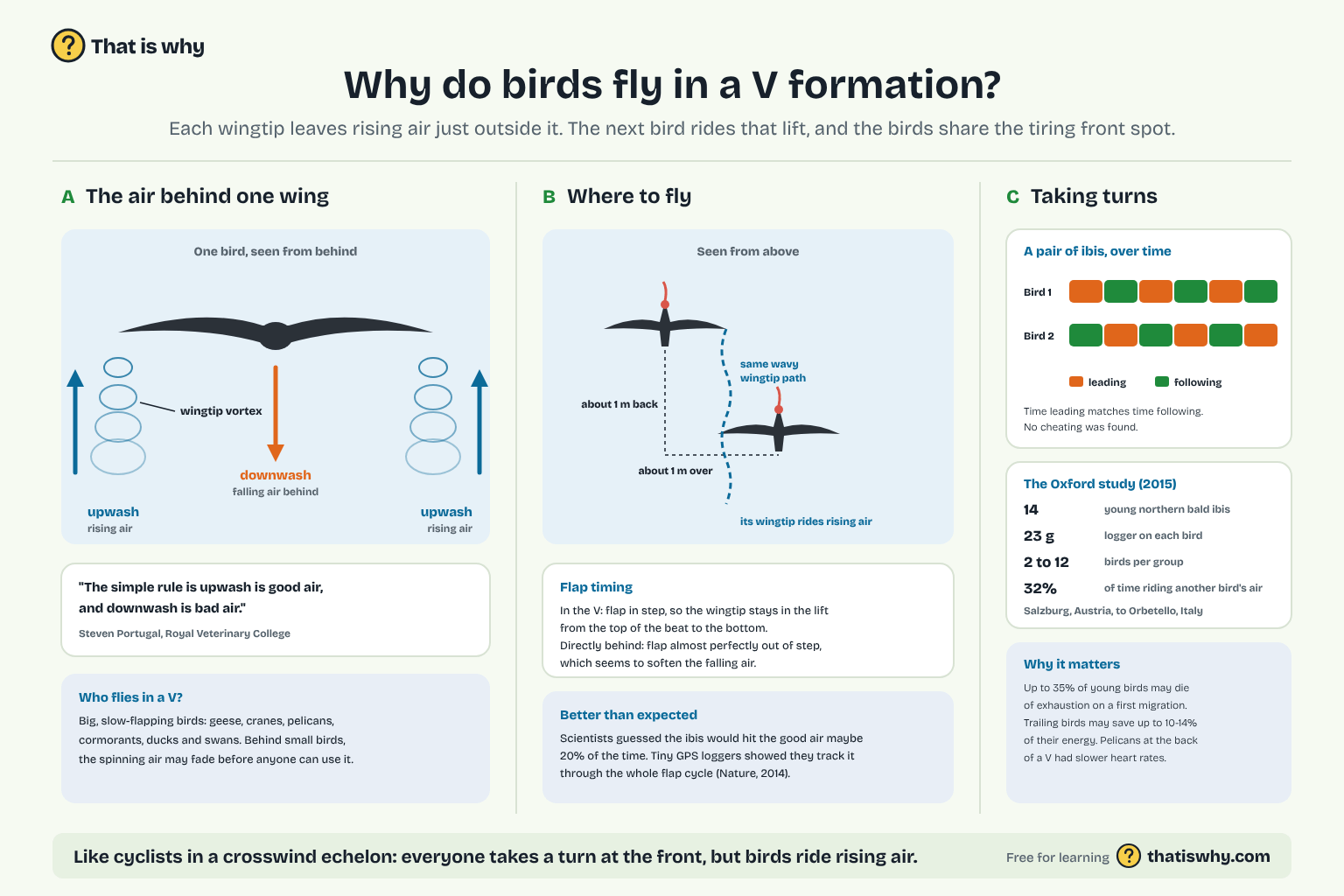
What the diagram shows
1. Air off a wing. A spinning spiral of air rolls off each flapping wingtip. Directly behind the bird the air falls, called downwash, and just outside the tip it rises, called upwash.
2. Where to fly. Northern bald ibises sit about 1 meter back and 1 meter to the side of the bird ahead. They flap in step so their wingtips follow the same wavy path and stay in the rising air through the whole beat.
3. Take turns. No bird lifts the one at the front, so the front spot is tiring. Birds swap places, and pairs match the time each spends leading and following, a trade called reciprocal altruism. That shared effort matters on a long migration, and it works without a boss, a classic case of collective behavior.
Key numbers
| Fact | Value |
|---|---|
| Spacing in an ibis V | about 1 m back and 1 m to the side |
| Good air expected vs found | maybe 20% of the time vs the whole flap cycle |
| Ibis in the Oxford study | 14 young birds, groups of 2 to 12 |
| Time each bird spent riding another bird's air | 32% on average |
| Possible energy saving for trailing birds | up to 10 to 14% |
| Young birds that may die of exhaustion on a first migration | up to 35% |
Common misconceptions
Myth The bird at the front is the flock's leader, the strongest bird in charge.
The truth In the ibis flocks, the birds swapped places a lot and the flock had no constant leader. The front spot is a hard shift that gets shared.
Myth The birds behind are drafting, like a cyclist tucked behind a wheel.
The truth Directly behind a bird the air is falling. The birds that save energy sit behind and off to the side, in the rising air.
Myth All migrating birds fly in a V.
The truth The famous Vs belong to big, slow-flapping birds like geese, cranes and pelicans. Behind a small bird, the spinning air may fade too fast to use.
Questions to use in class
Tap a question to reveal a model answer.
1Why do birds fly in a V formation?
To save energy. A spinning spiral of air rolls off each flapping wingtip, and just behind and to the side of the bird that air is rising. The next bird sits in that rising air and gets a little free lift on every wingbeat.
2Why don't birds fly directly behind each other?
Directly behind a bird, the air is pushed down, which is called downwash. A bird stuck there flaps out of step with the one ahead, which seems to soften the falling air.
3Who leads a V of birds?
No one bird for long. In northern bald ibis flocks, birds swapped places a lot, and birds flying in pairs matched the time each spent leading and following.
4How much energy does a V save?
Some studies suggest the birds trailing in a V can save up to 10 to 14% of their energy, and pelicans at the back of a V had slower heart rates than those in front.
Key terms
- Upwash
- Rising air just outside and behind a flying bird's wingtip, made by the spinning wingtip vortex. Directly behind the bird the air falls instead (downwash), so birds in a V sit off to the side to ride the upwash.
- Reciprocal altruism
- Helping another animal at a cost to yourself, then being helped back later. Northern bald ibis flying in pairs take turns in the tiring lead spot, matching the time each spends leading and following.
- Migration
- A regular, often seasonal journey between two areas, such as the Arctic tern's yearly trip between the Arctic and the Southern Ocean.
- Collective behavior
- Group movement that emerges when many animals follow simple rules with their neighbors, as in fish schools and starling flocks, without a single leader.
Sources
- Upwash exploitation and downwash avoidance by flap phasing in ibis formation flight (Portugal et al., Nature 2014) Nature
- Birds That Fly in a V Formation Use An Amazing Trick National Geographic
- One good turn: birds swap energy-sapping lead role (Voelkl et al., PNAS 2015) University of Oxford
- Scientists Solve Mystery of Birds' Flying V Smithsonian Magazine
- Why Do Birds Fly in a V Formation? Breaking Down a Brilliant Migration Hack Audubon