Free teaching diagram
Arctic Tern Migration Map: The Longest Animal Migration
Arctic terns fly about 70,000 km a year between the Arctic and the Southern Ocean, the longest known animal migration.
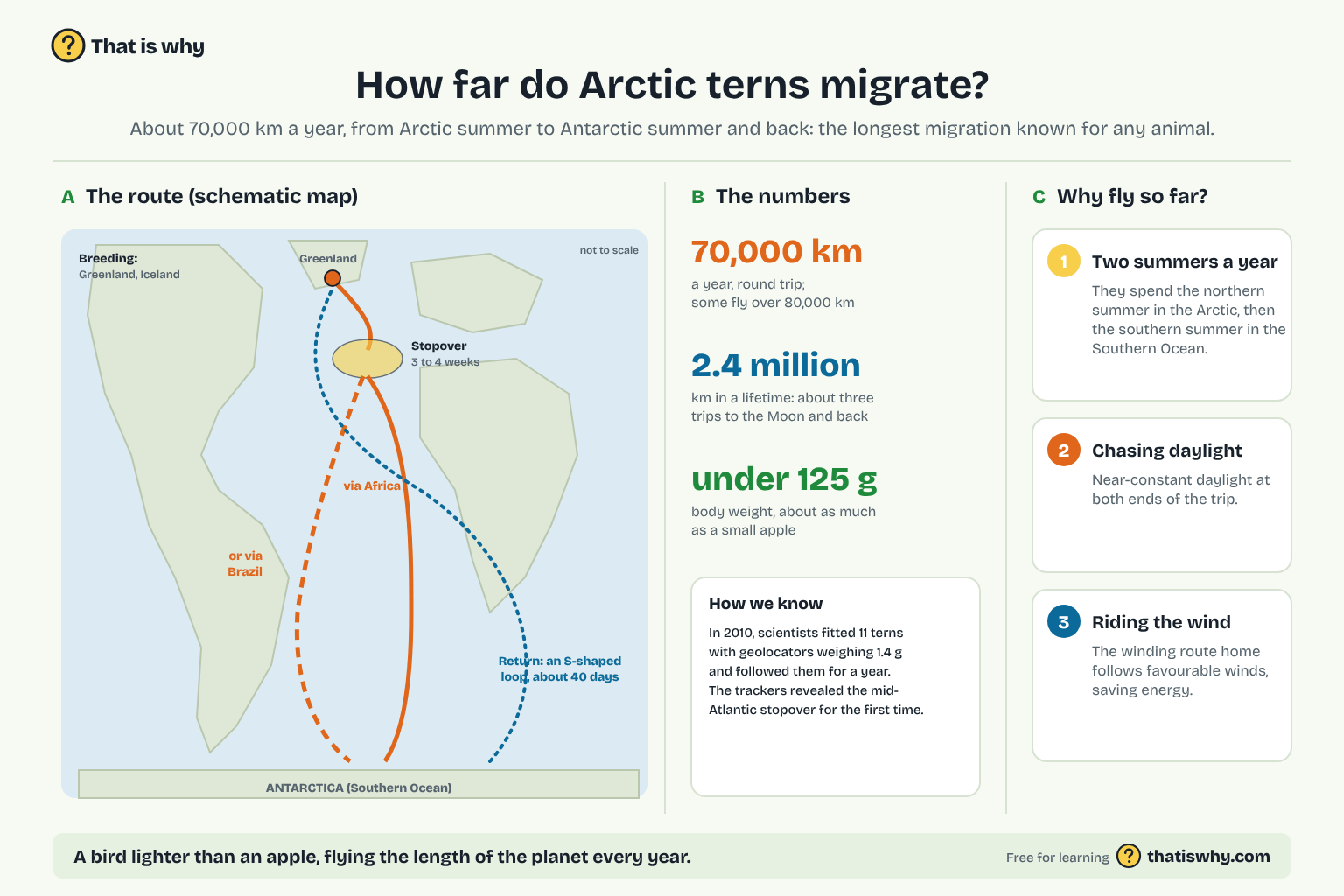
What the diagram shows
A. The route. Arctic terns breed in the far north, including Greenland and Iceland. After breeding they fly to a stopover in the middle of the North Atlantic, where they feed for 3 to 4 weeks. Then they head south by one of two routes, along the coast of Africa or along the coast of South America (Brazil), to spend the southern summer in the Southern Ocean near Antarctica. The return migration follows an S-shaped loop across the Atlantic, aided by favorable winds, and takes about 40 days.
B. The numbers. The round trip is about 70,000 km a year, and some birds fly more than 80,000 km. Over a lifetime that adds up to more than 2.4 million km, about three trips to the Moon and back, made by a bird weighing under 125 g. These routes were revealed in 2010, when scientists fitted 11 terns with geolocators weighing just 1.4 g.
C. Why fly so far? By following the sun between the poles, terns get two summers a year, with long days for feeding at both ends of the trip. Their winding route uses favorable winds to save energy.
Key numbers
| Fact | Value |
|---|---|
| Round trip | about 70,000 km a year (some over 80,000 km) |
| Lifetime distance | over 2.4 million km |
| North Atlantic stopover | 3 to 4 weeks |
| Return journey | about 40 days |
| Body weight | under 125 g |
Common misconceptions
Myth Arctic terns fly straight from pole to pole.
The truth Tracking showed a winding route: a long stopover in the North Atlantic, a choice of two routes south, and an S-shaped loop home that follows favorable winds.
Myth Only big birds can fly that far.
The truth Arctic terns weigh under 125 g, less than a small apple, yet some fly more than 80,000 km a year.
Myth Migrating birds fly non-stop.
The truth Arctic terns pause for 3 to 4 weeks at an ocean stopover to feed before continuing south.
Questions to use in class
Tap a question to reveal a model answer.
1Why might a bird gain from living in two summers each year?
Summers bring long days and plenty of food. By moving between the Arctic and Antarctic summers, the tern spends most of its life in daylight with good feeding.
2A tern lives 30 years and flies 70,000 km a year. How far is that in a lifetime?
About 2.1 million km (70,000 × 30), close to the 2.4 million km reported for long-lived birds.
3Why is the route home S-shaped instead of straight?
Following favorable winds across the Atlantic saves energy, even if the path is longer.
4How did scientists track such small birds?
With tiny geolocators weighing about 1.4 g that record light levels, from which the bird's position each day can be worked out.
Key terms
- Migration
- A regular, often seasonal journey between two areas, such as the Arctic tern's yearly trip between the Arctic and the Southern Ocean.
- Geolocator
- A tiny tag that records light levels, from which scientists can work out roughly where an animal was each day.
- Stopover
- A place where migrating animals pause to rest and feed before continuing their journey.
Sources
- Tracking of Arctic terns Sterna paradisaea reveals longest animal migration (Egevang et al., PNAS 2010) NERC Open Research Archive
- Chasing daylight: tiny trackers reveal the incredible flight plans of the Arctic tern National Geographic