Free teaching diagram
School vs Shoal Diagram: What's the Difference?
A shoal is a group of fish that stay together; a school is a shoal moving in step, the same way at the same speed.
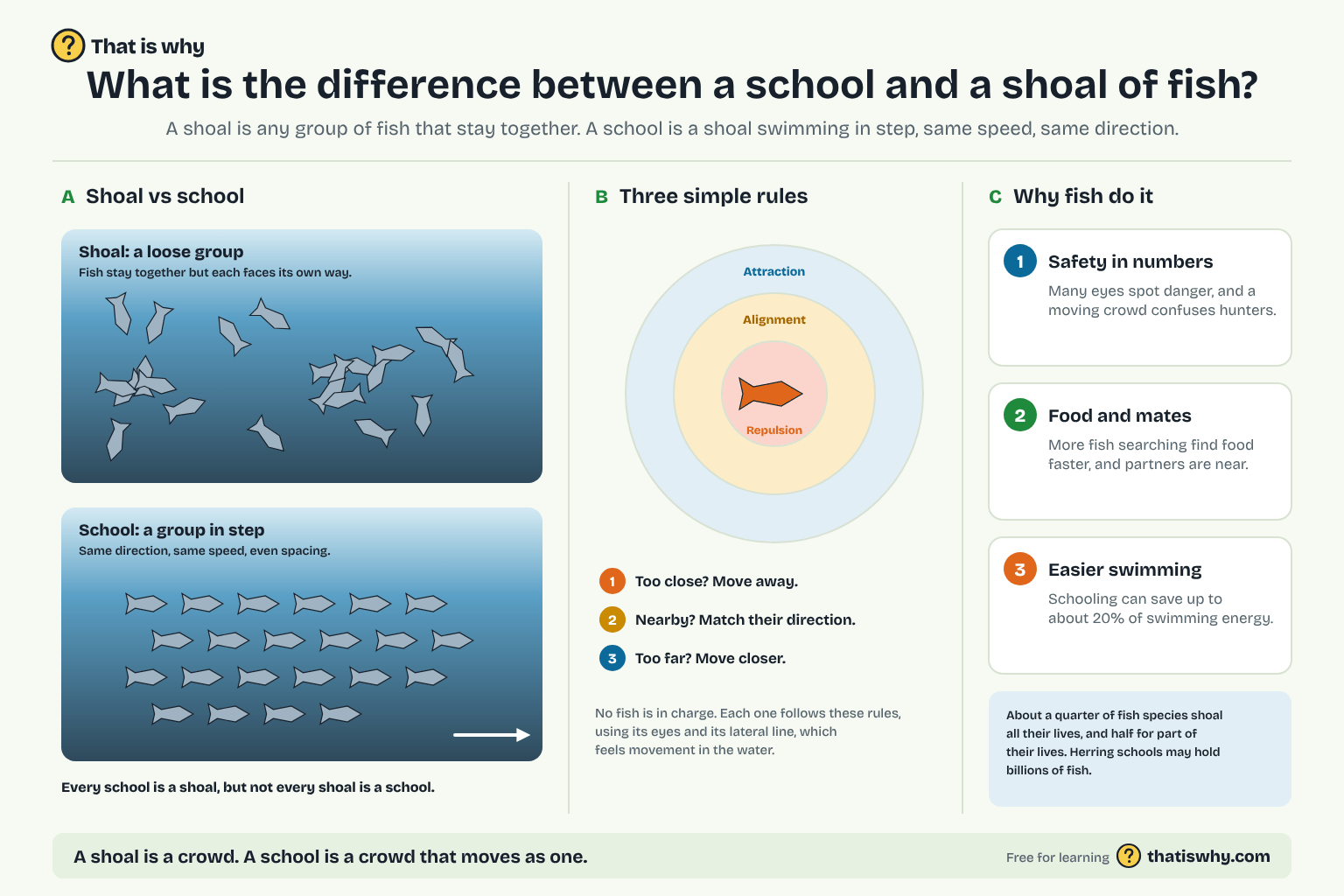
What the diagram shows
A. Shoal vs school. A shoal is any group of fish that stay together for social reasons. Each fish swims more or less on its own, facing its own way. A school is a shoal that becomes organized: the fish swim in the same direction, at the same speed and with even spacing, turning together as if they were one animal. So every school is a shoal, but not every shoal is a school. Many fish switch between the two, shoaling while they feed and schooling when they travel or sense danger.
B. Three simple rules. Schools have no fixed leader. Computer models reproduce schooling with three rules that each fish follows with its neighbors:
- Repulsion: too close? Move away.
- Alignment: nearby? Match their direction.
- Attraction: too far? Move closer.
Fish keep track of their neighbors with their eyes and their lateral line, a row of sense organs that feels movement in the water. Most schools lose their tight order after dark, which shows how much they rely on sight. This kind of group movement from simple rules is called collective behavior.
C. Why fish do it. Many eyes spot predators sooner, and a moving crowd confuses them. Groups find food faster and make it easier to find mates. Swimming in a school can also save up to about 20% of swimming energy. About a quarter of fish species shoal all their lives and about half for part of their lives, and North Atlantic herring schools have been estimated at up to three billion fish.
Shoal or school?
| Shoal | School | |
|---|---|---|
| Stay together | yes | yes |
| Same direction | not necessarily | yes |
| Same speed and spacing | no | yes |
| Example | fish feeding over a reef | sardines fleeing a predator |
Common misconceptions
Myth Shoal and school mean exactly the same thing.
The truth A shoal is any group of fish that stay together. A school is a shoal that swims in a coordinated way, in the same direction and at the same speed.
Myth A school follows one leader fish.
The truth There is no fixed leader. Each fish reacts to its neighbors using a few simple rules, and the fish at the front change over time.
Myth Fish stay in schools all the time.
The truth Many fish switch between loose shoals while feeding or resting and tight schools when traveling or threatened. Most schools also break up after dark.
Questions to use in class
Tap a question to reveal a model answer.
1Is every shoal a school? Is every school a shoal?
Every school is a shoal, because it is a group of fish staying together. But not every shoal is a school, because a shoal does not have to swim in step.
2Name the three rules each fish follows in a school.
Move away if too close (repulsion), match your neighbors' direction (alignment), and move closer if too far (attraction).
3Why might a large, moving school make it harder for a predator to catch one fish?
With so many fish moving and changing direction together, the predator struggles to pick out and follow a single target.
4What is the lateral line, and how does it help schooling?
It is a line of sense organs along each side of a fish that feels water movement and pressure changes, so a fish can sense its neighbors' movements even without seeing them.
Key terms
- Shoal
- Any group of fish that stay together for social reasons. The fish do not have to face the same way or move in step.
- School (of fish)
- A shoal of fish swimming in a coordinated way, in the same direction, at the same speed and with even spacing.
- Lateral line
- A row of sense organs along each side of a fish that detects water movement and pressure changes, helping it sense neighbors and predators.
- Collective behavior
- Group movement that emerges when many animals follow simple rules with their neighbors, as in fish schools and starling flocks, without a single leader.
Sources
- Shoaling and schooling Wikipedia
- From schooling to shoaling: patterns of collective motion in zebrafish (Miller & Gerlai, 2012) PLOS ONE (PubMed Central)