Free teaching diagram
Shark Electroreception Diagram: How Sharks Sense Electricity
A hidden fish's muscles leak a faint electric field, and jelly-filled pores on the shark's snout pick it up.
The detailed teaching diagram
What the diagram shows
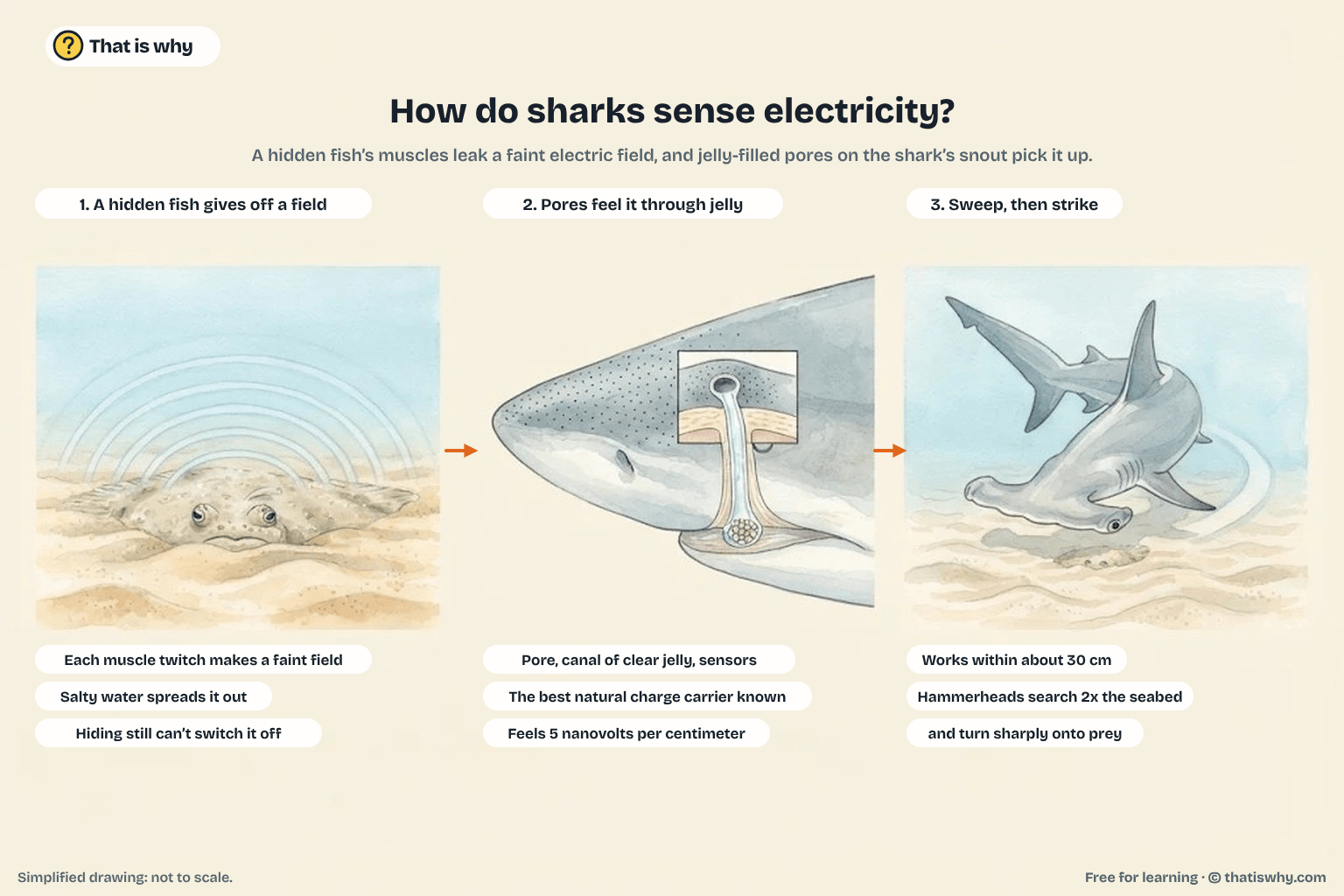
1. A hidden fish gives off a field. Every muscle in an animal runs on tiny electrical signals. In salty water, the faint electric field from a fish's muscles spreads out around it, even when the fish lies buried and perfectly still.
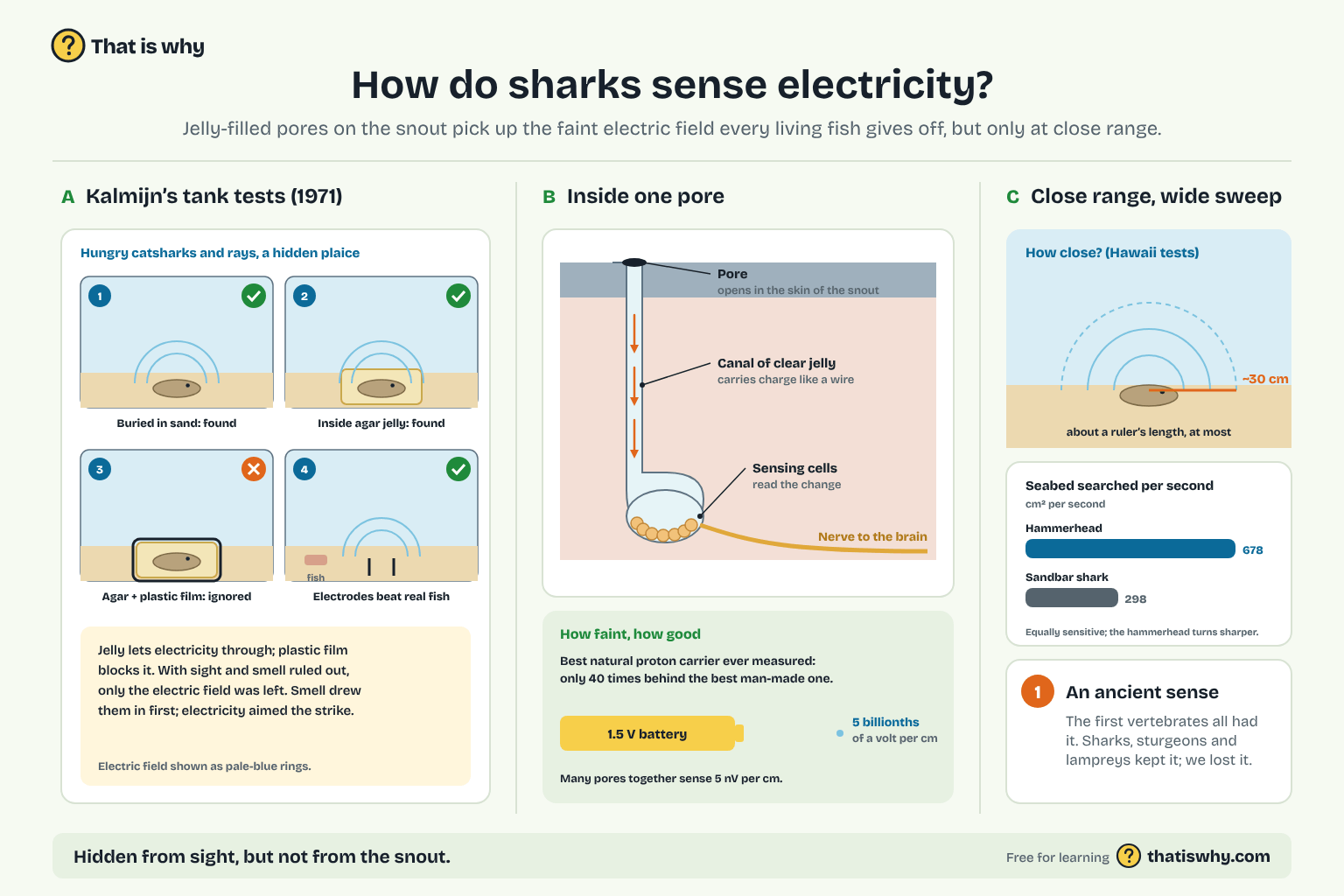
2. Pores feel it through jelly. A shark's snout is dotted with pores, the ampullae of Lorenzini. Each one opens into a long canal of clear jelly that leads to a cluster of sensing cells. The jelly carries electrical charge better than any other natural material ever measured, and together the pores can detect fields as small as 5 nanovolts per centimeter. This sense is called electroreception.
3. Sweep, then strike. The sense only works up close, about 30 centimeters at most, so a shark sweeps its snout low over the seabed. A hammerhead's wide head searches more than twice as much seabed per second as a sandbar shark's and turns more sharply onto prey. The sense develops in the embryo the same way as the lateral line, a row of sensors that feels moving water.
Key numbers
| Fact | Value |
|---|---|
| Smallest field sharks, skates and rays detect | 5 nanovolts per centimeter |
| Maximum distance for turning toward a hidden source | about 30 cm |
| Seabed searched per second, scalloped hammerhead | 677.8 cm² |
| Seabed searched per second, sandbar shark | 298.0 cm² |
| Jelly conductivity compared with the best man-made material | only 40 times lower |
| Year of Kalmijn's tank-test paper | 1971 |
Common misconceptions
Myth Sharks use electricity to track prey from far away.
The truth The electric sense works only at close range, about 30 centimeters at most in tests in Hawaii. Smell and other senses bring a shark close first.
Myth The hammerhead's wide head makes it more sensitive to electricity.
The truth Young hammerheads and sandbar sharks were equally sensitive. The hammerhead searched more than twice as much seabed per second and turned more sharply.
Myth A magnetic or electric shark repellent makes you shark-proof.
The truth Some devices repel some sharks under certain conditions. In 2016, a Florida teenager was bitten while wearing a shark repellent device.
Questions to use in class
Tap a question to reveal a model answer.
1How do sharks sense electricity?
Through jelly-filled pores on the snout called the ampullae of Lorenzini. Each pore leads down a jelly-filled canal to sensing cells that pick up the faint electric fields made by other animals' muscles.
2How weak an electric field can a shark detect?
Sharks, skates and rays can detect changes in an electric field as small as 5 nanovolts per centimeter.
3How was the shark's electric sense discovered?
In tests published in 1971, Adrianus Kalmijn showed that catsharks and rays found a buried plaice even inside an agar chamber, but not when it was covered with plastic film, and that they attacked electrodes copying a fish's field.
4Why can't land animals hunt by electricity?
Air carries electricity poorly, so an animal's faint electric field doesn't spread around it. In salty water it does.
Key terms
- Electroreception
- The ability to sense electric fields. The platypus uses about 40,000 electroreceptors on its bill to find prey in the dark.
- Ampullae of Lorenzini
- Small pores on the heads of sharks, skates and rays, each joined by a long jelly-filled canal to a cluster of sensing cells. They detect the faint electric fields made by other animals.
- Lateral line
- A row of sense organs along each side of a fish that detects water movement and pressure changes, helping it sense neighbors and predators.
Sources
- The Electric Sense of Sharks and Rays (A. J. Kalmijn, Journal of Experimental Biology 1971) The Company of Biologists
- The Discovery of the Shark's Electric Sense American Scientist
- Electroreception in juvenile scalloped hammerhead and sandbar sharks (Kajiura and Holland, Journal of Experimental Biology 2002) Florida Atlantic University
- Proton-conducting material found in jelly that fills organs of sharks, skates and rays University of Washington
- UF scientists trace origin of shark's electric sense University of Florida