Free teaching diagram
Pufferfish Diagram: How a Pufferfish Puffs Up
Gulp, unfold, swell: how a pufferfish turns into a ball too wide to bite.
The detailed teaching diagram
What the diagram shows
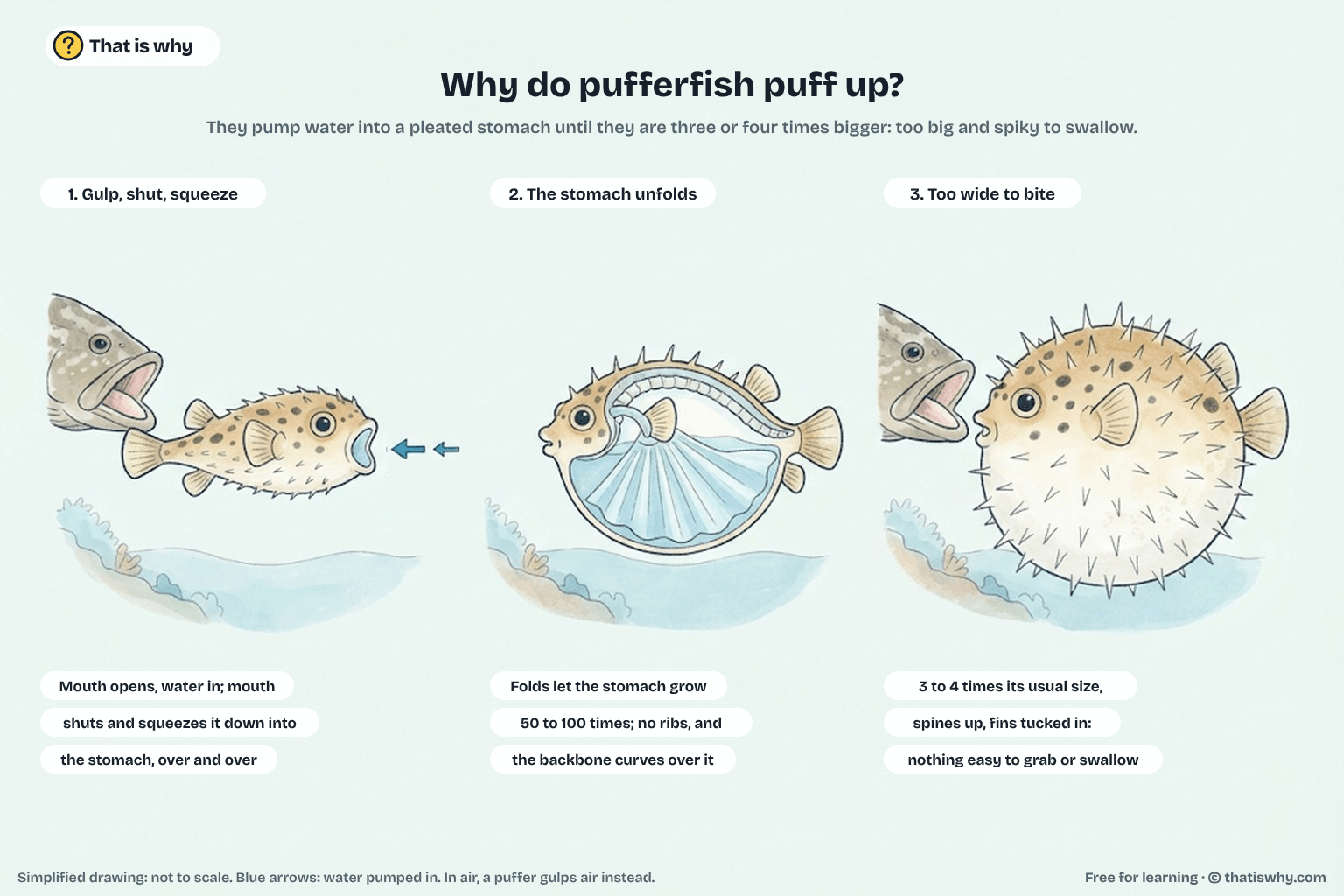
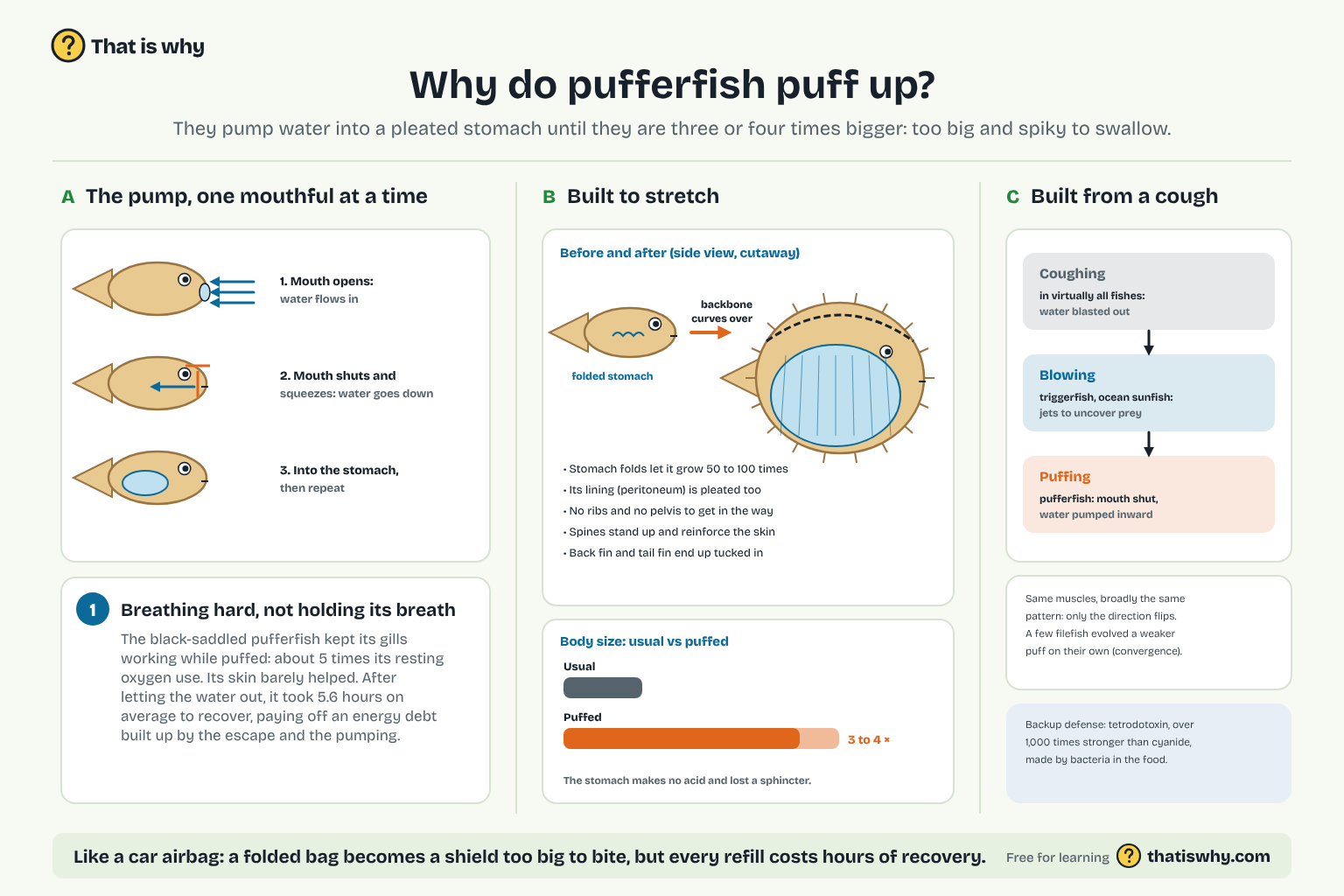
1. Gulp, shut, squeeze. A pufferfish puffs up by buccal pumping: it opens its mouth to take in water, shuts it, and squeezes the water down into its stomach, mouthful after mouthful. Out of the water, it gulps air instead.
2. The stomach unfolds. The stomach's many folds let it expand 50 to 100 times, and the belly lining unfurls too. With no ribs and no pelvis, nothing cages the swelling stomach, and the flexible backbone curves over it. All the while, the fish keeps breathing hard through its gills.
3. Too wide to bite. The fish ends up three or four times its usual size, spines up and fins tucked in. Afterward it pays an oxygen debt from anaerobic metabolism, taking hours to recover. A few filefish evolved a weaker puff of their own, a case of convergent evolution, and many puffers also carry tetrodotoxin as a backup defense.
Key numbers
| Fact | Value |
|---|---|
| Puffed size | 3 to 4 times usual size |
| How far the stomach can expand | 50 to 100 times |
| Oxygen use while puffed (black-saddled pufferfish) | about 5 times resting |
| Average recovery after deflating | 5.6 hours |
| Strength of tetrodotoxin | over 1,000 times more powerful than cyanide |
Common misconceptions
Myth Pufferfish fill themselves with air.
The truth In the sea they pump in water. They gulp air only when they are out of the water.
Myth A puffed-up pufferfish holds its breath.
The truth The black-saddled pufferfish kept its gills working while inflated, taking up about five times as much oxygen as at rest, and its skin barely helped.
Myth Pufferfish make their own poison.
The truth Their tetrodotoxin is produced by bacteria that live on the food they eat. Puffers collect it and are immune to it thanks to a genetic mutation.
Questions to use in class
Tap a question to reveal a model answer.
1How does a pufferfish puff up?
It pumps mouthful after mouthful of water into its stomach: it opens its mouth to take water in, shuts it, and squeezes the water down into a stomach whose folds let it expand 50 to 100 times.
2How big can a pufferfish get when it puffs up?
London's Natural History Museum says pufferfish can swell to three or four times their usual size, which makes them too big and spiky for most predators to swallow.
3Can a pufferfish breathe when it is puffed up?
Yes. A 2014 study found the black-saddled pufferfish took up oxygen through its gills at about five times its resting rate while inflated, then needed 5.6 hours on average to recover.
4How did pufferfish evolve to puff up?
From the cough that almost all fishes use to blast water out. Puffer relatives turned it into water blowing, and pufferfish flipped the direction, keeping the mouth shut and pumping the water into the stomach instead.
Key terms
- Buccal pumping
- Using the mouth and throat as a pump: the animal takes in a mouthful, closes its mouth and squeezes. Pufferfish use it to force water down into their stomachs and puff up.
- Gills
- Feathery organs that take oxygen from water into the blood and release carbon dioxide. Most fish depend on them entirely.
- Anaerobic metabolism
- Getting energy from food without using oxygen. In most animals it makes lactic acid; goldfish and crucian carp make alcohol instead.
- Convergent evolution
- When unrelated living things evolve similar features on their own, by different routes. Octopuses and humans evolved big, clever brains separately, after more than 600 million years apart.
- Tetrodotoxin
- A powerful nerve poison found in many pufferfish and some other animals, such as the blue-ringed octopus. It is made by bacteria, and puffers collect it through their food.
Sources
- Pufferfish: the underwater balloon of death Natural History Museum, London
- All puffed out: do pufferfish hold their breath while inflated? (McGee and Clark, Biology Letters 2014) Biology Letters (via PubMed Central)
- A Swell Adaptation Marine Science Institute, The University of Texas at Austin
- Evolution of pufferfish inflation behavior (Wainwright and Turingan, Evolution 1997) Wainwright Lab, University of California, Davis
- Pufferfish Don't Need Functional Stomach, Inflate Instead The Scientist