Free teaching diagram
Seahorse Diagram: Why Male Seahorses Get Pregnant
She makes the eggs, he carries and feeds them, so she can start the next batch right away.
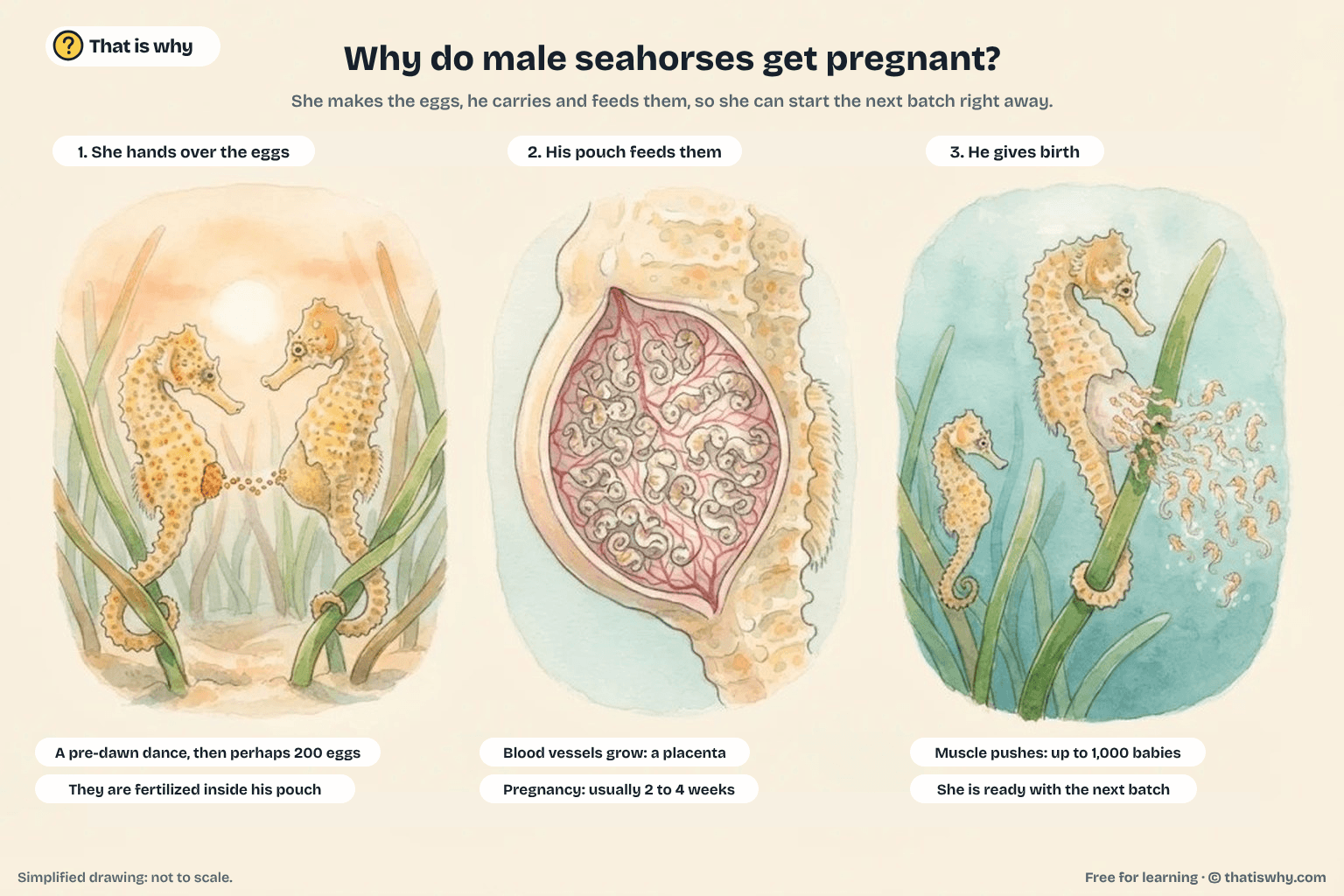
The detailed teaching diagram
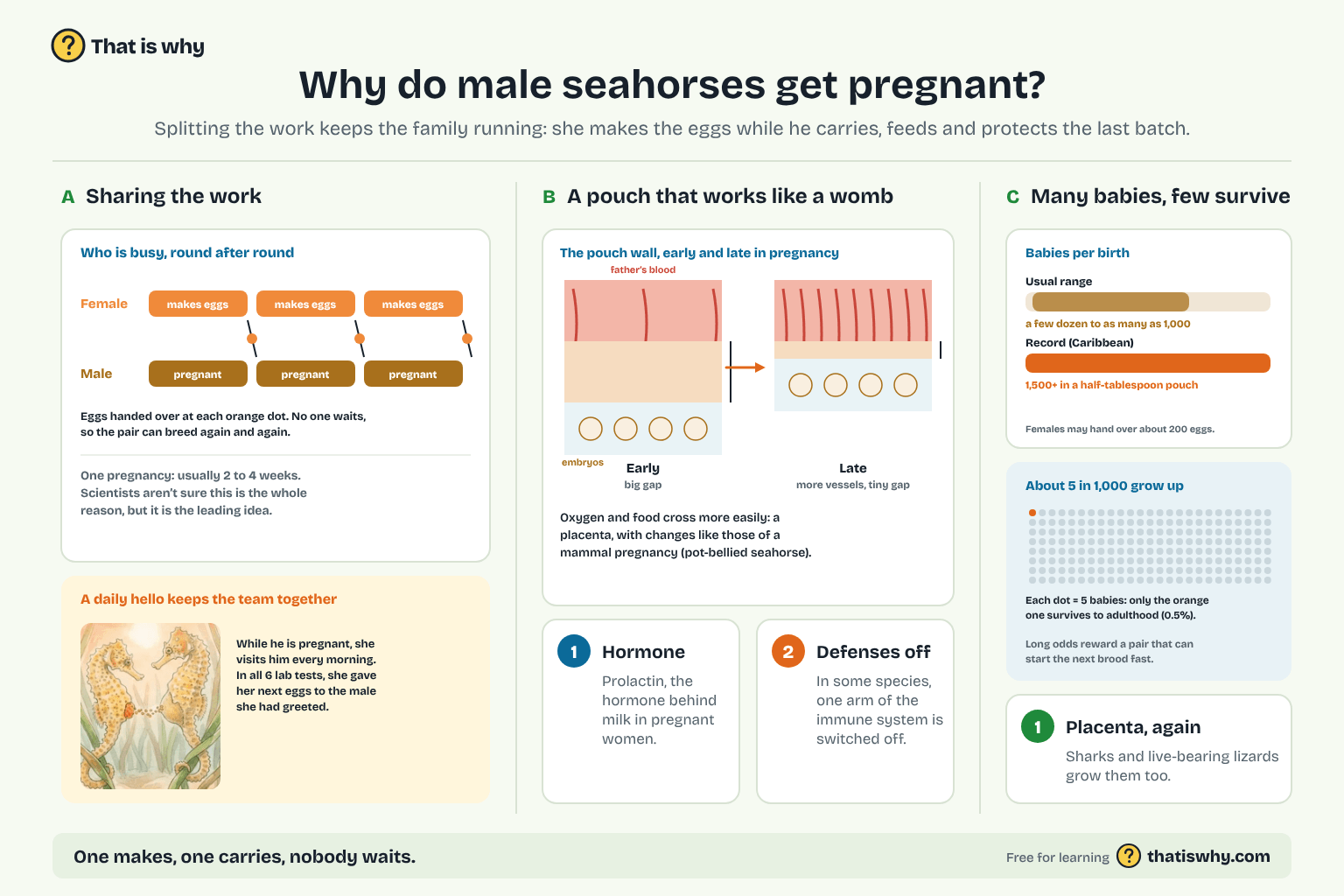
What the diagram shows
1. She hands over the eggs. After a dance at dawn, the female passes her eggs, perhaps 200 of them, into a pocket on the male's belly, his brood pouch. The eggs are fertilized there, inside his body.
2. His pouch feeds them. During a pregnancy of usually two to four weeks, small blood vessels grow in the pouch wall and the gap between the father's blood and his embryos shrinks. The pouch becomes a placenta, passing oxygen and food to the babies. Sharks and live-bearing lizards grow placentas too, an example of convergent evolution.
3. He gives birth. Muscular contractions push out from a few dozen to as many as 1,000 fully formed babies. Meanwhile, the female has been preparing her next batch of eggs, so the pair can start again almost at once. That matters, because only about 0.5 percent of the babies survive to adulthood.
Key numbers
| Fact | Value |
|---|---|
| Eggs handed over | perhaps 200 |
| Length of pregnancy | usually 2 to 4 weeks |
| Babies per birth | a few dozen to as many as 1,000 |
| Record brood | more than 1,500 (Caribbean male) |
| Babies that survive to adulthood | about 0.5% |
| Known seahorse species | 47 |
Common misconceptions
Myth The male only babysits eggs the female already laid.
The truth The eggs are fertilized inside his pouch, and placenta-like tissue then supplies the babies with oxygen and food.
Myth Hundreds of babies means seahorses are everywhere.
The truth Only about 0.5 percent of baby seahorses survive to adulthood, and many, if not all, of the 47 known species are in decline.
Myth Seahorses are the only males that get pregnant.
The truth Their close relatives in the same fish family, including pipefishes and seadragons, carry the young too.
Questions to use in class
Tap a question to reveal a model answer.
1Why do male seahorses get pregnant?
The leading idea is that sharing the work shortens the breeding cycle: while the male carries the young, the female can prepare her next batch of eggs.
2How long is a seahorse pregnancy?
Usually two to four weeks. Then strong muscular contractions push out from a few dozen to as many as 1,000 fully formed babies.
3Do male seahorses have a placenta?
Yes. In pot-bellied seahorses, small blood vessels grow in the pouch, especially late in pregnancy, and the gap between the father's blood and the embryos shrinks.
4How many baby seahorses survive?
Only about 0.5 percent survive to adulthood, which is why each birth brings so many babies.
Key terms
- Brood pouch
- A pocket of skin on the belly of a male seahorse, or its close relatives, where the female places her eggs. The eggs are fertilized there, and the father carries the young until he gives birth.
- Placenta
- An organ that links a parent's blood supply to a baby growing inside them, passing over oxygen and food. Most mammals have one, and so do some sharks, live-bearing lizards and pregnant male seahorses.
- Convergent evolution
- When unrelated living things evolve similar features on their own, by different routes. Octopuses and humans evolved big, clever brains separately, after more than 600 million years apart.
Sources
- How do seahorses differ from all other animals? NOAA National Ocean Service
- Pregnant male seahorses support growing babies by forming placenta (Camilla Whittington and Jessica Suzanne Dudley) The University of Sydney
- Pregnant—and Still Macho (Susan Milius) Science News
- Seahorse Fathers Take Reins in Childbirth National Geographic
- Q&A: The curious case of male pregnancy in seahorses and pipefishes (interview with Olivia Roth) Horizon, the EU Research and Innovation Magazine