Free teaching diagram
Octopus Brain Diagram: Why Octopuses Are So Smart
One brain sets the goal, a nerve cord in every arm works out the details, and each sucker has its own patch of nerves.
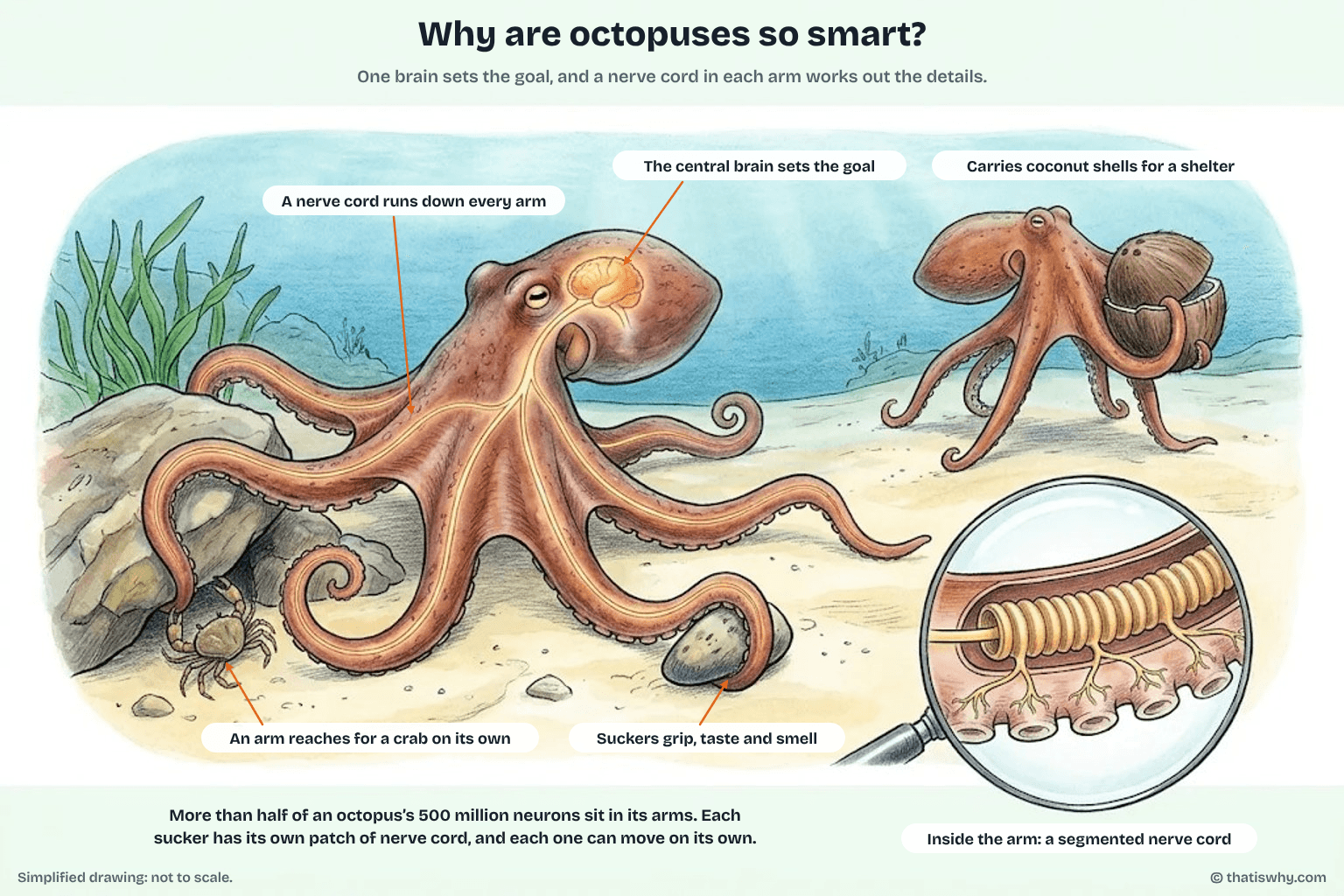
The detailed teaching diagram
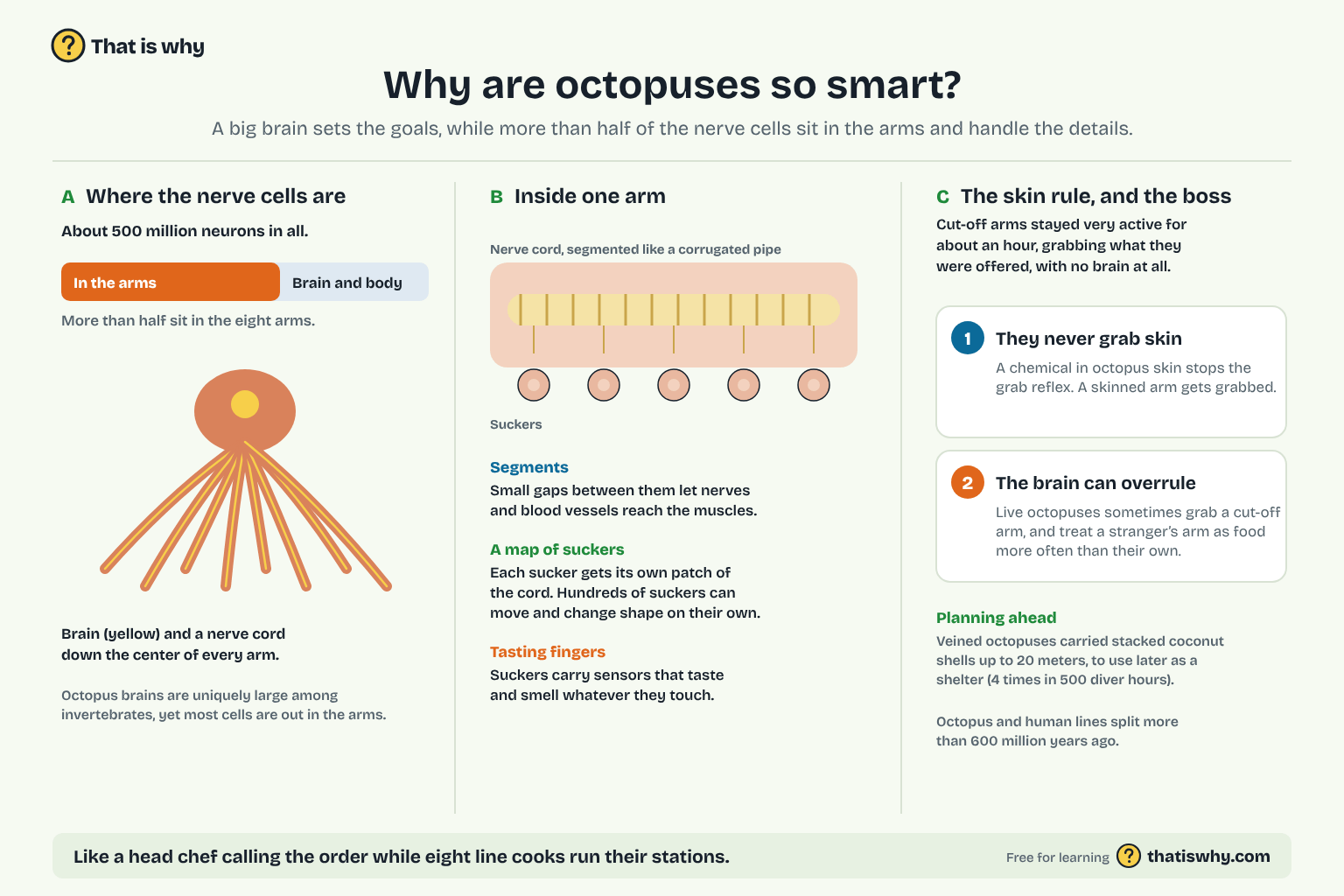
What the diagram shows
A. Where the nerve cells are. An octopus has about 500 million neurons, and more than half of them sit in its eight arms. Octopus brains are uniquely large among invertebrates, the animals without backbones, yet most of the nerve cells work out in the arms.
B. Inside one arm. Down the center of each arm runs the axial nerve cord. In the California two-spot octopus, its nerve cells form segments "like a corrugated pipe," with small gaps where nerves and blood vessels reach the nearby muscles. Each sucker gets its own patch of the cord, so the octopus can move and reshape hundreds of suckers on their own, and each sucker can taste and smell what it touches.
C. The skin rule, and the boss. Cut-off arms stayed very active for about an hour, grabbing what they were offered with no brain at all, but they never grabbed octopus skin, because a chemical in the skin stops the grab reflex. Live octopuses can overrule that rule: they sometimes grab a cut-off arm, and they treat a stranger's arm as food more often than their own. The brain also plans ahead, as when veined octopuses carry coconut shells up to 20 meters to use later as a shelter. As a cephalopod, the octopus built this mind by convergent evolution, on a line that split from ours more than 600 million years ago.
Key numbers
| Fact | Value |
|---|---|
| Neurons in an octopus | about 500 million |
| Share in the arms | more than half |
| Cut-off arms stay active | about an hour |
| Coconut shells carried | up to 20 meters |
| Diver hours in the coconut study | 500 |
| Time since octopus and human lines split | more than 600 million years |
Common misconceptions
Myth An octopus has nine brains.
The truth It has one central brain plus a nerve cord in each of its eight arms that handles the details.
Myth The arms run the show and the brain just watches.
The truth The brain sets the goals and can overrule the arms, for example by grabbing a cut-off arm.
Myth Octopuses must tangle their sticky arms.
The truth A chemical in octopus skin stops the suckers from grabbing it.
Questions to use in class
Tap a question to reveal a model answer.
1How many neurons does an octopus have, and where are they?
About 500 million, and more than half of them are in the arms.
2What runs down the middle of each octopus arm?
The axial nerve cord, a main cable of nerve cells grouped into segments like a corrugated pipe.
3Why don't octopus arms stick to each other?
Something in octopus skin stops the suckers' grabbing reflex.
4How do we know octopuses plan ahead?
Veined octopuses carry coconut shells up to 20 meters to use later as a shelter.
Key terms
- Neuron
- A nerve cell: the basic unit of a nervous system, which carries signals around the body. An octopus has about 500 million, more than half of them in its arms.
- Axial nerve cord
- The main cable of nerve cells running down the center of each octopus arm. Its cells are grouped into segments, and it controls the arm and its suckers with little help from the brain.
- Cephalopod
- The group of soft-bodied mollusks that includes octopuses, squid and cuttlefish. Their ancestors lost their protective shells and evolved brains that are uniquely large among invertebrates.
- Convergent evolution
- When unrelated living things evolve similar features on their own, by different routes. Octopuses and humans evolved big, clever brains separately, after more than 600 million years apart.
Sources
- Thinking like an octopus Harvard Gazette (Harvard University)
- UChicago scientists reveal nervous system secrets that give octopus arms their incredible dexterity (Olson, Schulz and Ragsdale, Nature Communications 2025) University of Chicago
- Self-recognition mechanism between skin and suckers prevents octopus arms from interfering with each other (Nesher, Levy, Grasso and Hochner, Current Biology 2014) The Hebrew University of Jerusalem
- How octopuses don't tie themselves in knots ScienceDaily (Cell Press)
- Tool use in an invertebrate: The coconut-carrying octopus (Finn, Tregenza and Norman, Current Biology 2009) Cell Press (EurekAlert!)
- Do octopus brains work like humans'—or is there another way to be smart? (Liam Drew, Nature) Scientific American