Free teaching diagram
Platypus Diagram: How Its Bill Senses Electricity
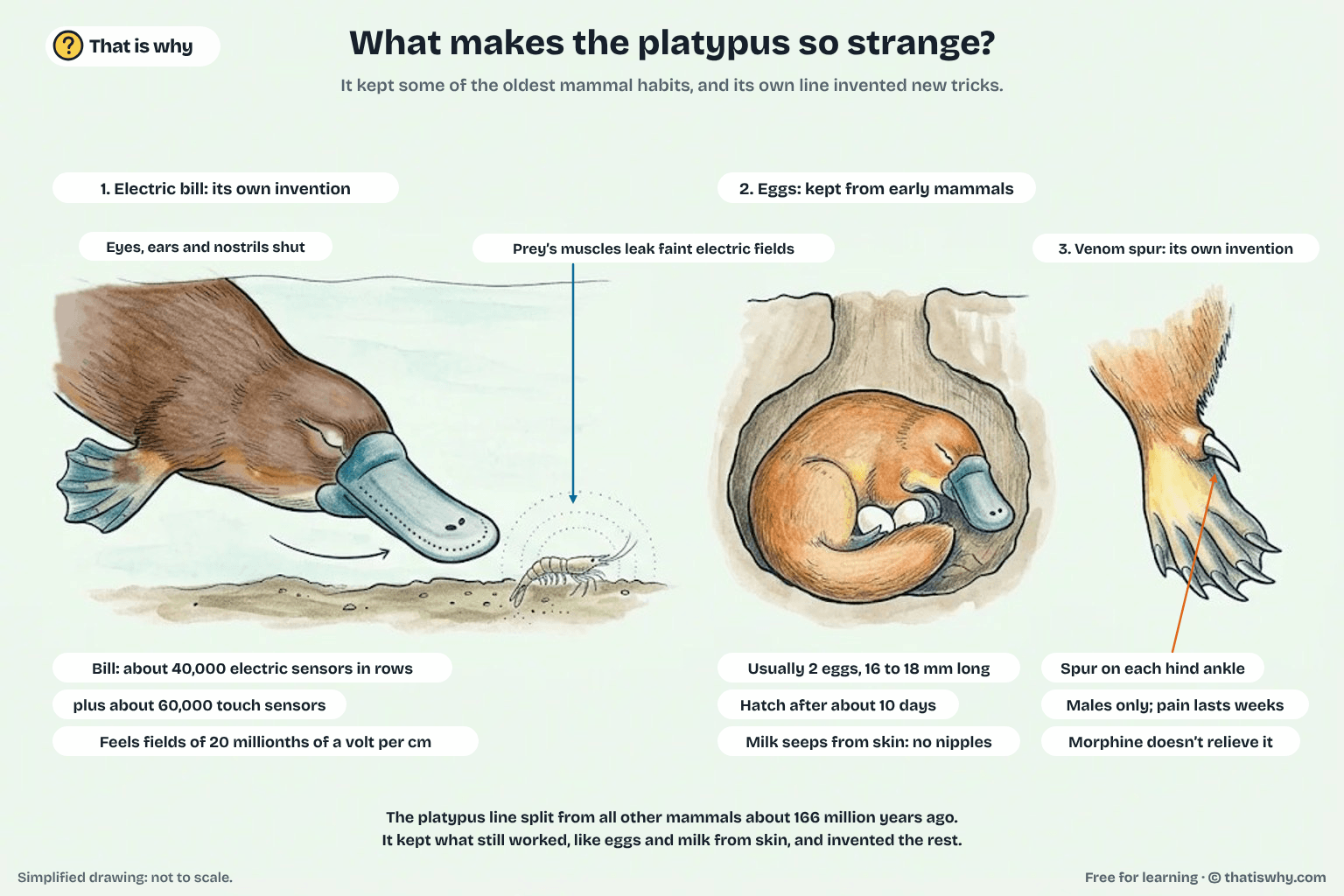
The electric bill and the venom spur are the platypus line's own inventions; the eggs are an old habit it kept.
The detailed teaching diagram
What the diagram shows
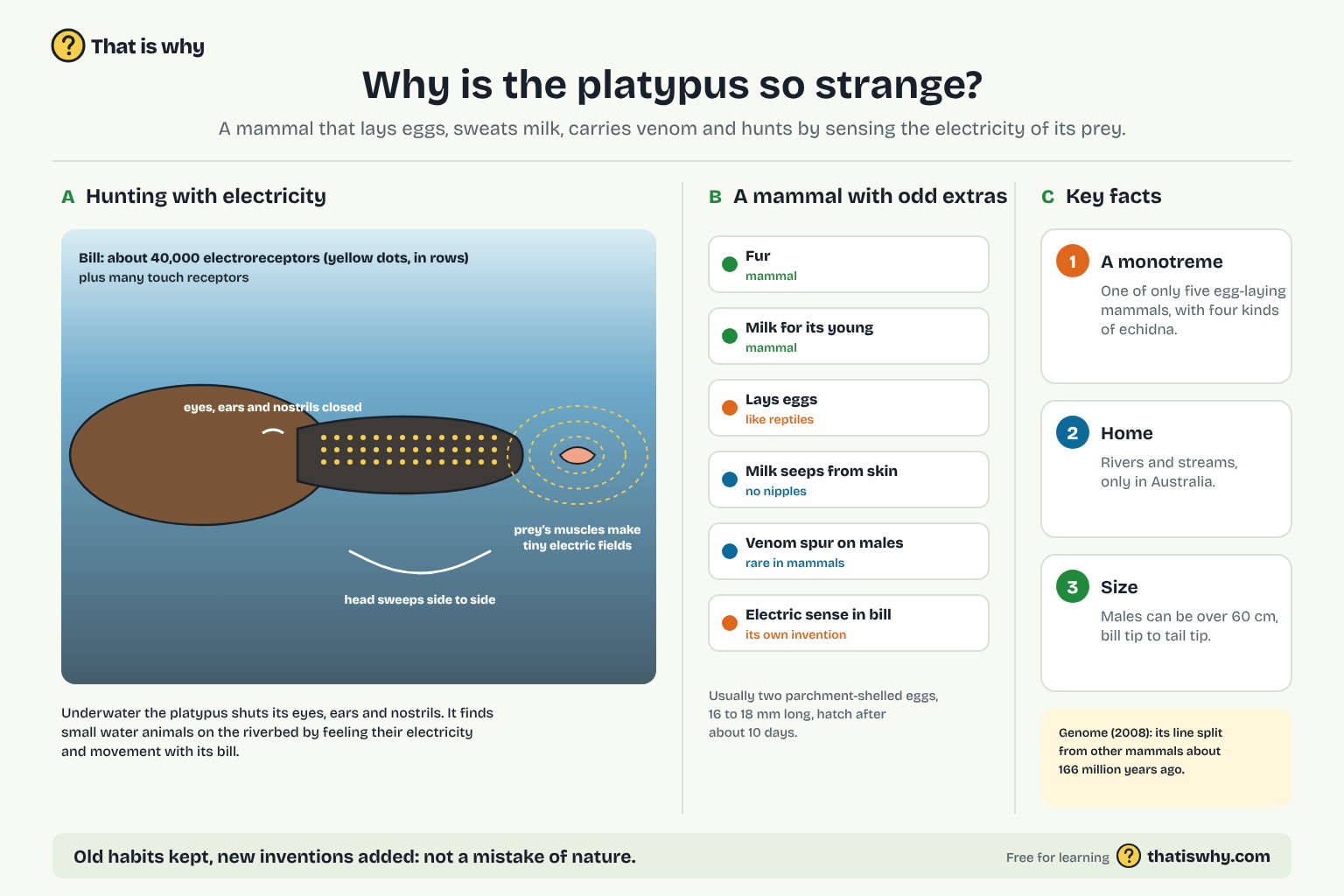
A. Hunting with electricity. When a platypus dives, it closes its eyes, ears and nostrils. It finds food with its bill, which carries about 40,000 electroreceptors in rows running down its length, plus about 60,000 touch receptors. The muscles of its prey make tiny electric fields, and the platypus senses them (electroreception) as it sweeps its bill from side to side. This sense is the platypus line's own invention: it grew out of the face's trigeminal nerve, not inherited from fish.
B. A mammal with odd extras. The platypus is a mammal: it has fur and feeds its young on milk. But it lays eggs, usually two, 16 to 18 millimeters long, with a parchment-like shell; they hatch after about 10 days. It has no nipples: milk seeps from two patches of skin on the mother's belly. Males carry a spur on each hind ankle that delivers venom, causing severe pain that morphine doesn't relieve.
C. Key facts. The platypus is a monotreme, one of only five egg-laying mammals alive today, along with four kinds of echidna. It lives only in Australia, in rivers, streams and other fresh water, and males can be over 60 centimeters long. Its genome, published in 2008, shows its line split from other mammals about 166 million years ago.
Key numbers
| Fact | Value |
|---|---|
| Electroreceptors in the bill | about 40,000 |
| Touch receptors in the bill | about 60,000 |
| Eggs | usually 2, 16 to 18 mm long |
| Incubation | about 10 days |
| Split from other mammals | about 166 million years ago |
Common misconceptions
Myth The platypus is part duck.
The truth Its bill only looks like a duck's. It is packed with electric and touch sensors, and the platypus is fully a mammal.
Myth Mammals do not lay eggs.
The truth Monotremes do. The platypus and four kinds of echidna are the only living egg-laying mammals.
Myth The platypus finds food by sight underwater.
The truth It closes its eyes, ears and nostrils when it dives and hunts by sensing electricity and movement with its bill.
Questions to use in class
Tap a question to reveal a model answer.
1What does a platypus detect with its electroreceptors?
The tiny electric fields produced when the muscles of its prey contract, as weak as 20 millionths of a volt per centimeter.
2Did the platypus inherit its electric sense from fish?
No. Its electric sense grew out of the trigeminal nerve of the face and mucus glands in the skin, a separate reinvention of the sense.
3Which features make the platypus a mammal, and which are unusual for a mammal?
Fur and feeding young on milk are mammal features. Laying eggs, having no nipples and males carrying venom are unusual.
4What is a monotreme?
An egg-laying mammal. The only living ones are the platypus and four kinds of echidna.
Key terms
- Electroreception
- The ability to sense electric fields. The platypus uses about 40,000 electroreceptors on its bill to find prey in the dark.
- Monotreme
- An egg-laying mammal. The only living monotremes are the platypus and four kinds of echidna.
- Venom
- A toxin delivered by a bite, sting or spur. Male platypuses have a venomous spur on each hind ankle.
- Mammal
- An animal with hair or fur that feeds its young on milk. Most give birth to live young; monotremes lay eggs.
Sources
- Platypus electroreception (information sheet) The University of Western Australia
- Platypus reproduction Australian Platypus Conservancy
- Platypus venom and spurs Australian Platypus Conservancy
- What is a monotreme? Australian Museum
- Platypus Australian Museum
- Platypus genome explains animal's peculiar features; holds clues to evolution of mammals (Warren et al., Nature 2008) Washington University in St. Louis
- Electroreceptors and Magnetoreceptors (Tricas and Carlson, Cell Physiology Sourcebook, 2012) University of Hawaii