Free teaching diagram
Rule-Breaking Animals Map: Twelve Living Things
Twelve living things that break biology's rules, each linked to its own guide.
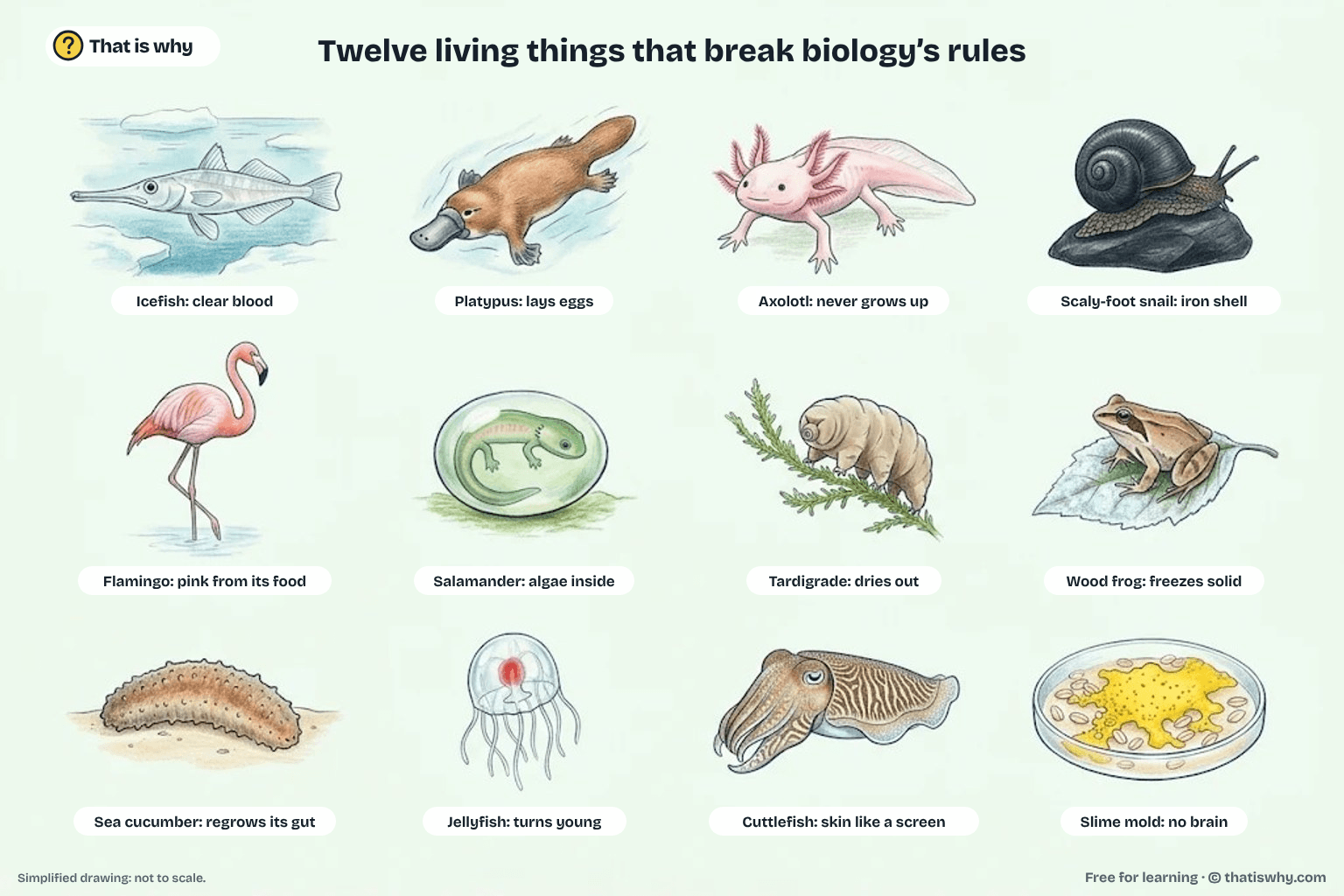
What the map shows
Twelve living things that don't fit the rules of a biology textbook. Each one survives because, over millions of years, evolution kept whatever worked:
- Parts that broke but kept running: the Antarctic icefish, which lost its hemoglobin.
- Old parts nobody threw away: the platypus, an egg-laying monotreme, and the axolotl, which keeps its young body through neoteny.
- Patches made from odd materials: the scaly-foot snail, the flamingo and the solar salamander.
- Emergency shutdowns and spare parts: the tardigrade, the wood frog and the sea cucumber.
- Turning back the clock: the immortal jellyfish, whose cells change type through transdifferentiation.
- Skin that works like a screen: the cuttlefish.
- No brain needed: the slime mold.
Key numbers
| Fact | Value |
|---|---|
| Oxygen an icefish's blood carries, compared with red-blooded cousins | less than 10% |
| Time since the platypus line split from other mammals | about 166 million years |
| Water a tardigrade keeps in its dried tun | 2 to 3% |
| Share of a wood frog's body that can freeze | up to 60% |
| Color sacs in an adult cuttlefish's skin | several million |
Common misconceptions
Myth These animals are mistakes of nature.
The truth Every one of them is still alive and reproducing. They simply never matched the rules we wrote down.
Myth Evolution always designs perfect solutions.
The truth It keeps whatever works well enough. The icefish lost hemoglobin by accident and pays for it with a giant heart.
Questions to use in class
Tap a question to reveal a model answer.
1Which animal on the map has no hemoglobin?
The Antarctic icefish. Its blood is clear and carries less than 10% of the oxygen of its red-blooded cousins.
2Which mammal on the map lays eggs?
The platypus, whose family split from other mammals about 166 million years ago.
3Which animals survive by shutting down?
The tardigrade, which dries into a tun, and the wood frog, which lets up to 60% of its body freeze.
4Why do scientists call evolution a tinkerer?
Because it doesn't follow a blueprint. Over millions of years it keeps whatever works, using the parts already at hand.
Key terms
- Hemoglobin
- The red, iron-containing protein inside red blood cells that picks up oxygen and carries it around the body. Antarctic icefish are a rare example of backboned animals that live without it.
- Monotreme
- An egg-laying mammal. The only living monotremes are the platypus and four kinds of echidna.
- Neoteny
- Keeping young features into adulthood. The axolotl grows up and breeds while keeping its larval gills.
- Transdifferentiation
- When a specialized cell changes directly into a different kind of specialized cell. The immortal jellyfish uses it to rebuild its adult body into a polyp.
Sources
- François Jacob (1920-2013), on "Evolution and Tinkering" (Science, 1977) The Embryo Project Encyclopedia, Arizona State University
- When bad things happen to good fish: the loss of hemoglobin and myoglobin expression in Antarctic icefishes (Sidell and O'Brien, 2006) The Journal of Experimental Biology
- Platypus genome explains animal's peculiar features; holds clues to evolution of mammals (Warren et al., Nature 2008) Washington University in St. Louis
- Rediscovering the axolotl as a model for thyroid hormone dependent development (Crowner et al., 2019) Frontiers in Endocrinology
- Celebrate Endangered Species Day: Meet the Scaly-Foot Snail, the Most Metal Animal in the World Scientific American
- Why Are Flamingos Pink? And Other Flamingo Facts Smithsonian's National Zoo and Conservation Biology Institute
- Solar salamander: photosynthetic algae found inside the cells of a vertebrate Scientific American
- Mechanisms of Desiccation Tolerance: Themes and Variations in Brine Shrimp, Roundworms, and Tardigrades (Hibshman, Clegg and Goldstein, Frontiers in Physiology 2020) Frontiers in Physiology
- Alaska frogs reach record lows in extreme temperature survival University of Alaska Fairbanks (via ScienceDaily)
- Morphological, Physiological and Mechanical Features of the Mutable Collagenous Tissues Associated with Autotomy and Evisceration in Dendrochirotid Holothuroids (Byrne, Marine Drugs 2023) Marine Drugs (MDPI)
- Reversing the life cycle: medusae transforming into polyps and cell transdifferentiation in Turritopsis nutricula (Piraino et al., 1996) Biological Bulletin (University of Salento repository)
- Elucidating the control and development of skin patterning in cuttlefish (Reiter et al., 2018) Nature
- Slime mould attacks simulates Tokyo rail network (Tero et al., Science 2010) National Geographic