Free teaching diagram
Axolotl Neoteny Diagram: Why the Axolotl Never Grows Up
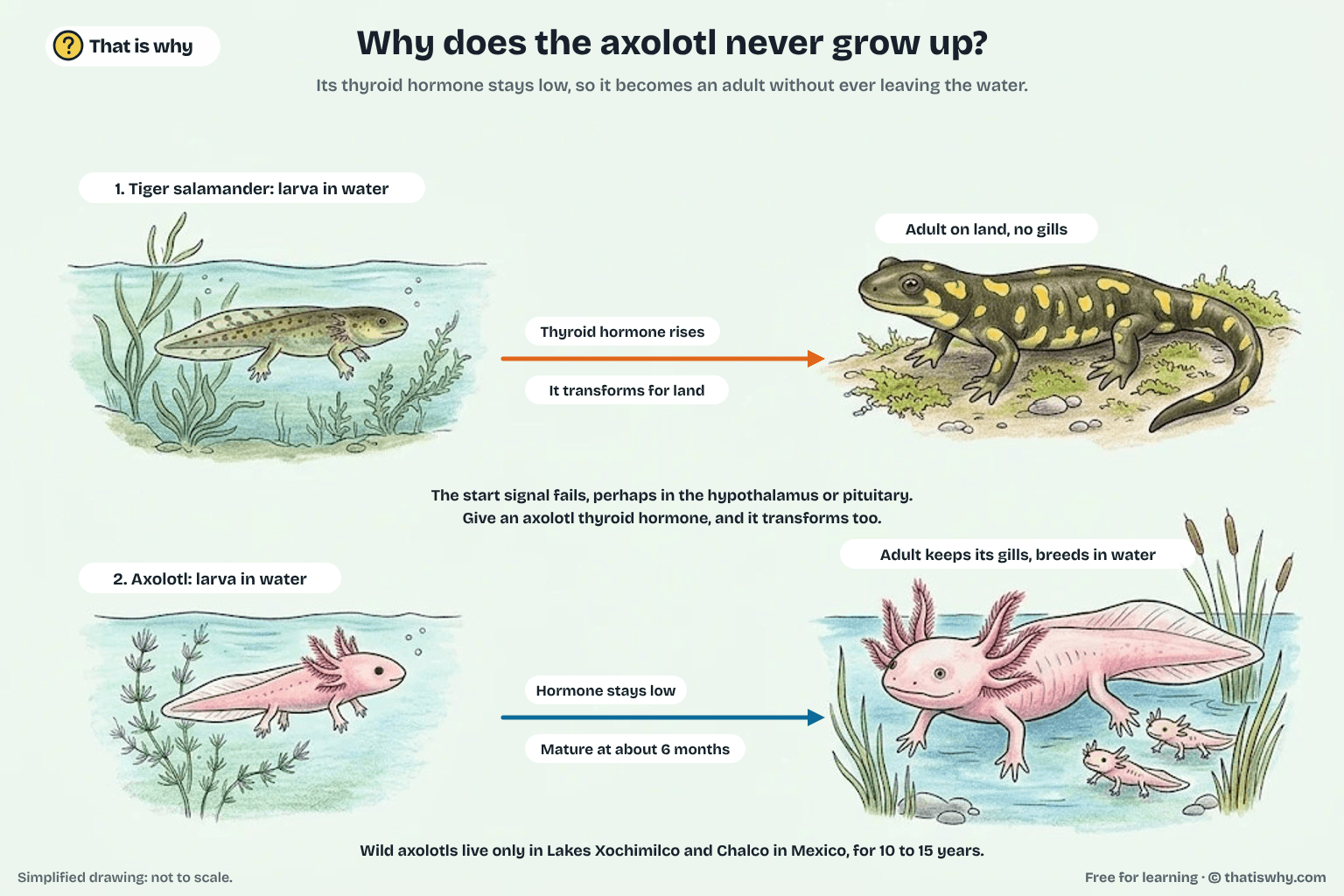
Tiger salamanders get the thyroid signal and move to land; axolotls grow up without it and stay in the water.
The detailed teaching diagram
What the diagram shows
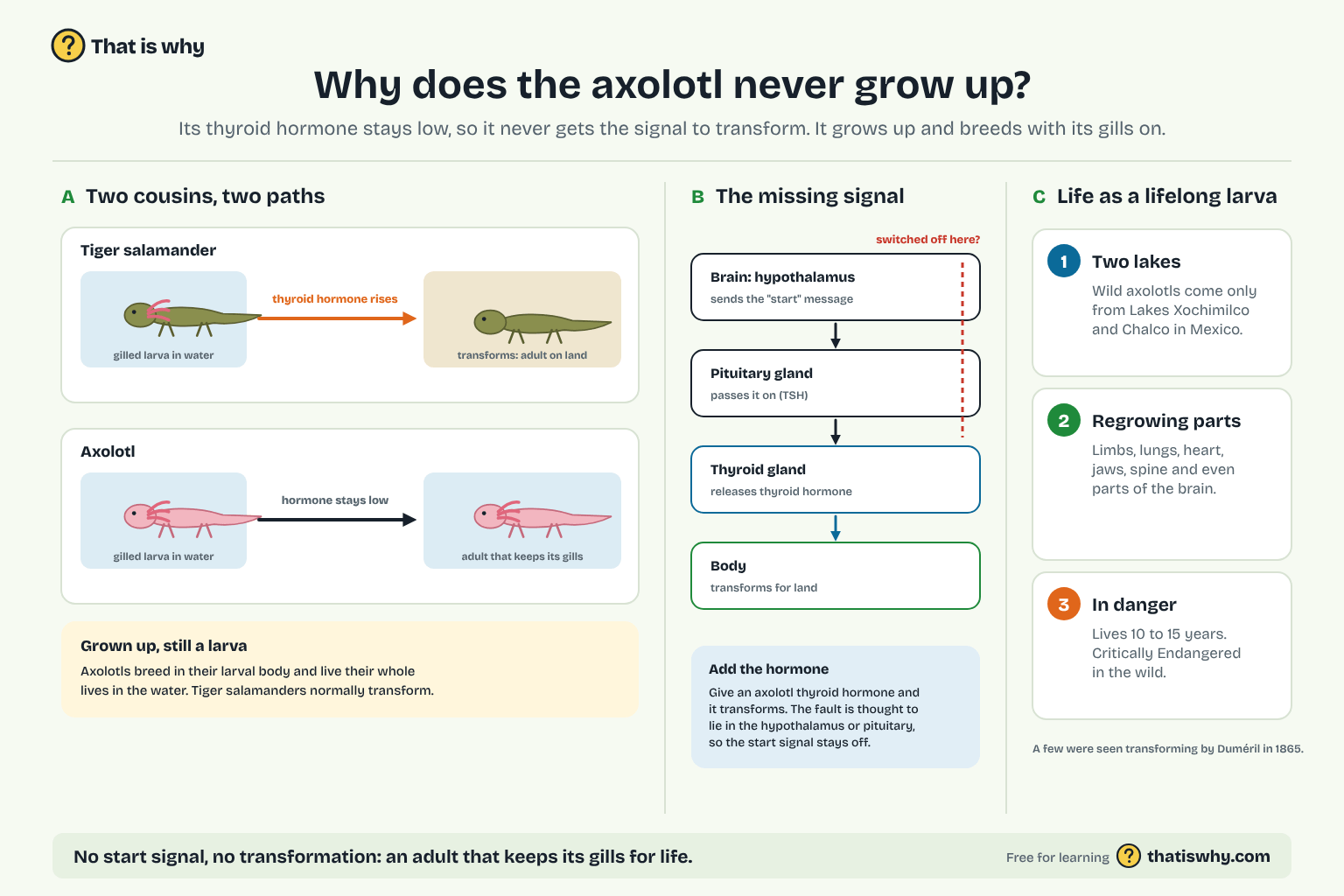
A. Two cousins, two paths. A tiger salamander starts as a gilled larva in water; its thyroid hormone rises and it transforms into an adult that can live on land. Its close relative, the axolotl, keeps low thyroid hormone throughout its larval life. It becomes an adult that keeps its gills, breeds in its larval body and lives its whole life in the water. This is called neoteny.
B. The missing signal. Metamorphosis is set off by a chain: the brain's hypothalamus, then the pituitary gland, then the thyroid gland, which releases thyroid hormone. In axolotls, most of this chain seems to work, but the start signal, probably in the hypothalamus or pituitary, stays off. Give an axolotl thyroid hormone and it transforms. A few axolotls were seen transforming on their own by Auguste Duméril in 1865.
C. Life as a lifelong larva. Wild axolotls come only from Lakes Xochimilco and Chalco in Mexico. They can regrow limbs, lungs, heart, jaws, spine and even parts of the brain. They live 10 to 15 years and are rated Critically Endangered.
Key numbers
| Fact | Value |
|---|---|
| Native lakes | 2 (Xochimilco and Chalco, Mexico) |
| Lifespan | about 10 to 15 years |
| Transformations seen by Auguste Duméril | 1865 |
| Conservation status | Critically Endangered |
Common misconceptions
Myth Axolotls are baby salamanders that never become adults.
The truth They are adults: they breed in their larval body, keeping their gills.
Myth Axolotls cannot transform at all.
The truth A few transform on their own, and giving them thyroid hormone makes them transform.
Myth Axolotls are fish.
The truth They are amphibians, a kind of salamander. They breathe mainly through gills but also develop lungs.
Questions to use in class
Tap a question to reveal a model answer.
1Why don't axolotls go through metamorphosis?
Their thyroid hormone stays low. The fault is thought to lie in the hypothalamus or pituitary, so the start signal stays off.
2Can an axolotl be made to transform?
Yes. Giving it thyroid hormone makes it change into a land-style salamander.
3How is the axolotl different from the tiger salamander?
Its close tiger salamander relatives normally transform into land adults; the axolotl stays in its larval form for life.
4Where do axolotls live in the wild?
Only in Lakes Xochimilco and Chalco in Mexico, and they are critically endangered.
Key terms
- Neoteny
- Keeping young features into adulthood. The axolotl grows up and breeds while keeping its larval gills.
- Metamorphosis
- A big change of body form as an animal grows up, like a gilled salamander larva turning into a land adult. In amphibians it is set off by thyroid hormone.
- Thyroid hormone
- A hormone made by the thyroid gland. In amphibians it triggers metamorphosis; axolotls keep it low, so they never transform unless they are given it.
Sources
- Rediscovering the axolotl as a model for thyroid hormone dependent development (Crowner et al., 2019) Frontiers in Endocrinology
- Axolotl Fact Sheet PBS Nature