Free teaching diagram
Octopus Heart Diagram: How Three Hearts Share the Work
Two gill hearts push blue blood through the gills, then the body heart sends it around the body, and it pauses when a hard jet squeezes the mantle.
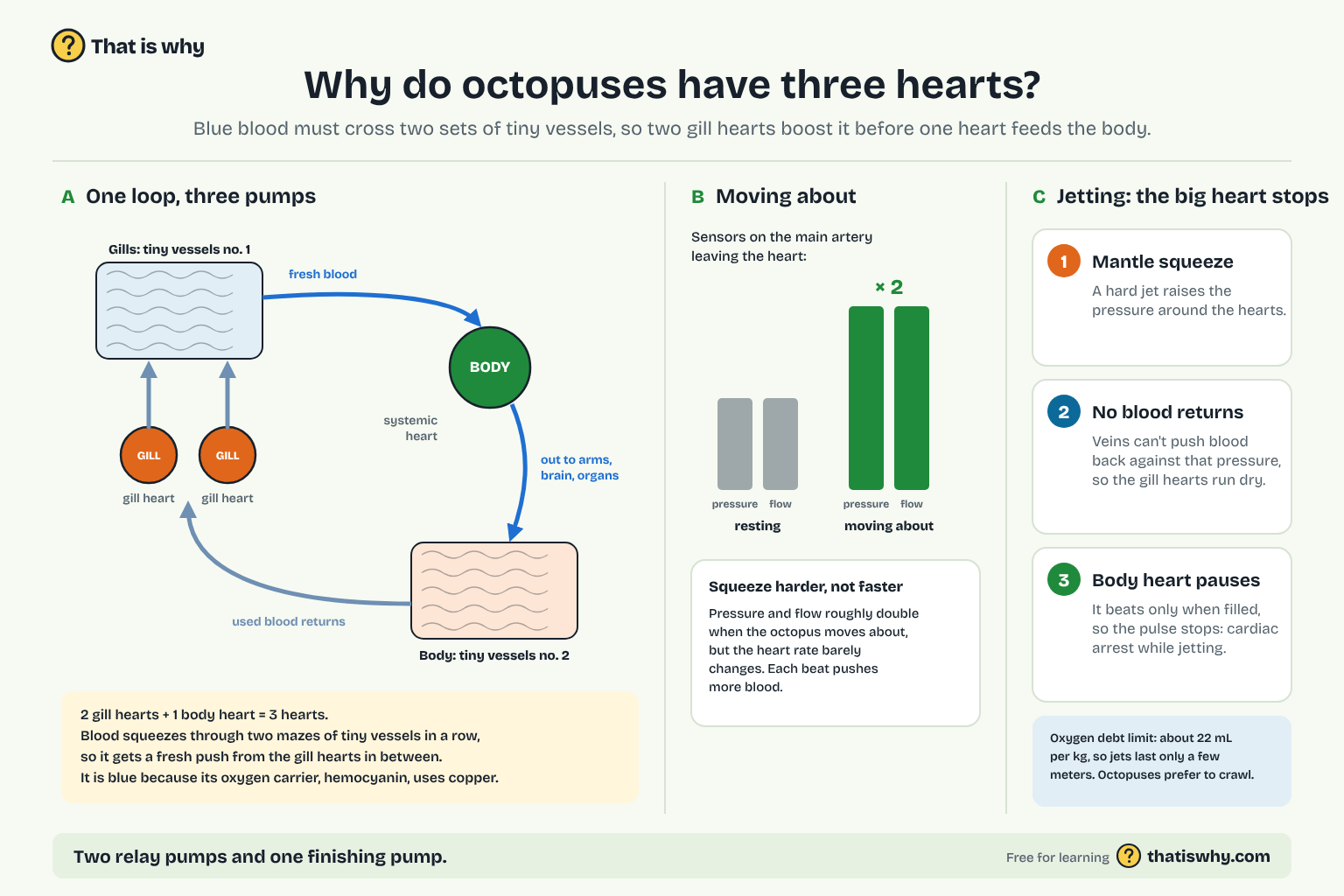
What the diagram shows
A. One loop, three pumps. Used blood returns from the body to two gill hearts, one beside each gill. They push it through the gills, the first set of tiny vessels, where it picks up oxygen. The fresh blood then reaches the systemic, or body, heart, which pumps it out to the arms, the brain and the other organs, the second set of tiny vessels. Because the blood must pass through two mazes of vessels in a row, it gets a fresh push in between. It is blue because its oxygen carrier, hemocyanin, contains copper.
B. Moving about. Researchers fitted octopuses with sensors on the main artery leaving the heart. When the animals moved about, blood pressure and flow roughly doubled while the heart rate barely changed: the heart squeezes harder rather than faster.
C. Jetting: the big heart stops. A hard jet squeezes the mantle and raises the pressure around the hearts. Blood can't return through the veins, so the gill hearts run dry, and the body heart, which beats only when it is filled, pauses. The researchers called it cardiac arrest. With an oxygen debt limit of only about 22 mL per kg, jets last just a few meters, and octopuses prefer to crawl.
Key numbers
| Fact | Value |
|---|---|
| Hearts | 3 (2 gill hearts + 1 body heart) |
| Blood pressure and flow when moving about | roughly double |
| Heart rate when moving about | barely changes |
| Oxygen debt limit | about 22 mL of oxygen per kg |
| Jet distance | only a few meters |
Common misconceptions
Myth The third heart is a spare in case one fails.
The truth Each heart has its own job: two push blood through the gills and the third sends it around the body.
Myth An octopus heart stops whenever the animal moves.
The truth Moving about roughly doubles blood pressure and flow. The main heart pauses during powerful jets, when the squeezing mantle stops blood from returning.
Myth Octopus blood is blue because of a dye.
The truth The color comes from copper in hemocyanin, the protein that carries oxygen.
Questions to use in class
Tap a question to reveal a model answer.
1Why does an octopus need two gill hearts as well as a body heart?
Its blood has to pass through two sets of tiny vessels in a row, in the gills and in the body. The gill hearts give it a fresh push through the gills before the body heart sends it around the body.
2How does an octopus get more blood to its muscles when it moves about?
Its heart squeezes harder rather than faster: blood pressure and flow roughly double while the heart rate barely changes.
3Why does the body heart stop during a hard jet?
The squeezing mantle raises the pressure around the hearts, so blood cannot return from the veins. The gill hearts run dry, and the body heart, which beats only when it is filled, pauses.
4Why is octopus blood blue?
It carries oxygen on hemocyanin, a protein that contains copper, instead of iron-based hemoglobin like ours.
Key terms
- Hemocyanin
- A copper-containing protein that carries oxygen in the blood of octopuses and many other mollusks and crustaceans. The copper turns the blood blue when it holds oxygen.
- Hemoglobin
- The red, iron-containing protein inside red blood cells that picks up oxygen and carries it around the body. Antarctic icefish are a rare example of backboned animals that live without it.
- Gill heart
- One of two small hearts in an octopus, one beside each gill, that pushes blood through the gills to pick up oxygen. A third, larger heart then sends that blood around the body.
- Capillary
- A hairlike blood vessel, thin enough for blood to pass oxygen to the tissue around it. Gills and muscles are packed with them.
Sources
- Blood Flow and Pressure Changes in Exercising Octopuses (Octopus vulgaris) (Wells et al., Journal of Experimental Biology, 1987) The Company of Biologists, Journal of Experimental Biology
- Nervous control of the heartbeat in octopus (Wells, Journal of Experimental Biology, 1980) The Company of Biologists, Journal of Experimental Biology
- Ten Wild Facts About Octopuses: They Have Three Hearts, Big Brains and Blue Blood Smithsonian Magazine