Free teaching diagram
Icefish Diagram: Why Its Blood Is Clear
Red-blooded cousins carry oxygen on hemoglobin; the icefish carries it dissolved in clear plasma and pays with a giant heart.
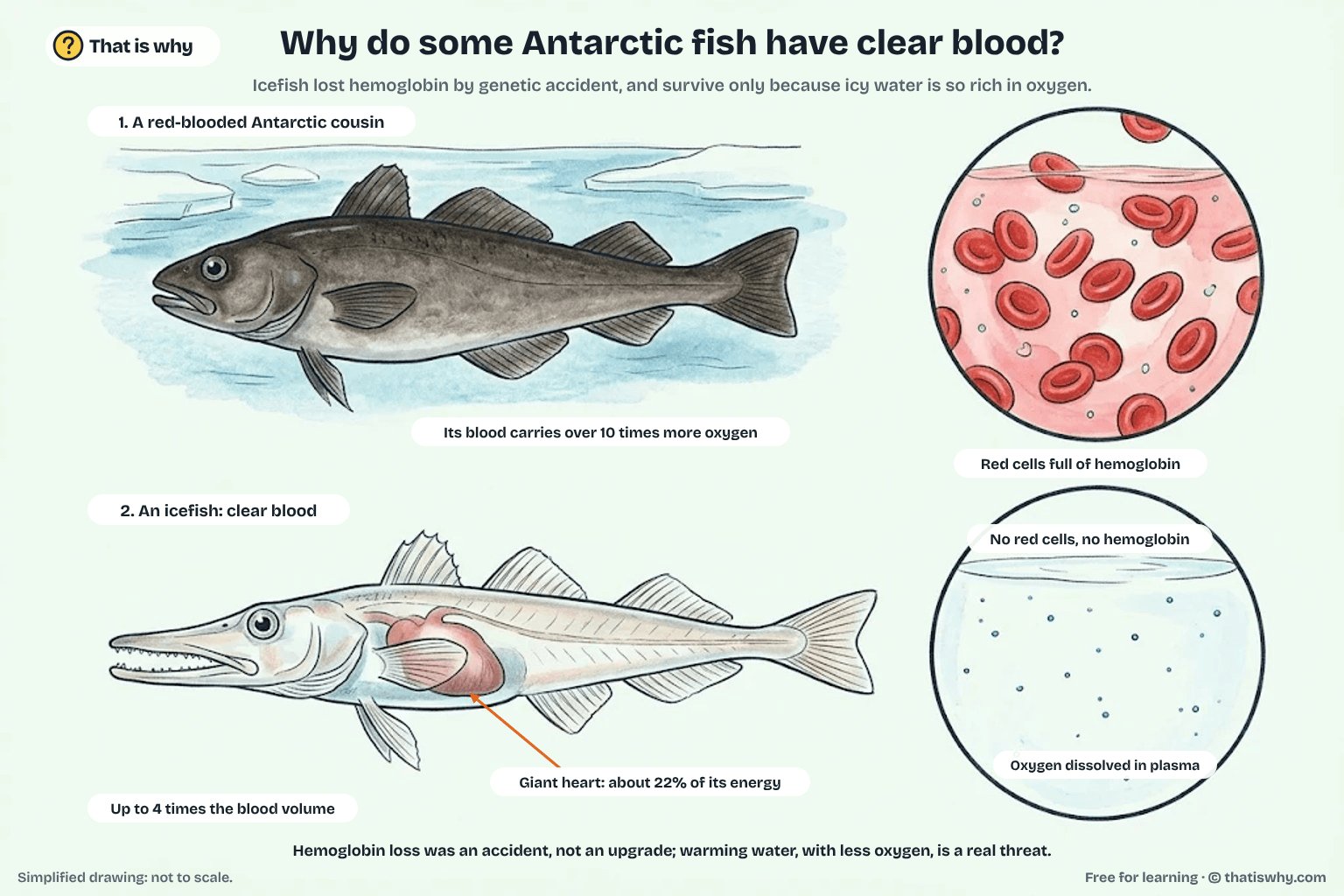
The detailed teaching diagram
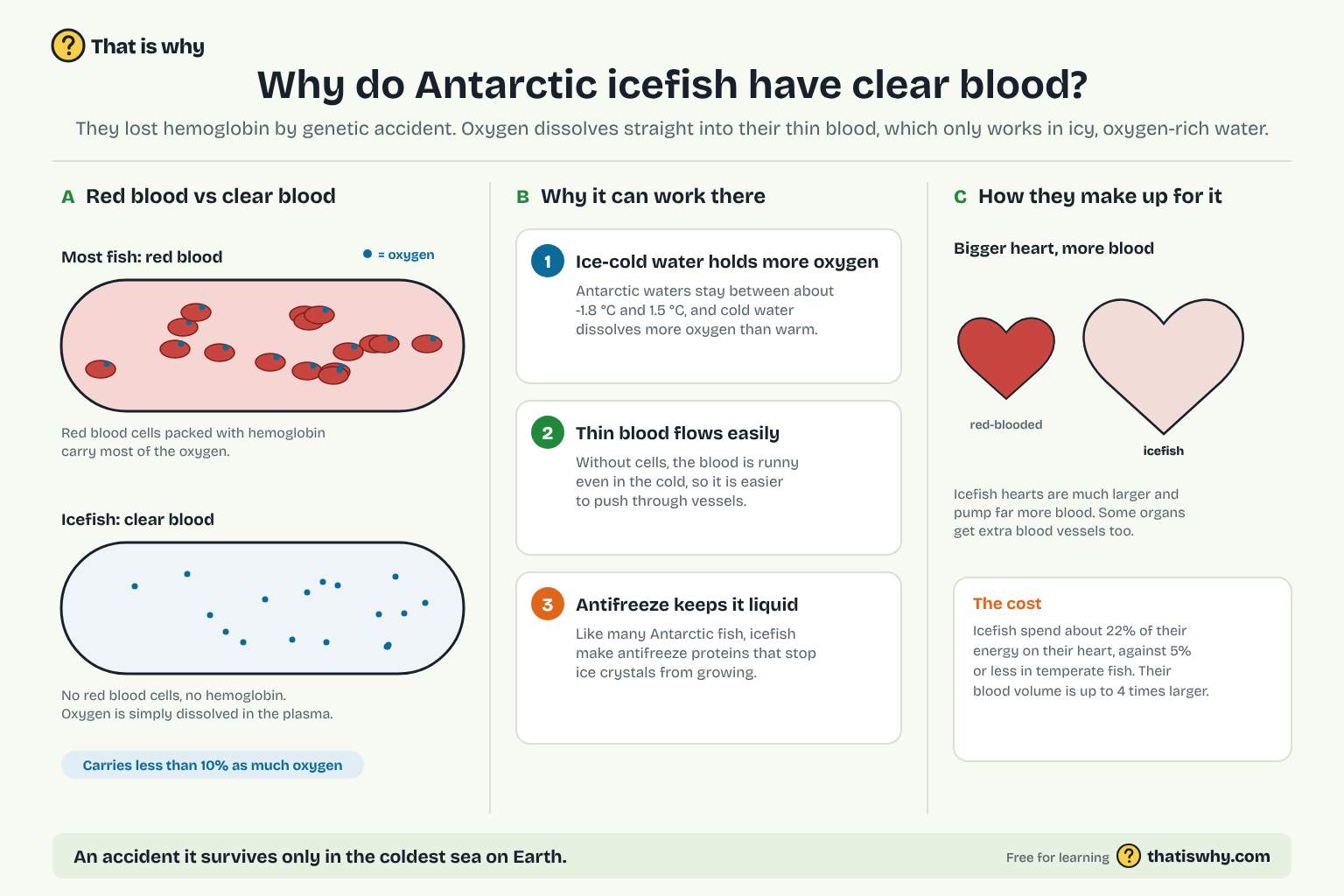
What the diagram shows
A. Red blood vs clear blood. In most fish, red blood cells packed with hemoglobin carry most of the oxygen. Icefish, a family of 16 species, are the only known vertebrates with no hemoglobin as adults, and they have no red blood cells. Oxygen is simply dissolved in the plasma, the liquid part of the blood. As a result, icefish blood carries less than 10% as much oxygen as the blood of their red-blooded relatives.
B. Why it can work there. Icefish live around Antarctica, where the water stays between about −1.8 °C and 1.5 °C. Cold water holds more dissolved oxygen than warm water. Blood without cells is also thinner and easier to push through vessels in the cold. Like many Antarctic fish, icefish make antifreeze proteins that stop ice crystals from growing in their bodies.
C. How they make up for it. Icefish have much larger hearts that pump far more blood, and wider, denser networks of blood vessels. Their blood volume can be up to four times that of other bony fish. The price is high: they spend about 22% of their energy on their hearts, against 5% or less in temperate fish. Scientists now see all of this as compensation for a genetic accident, not as an upgrade over their red-blooded notothenioid cousins.
Key numbers
| Fact | Value |
|---|---|
| Icefish species | 16 |
| Oxygen carried, compared with red blood | less than 10% |
| Water temperature | about −1.8 °C to 1.5 °C |
| Energy spent on the heart | about 22% (5% or less in temperate fish) |
| Blood volume, compared with other bony fish | up to 4 times |
Common misconceptions
Myth Icefish have no blood.
The truth They have plenty of blood. It is simply clear, because it has no red blood cells or hemoglobin, the red pigment that carries oxygen in most animals.
Myth Clear blood is a clever upgrade.
The truth Scientists now see it as a genetic accident that the fish survives. Icefish spend about 22% of their energy on their hearts, against 5% or less in temperate fish.
Myth Icefish blood stays liquid because it has no cells.
The truth Thin blood flows more easily, but what stops ice forming in many Antarctic fish is antifreeze proteins in their body fluids.
Questions to use in class
Tap a question to reveal a model answer.
1What does hemoglobin do in red blood?
It binds oxygen in the gills or lungs and releases it in the body's tissues, so blood can carry far more oxygen than it could dissolved in plasma alone.
2Why could a fish without hemoglobin survive in the Southern Ocean but not in a warm sea?
Cold water dissolves more oxygen than warm water, and cold slows the fish's needs. In a warm sea there would not be enough dissolved oxygen to keep it alive.
3Icefish blood carries less than 10% as much oxygen. How do they still deliver enough to their organs?
They pump much more blood, using larger hearts, and have wider and denser blood vessels.
4Why might warming of the Southern Ocean be a particular problem for icefish?
Warmer water holds less oxygen and raises the fish's energy needs, and icefish already depend on dissolved oxygen alone.
Key terms
- Hemoglobin
- The red, iron-containing protein inside red blood cells that picks up oxygen and carries it around the body. Antarctic icefish are a rare example of backboned animals that live without it.
- Plasma
- The pale liquid part of blood, mostly water, in which cells, nutrients and dissolved gases are carried.
- Dissolved oxygen
- Oxygen gas mixed into water. Cold water can hold more dissolved oxygen than warm water, which is why icy seas are rich in it.
- Antifreeze protein
- A protein that sticks to tiny ice crystals and stops them from growing, letting many polar fish live in water colder than the freezing point of their blood.
- Notothenioid
- A group of fish that dominates the Southern Ocean around Antarctica, making up about 90% of its fish. The icefish are notothenioids.
Sources
- Cold-blooded and clear-blooded American Museum of Natural History
- When bad things happen to good fish: the loss of hemoglobin and myoglobin expression in Antarctic icefishes (Sidell and O'Brien, 2006) The Journal of Experimental Biology
- How the Antarctic icefish lost its red blood cells but survived anyway Scientific American