Free teaching diagram
Deep-Sea Gigantism Diagram: Why Animals Grow Huge in the Deep
Cold, oxygen-rich water lets deep-sea animals grow big, and a big body burns its energy slowly where food is scarce.
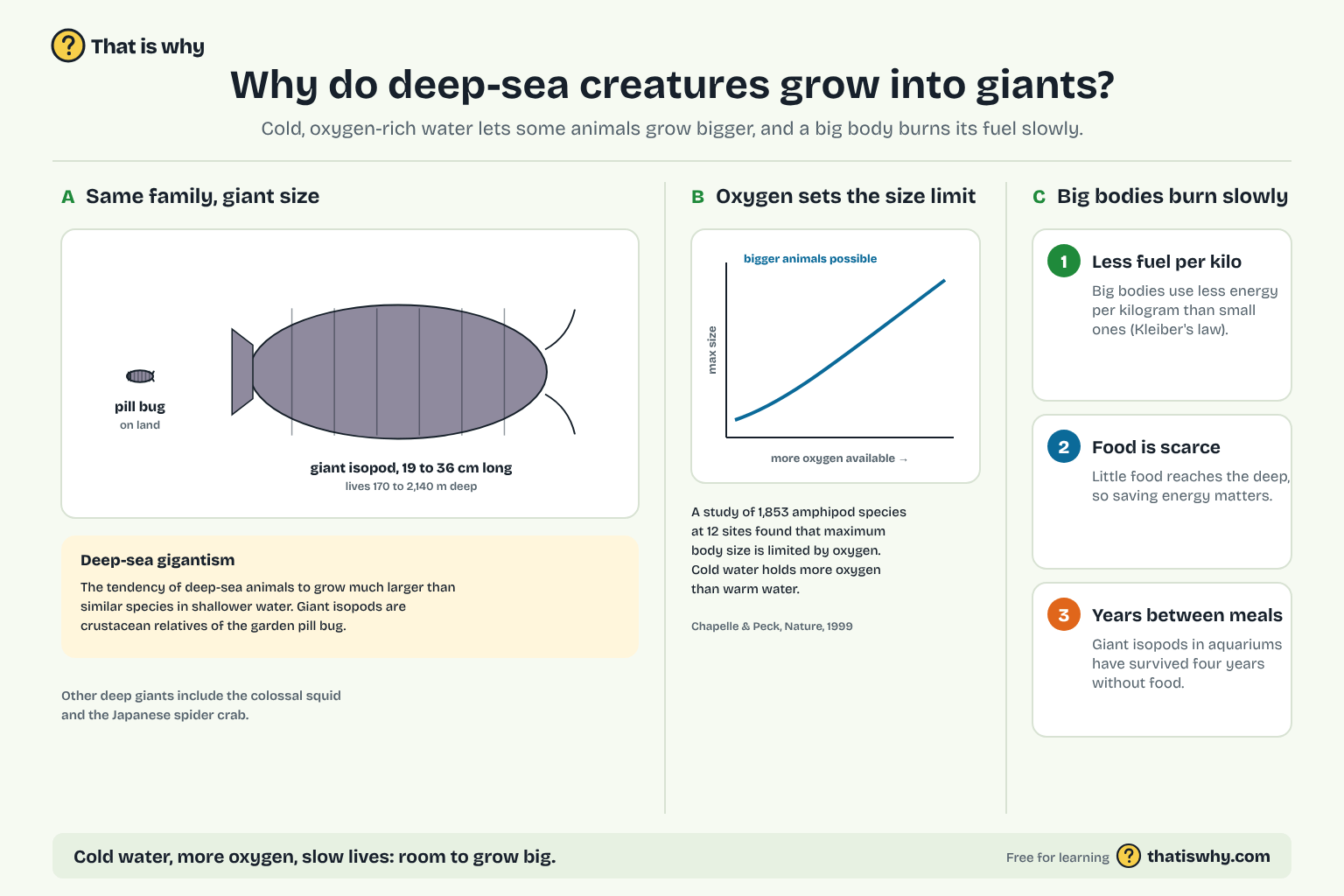
What the diagram shows
A. Same family, giant size. The giant isopod is a crustacean relative of the garden pill bug, but it grows 19 to 36 cm long and lives 170 to 2,140 m deep. This is deep-sea gigantism: the tendency of deep-sea animals to grow much larger than similar species in shallower water. Other deep giants include the colossal squid and the Japanese spider crab.
B. Oxygen sets the size limit. A study of 1,853 species of amphipods, small crustaceans, at 12 sites from polar to tropical waters found that their maximum potential size is limited by oxygen availability. Cold water holds more dissolved oxygen than warm water, which helps explain why cold seas raise giants.
C. Big bodies burn slowly. A big body uses less energy per kilogram than a small one (Kleiber's law). In the deep, where little food arrives, that thrift matters: giant isopods kept in aquariums have survived four years without food.
Key numbers
| Fact | Value |
|---|---|
| Giant isopod length | 19 to 36 cm |
| Giant isopod depth range | 170 to 2,140 m |
| Amphipod species studied | 1,853, at 12 sites |
| Longest recorded fast (aquarium) | four years |
Common misconceptions
Myth Water pressure stretches deep-sea animals into giants.
The truth Pressure doesn't make them big. Cold, oxygen-rich water and slow lifestyles are the main explanations.
Myth Every deep-sea animal is huge.
The truth Gigantism shows up in some groups, like isopods and amphipods; many deep-sea animals are small.
Myth Giant deep-sea animals must eat constantly.
The truth Big bodies burn energy slowly. Giant isopods in aquariums have survived four years without food.
Questions to use in class
Tap a question to reveal a model answer.
1What is deep-sea gigantism?
The tendency of deep-sea animals to grow much larger than similar species in shallower water.
2How big can a giant isopod get, and where does it live?
About 19 to 36 cm long, at depths of 170 to 2,140 m.
3What did a study of 1,853 amphipod species find?
Their maximum body size is limited by how much oxygen is available, and cold water holds more oxygen than warm water.
4Why does a big body help where food is scarce?
A big body uses less energy per kilogram than a small one, so it can last longer between meals.
Key terms
- Deep-sea gigantism
- The tendency of deep-sea animals to grow much larger than similar species in shallower water, like the giant isopod, a relative of the garden pill bug.
- Dissolved oxygen
- Oxygen gas mixed into water. Cold water can hold more dissolved oxygen than warm water, which is why icy seas are rich in it.
Sources
- Giant Isopod Aquarium of the Pacific
- Polar gigantism dictated by oxygen availability (Chapelle & Peck, Nature 1999) Nature (via RePEc)