Free teaching diagram
Greenland Shark Diagram: Why They Live for Centuries
Live slowly, read the age in the eye, keep repairing.
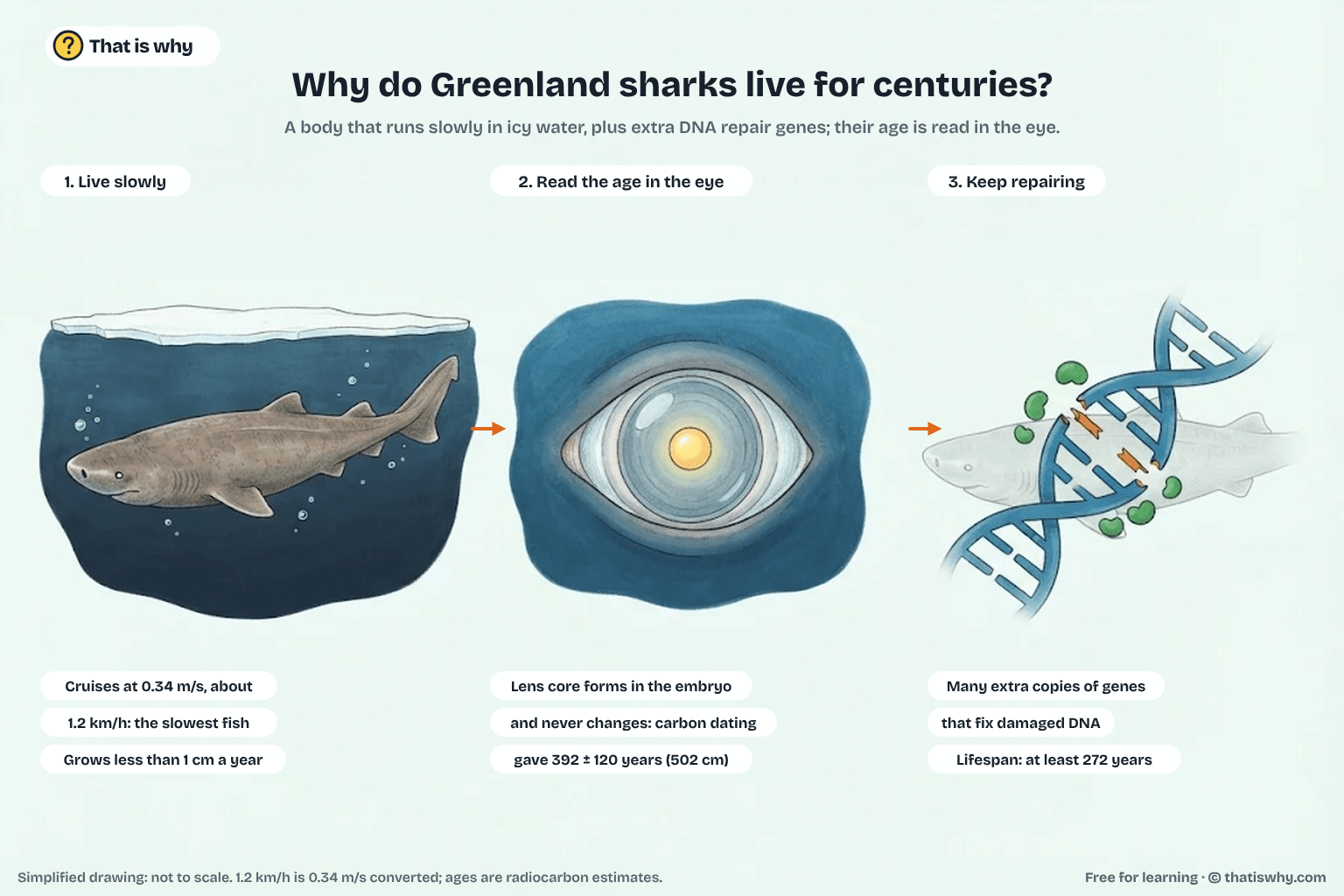
The detailed teaching diagram
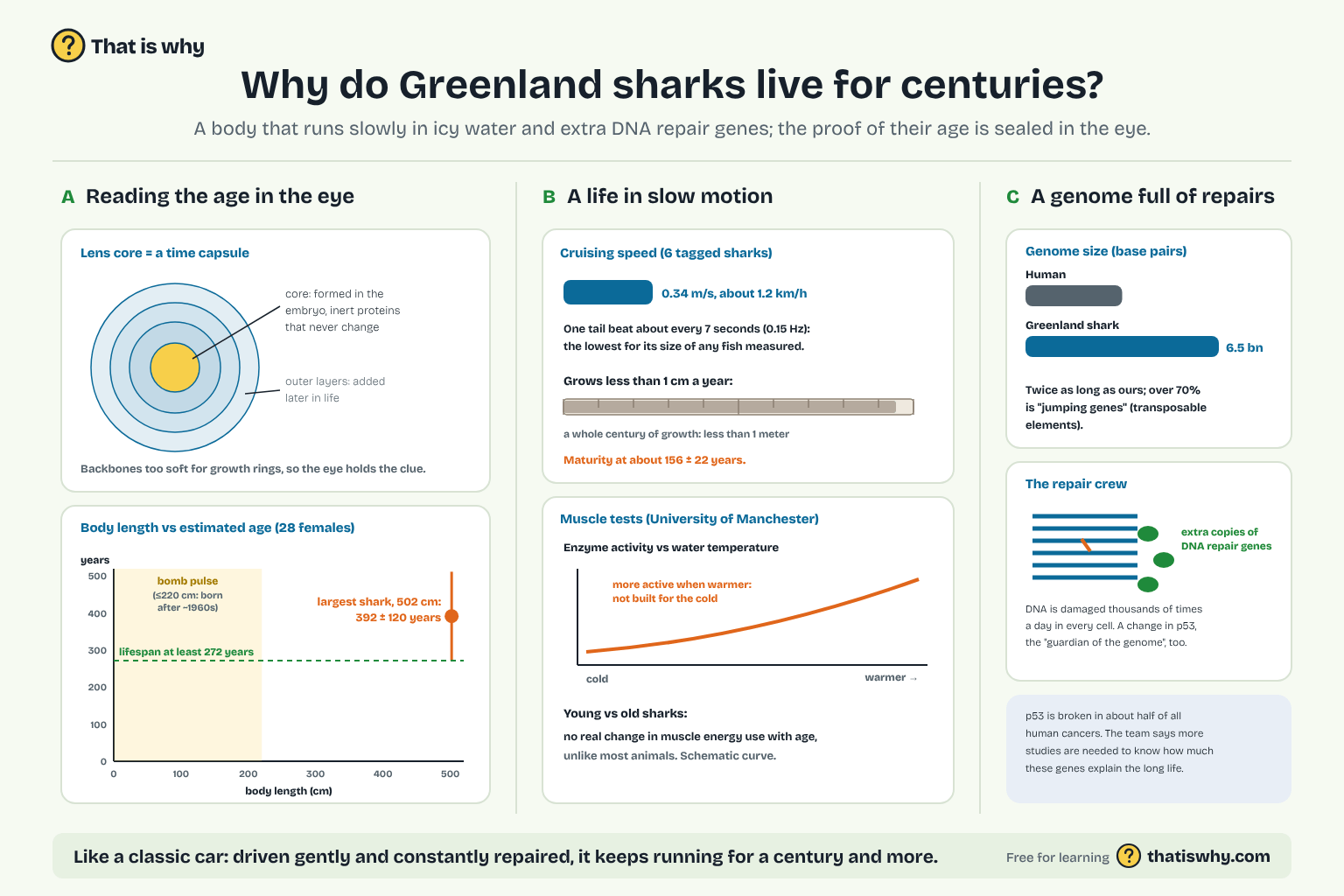
What the diagram shows
1. Live slowly. A Greenland shark's metabolism runs very slowly in icy water. Six tagged sharks cruised at just 0.34 meters per second, and the species grows less than 1 centimeter a year.
2. Read the age in the eye. Their backbones are too soft for growth rings, so scientists used radiocarbon dating on the core of the eye lens, which forms in the embryo and never changes. The bomb pulse from nuclear tests in the early 1960s showed up only in the smallest sharks, and the largest, 502 centimeters long, came out at 392 years, give or take 120.
3. Keep repairing. The shark's huge genome, more than 70% transposable elements, holds many extra copies of genes for DNA repair. That may help its body keep working for centuries, though the researchers say more studies are needed.
Key numbers
| Fact | Value |
|---|---|
| Largest shark's estimated age | 392 ± 120 years (502 cm long) |
| Minimum lifespan | at least 272 years |
| Age at sexual maturity | about 156 ± 22 years |
| Growth rate | less than 1 cm a year |
| Cruising speed | 0.34 m/s (about 1.2 km/h) |
| Tail beat | 0.15 per second (about one every 7 seconds) |
| Genome size | 6.5 billion base pairs, twice a human's |
| Share of the genome that is transposable elements | over 70% |
Common misconceptions
Myth Scientists know Greenland sharks live exactly 400 years.
The truth Every age is an estimate with a wide range. The biggest shark came out at 392 years, give or take 120, and NOAA notes that carbon dating can only provide estimates.
Myth The cold water alone explains their long lives.
The truth The cold slows them down, but their muscle enzymes work better in warmer water, and their genes carry extra DNA repair tools.
Myth You can count a Greenland shark's age in rings like a tree's.
The truth Their backbones are too soft to form growth bands, so scientists used radiocarbon in the core of the eye lens instead.
Questions to use in class
Tap a question to reveal a model answer.
1How old can Greenland sharks get?
A 2016 study estimated the largest shark it measured, 502 centimeters long, at 392 years, give or take 120. The species lives at least 272 years, making it the longest-lived vertebrate known.
2How do scientists know a Greenland shark's age?
They carbon-date the core of the eye lens, which forms in the embryo from inert proteins that never change. Sharks born after nuclear bomb tests carry an extra pulse of radiocarbon from the early 1960s.
3How fast does a Greenland shark swim?
Six tagged sharks cruised at just 0.34 meters per second, about 1.2 kilometers an hour, with a tail beat about every 7 seconds, the lowest for their size of any fish measured.
4Why do Greenland sharks live so long?
Their bodies run very slowly in icy water and grow less than 1 centimeter a year, and their genome holds many extra copies of genes that repair damaged DNA.
Key terms
- Metabolism
- All the chemical reactions that turn food into energy and building blocks inside a living body. In the cold, slow Greenland shark it runs at a very low pace.
- Radiocarbon dating
- A way to estimate the age of once-living material by measuring its radioactive carbon. It was used on Greenland shark eye lenses, which form before birth, to show these sharks live for centuries.
- Bomb pulse
- The sudden jump in radioactive carbon in the air caused by nuclear bomb tests, which marks the early 1960s. Anything that formed after it carries the extra carbon, so it works as a time stamp.
- DNA repair
- The ways a cell finds and fixes damage to its DNA, which happens all the time. The Greenland shark's genome holds many extra copies of DNA repair genes.
- Transposable element
- A stretch of DNA that can copy itself and move to new places in the genome. Transposable elements make up more than 70% of the Greenland shark's genome.
Sources
- Eye lens radiocarbon reveals centuries of longevity in Greenland shark (Somniosus microcephalus) (Nielsen et al., Science 2016) University of Oxford Research Archive
- These Ridiculously Long-Lived Sharks Are Older Than the United States, and Still Living It Up Smithsonian Magazine
- How long do Greenland sharks live? NOAA Ocean Service
- The slowest fish: Swim speed and tail-beat frequency of Greenland sharks (Watanabe et al., 2012) University of Windsor
- The longest-living vertebrate genome University of Copenhagen, Faculty of Science
- Discovering new anti-aging secrets from the world's longest-living vertebrate Society for Experimental Biology (EurekAlert!)