Free teaching diagram
Sea Otter Tool Use Diagram: Why Otters Use Rocks
Dive, float and strike, or use a shoreline anvil: three ways a rock saves a sea otter's teeth.
The detailed teaching diagram
What the diagram shows
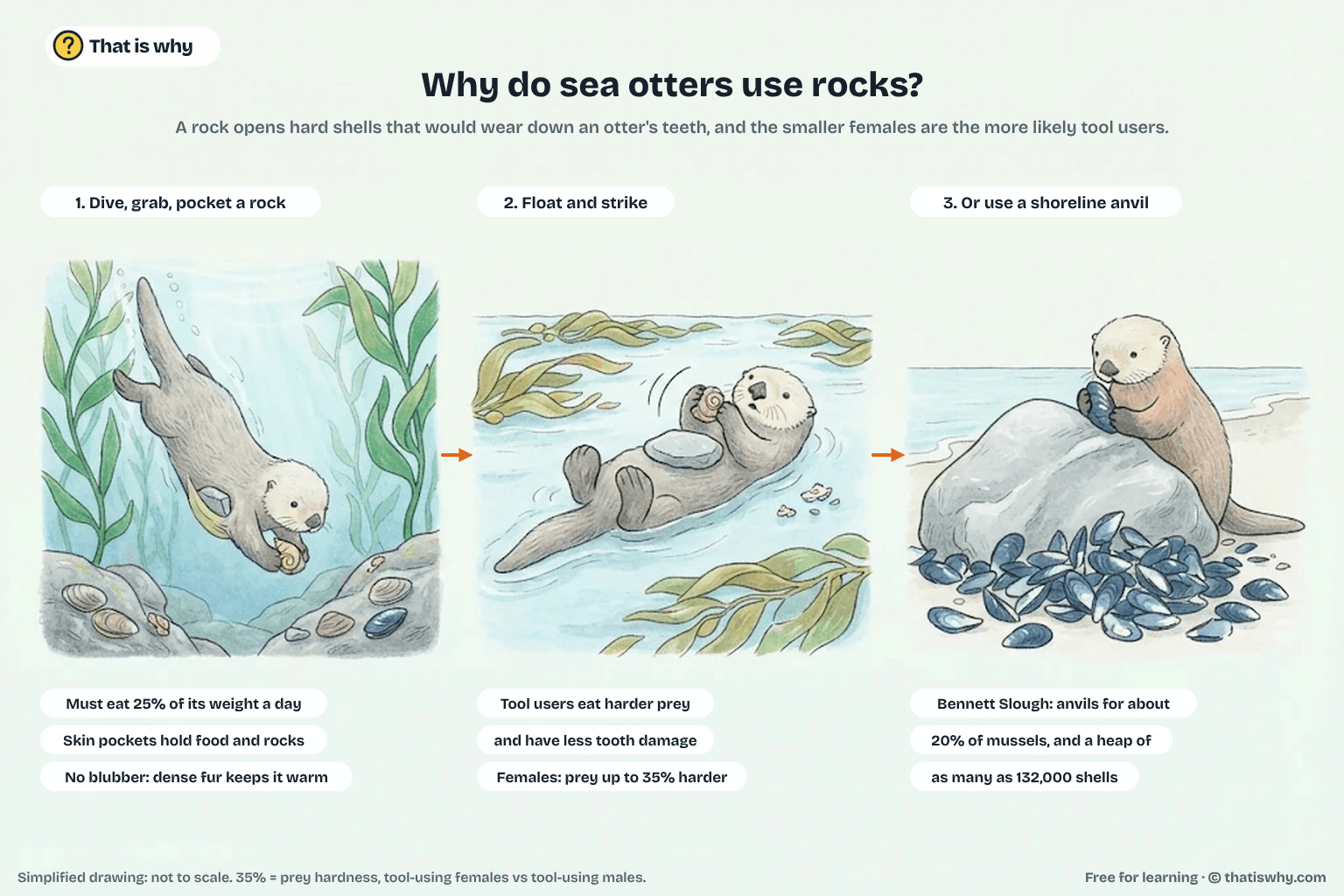
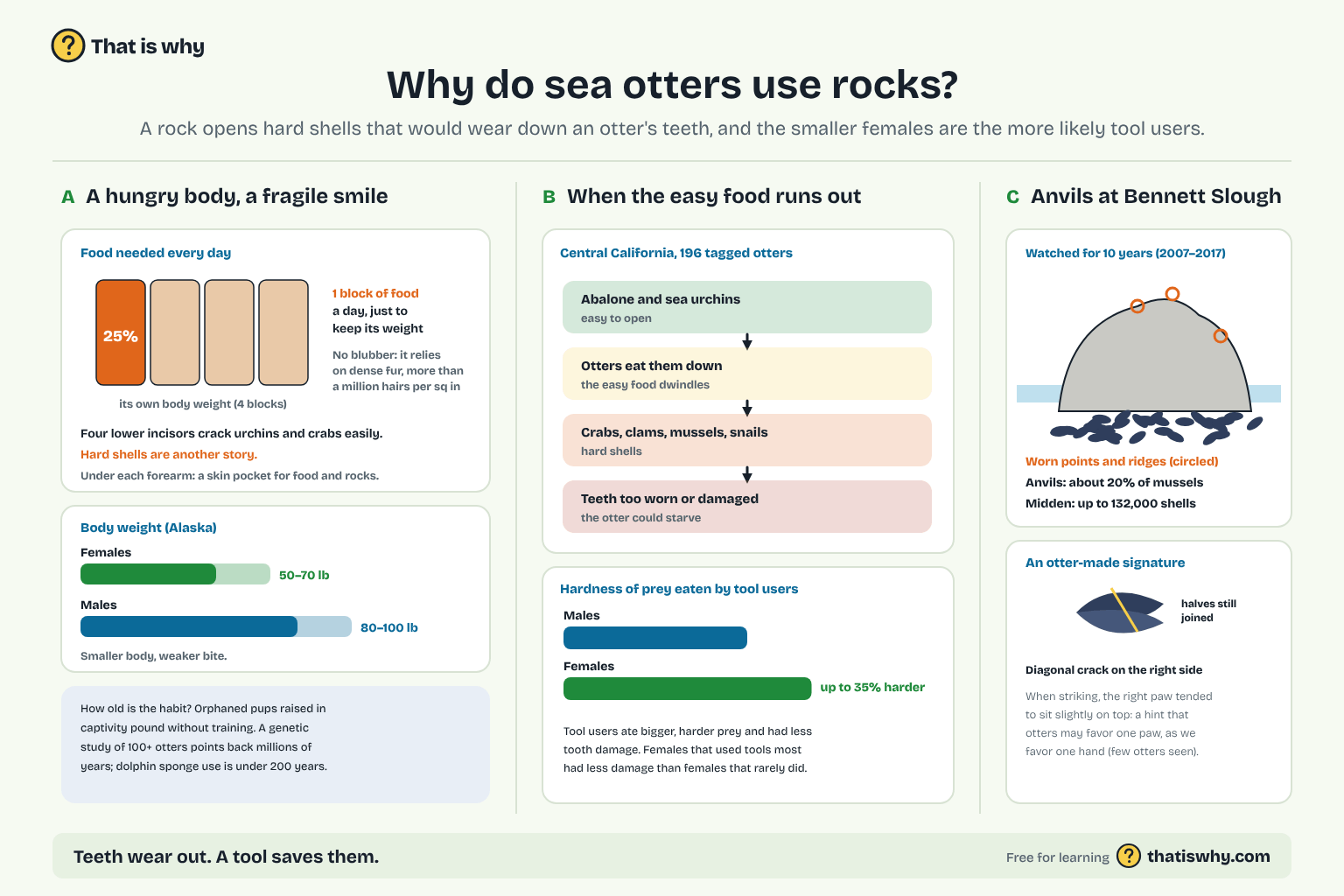
1. Dive, grab, pocket a rock. A sea otter is the only marine mammal without blubber, so it relies on dense fur and must eat 25% of its body weight every day. It dives for food and keeps food and favorite rocks in baggy skin pockets under its forearms.
2. Float and strike. Its four lower incisors crack urchins and crabs easily, but snails, clams and mussels are harder. Floating on its back with a stone on its chest, the otter strikes the shell open. This animal tool use lets it eat harder prey with less tooth damage, and tool-using females ate prey up to 35% harder than tool-using males.
3. Or use a shoreline anvil. At Bennett Slough in California, otters struck mussels against fixed shoreline rocks for about 20% of the mussels they ate. The heap of broken shells, a shell midden, likely held as many as 132,000 mussels.
Key numbers
| Fact | Value |
|---|---|
| Food needed per day | 25% of body weight |
| Fur density | more than a million hairs per square inch |
| Females vs males (Alaska) | 50–70 lb vs 80–100 lb |
| Radio-tagged otters followed (California) | 196 |
| Prey hardness, tool-using females vs tool-using males | up to 35% harder |
| Mussels opened on shoreline anvils (Bennett Slough) | about 20% |
| Shells in the Bennett Slough midden | as many as 132,000 |
| Years of observation at Bennett Slough | 10 (2007–2017) |
Common misconceptions
Myth Every sea otter uses a rock all the time.
The truth Tool use varies a lot from otter to otter. In California, females are more likely to use tools than males, and at the Bennett Slough boulders, anvils were used for only about 20% of the mussels.
Myth Pups only learn rock-smashing by copying their mothers.
The truth Orphaned pups raised in captivity start pounding without any training, and wild pups use tools before weaning whatever their mother eats.
Myth Otters stay warm with blubber, like seals.
The truth Sea otters are the only marine mammals with no blubber at all. They rely on dense fur, with more than a million hairs per square inch.
Questions to use in class
Tap a question to reveal a model answer.
1Why do sea otters use rocks?
To break hard shells their teeth can't crack safely. Tool use lets otters eat bigger, harder prey such as snails, clams and mussels with less tooth damage, which matters because an otter with worn or damaged teeth could starve.
2Do female sea otters use tools more than males?
Yes. In a study of 196 radio-tagged southern sea otters, females were more likely to use tools, and tool-using females ate prey up to 35% harder than tool-using males did.
3Where do sea otters keep their rocks?
In baggy pockets of loose skin under each forearm, which NOAA notes they use to store food and favorite rocks.
4How much do sea otters eat?
The Alaska Department of Fish and Game says a sea otter must eat 25% of its body weight every day to maintain its weight.
Key terms
- Animal tool use
- An animal using an object from outside its own body to reach a goal, such as a sea otter smashing a shell open with a rock or a crow bending a twig into a hook.
- Shell midden
- A heap of discarded shells left at a feeding spot. Sea otters pounding mussels on shoreline rocks build them too, and researchers study these heaps with the methods archaeologists use.
Sources
- Sea otters use tools when feeding to survive a changing world (Law et al., Science 2024) University of California, Santa Cruz
- Sea Otters' Tool Use Leaves Behind Distinctive Archaeological Evidence (Haslam et al., Scientific Reports 2019) Max Planck Institute for the Science of Human History
- Sea Otters Have Been Using Tools for Millions of Years PBS NOVA
- Sea Otter (Enhydra lutris) species profile Alaska Department of Fish and Game
- Sea Otter Anatomy NOAA Ocean Today