Free teaching diagram
Jewel Wasp Diagram: How a Wasp Turns a Cockroach Into a Zombie
Two precise stings, one in the thorax and one in the brain, leave the roach able to walk but unwilling to flee, so the wasp can lead it home.
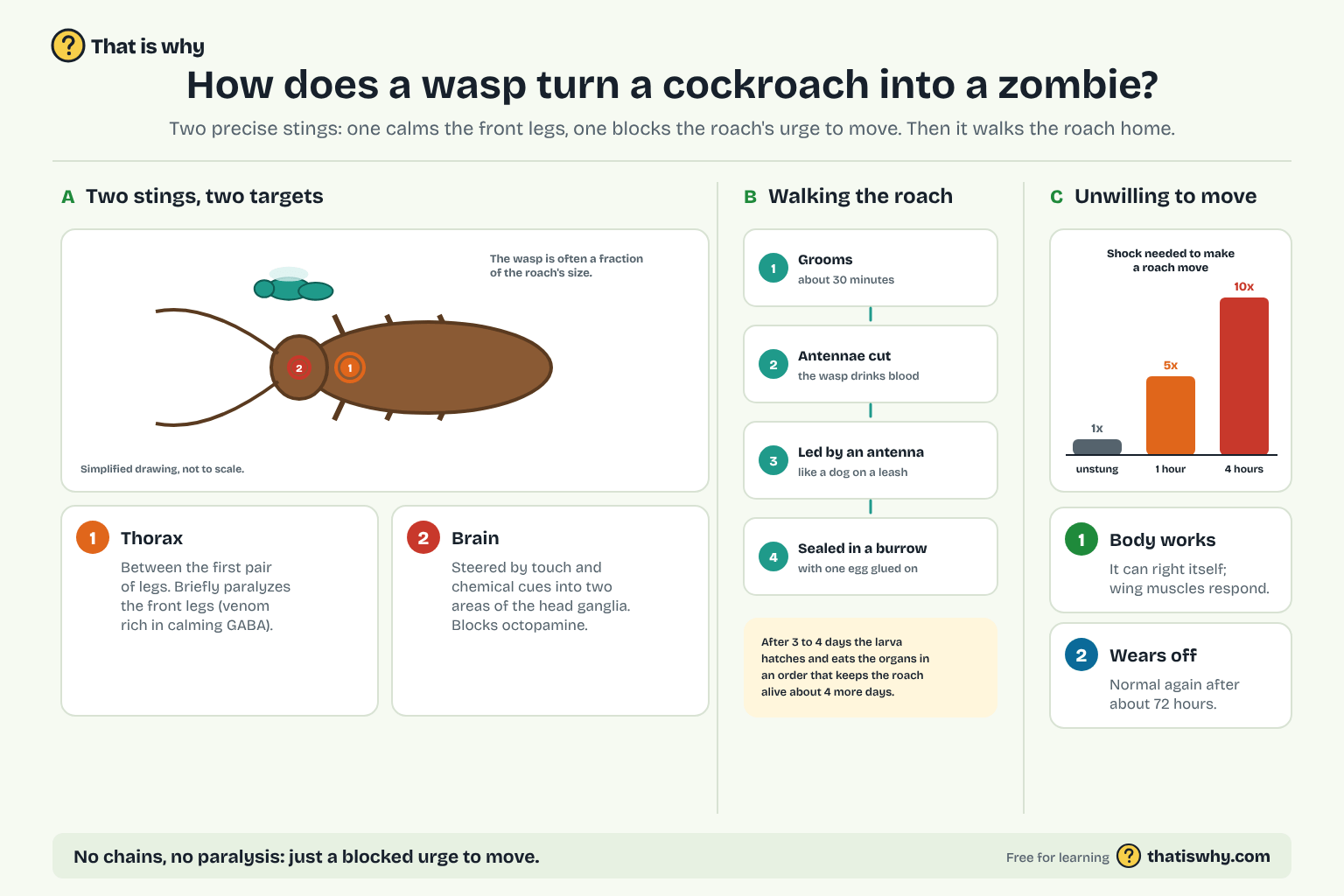
What the diagram shows
A. Two stings, two targets. The jewel wasp, Ampulex compressa, is often just a fraction of the size of its cockroach victim. It first stings the thorax, between the first pair of legs, and its venom, rich in calming chemicals such as GABA, briefly paralyzes the front legs. Then it stings directly into the head, steering by touch and chemical cues into two areas of the ganglia, where the venom blocks receptors for octopamine. The drawing is simplified and not to scale.
B. Walking the roach. The roach grooms for about 30 minutes. The wasp cuts the ends of its antennae and drinks some blood, then leads it by an antenna, like a dog on a leash, into a burrow, glues on one egg and seals it in. After 3 to 4 days the larva hatches and eats the organs in an order that keeps the roach alive about 4 more days.
C. Unwilling to move. Stung roaches needed almost 5 times the electric shock to move after 1 hour and 10 times after 4 hours. They can still right themselves and their wing muscles respond: what is missing is the decision to walk. Responses return to normal after about 72 hours.
Key numbers
| Fact | Value |
|---|---|
| Stings | 2 (thorax, then head ganglia) |
| Grooming after the sting | about 30 minutes |
| Shock needed after 1 hour | almost 5 times normal |
| Shock needed after 4 hours | 10 times normal |
| Recovery if left alone | about 72 hours |
| Egg hatches after | 3 to 4 days |
Common misconceptions
Myth The stung cockroach is paralyzed.
The truth It can right itself and its wing muscles respond; it just needs a far bigger shock to get moving.
Myth The wasp drags the roach to its burrow.
The truth The roach walks under its own power while the wasp steers it by an antenna.
Myth The effect is permanent.
The truth Left alone, stung roaches return to normal after about 72 hours, too late for one sealed in a burrow.
Questions to use in class
Tap a question to reveal a model answer.
1Where does the jewel wasp sting the cockroach?
First in the thorax, between the first pair of legs, then directly into two areas of the head ganglia.
2What does the brain sting do?
Its venom blocks receptors for octopamine, a chemical messenger that helps get an insect moving.
3How was the effect measured?
Stung roaches needed almost 5 times the electric shock to move after 1 hour, and 10 times after 4 hours.
4What happens to the roach in the burrow?
The egg hatches after 3 to 4 days, and the larva eats the organs in an order that keeps the roach alive about 4 more days.
Key terms
- Venom
- A toxin delivered by a bite, sting or spur. Male platypuses have a venomous spur on each hind ankle.
- Octopamine
- A chemical messenger in insects that helps get them moving. The jewel wasp blocks its receptors, so a stung cockroach no longer tries to walk away.
- Ganglion
- A cluster of nerve cells. Insects have ganglia in the head that act as the brain, and more along the body.
Sources
- The wasp that walks cockroaches National Geographic
- Parasitic wasp turns roaches into zombie slaves using neurotoxic cocktail Live Science
- How a wasp turns cockroaches into zombies Scientific American