Free teaching diagram
Army Ant Bridge Diagram: How Ants Become a Shortcut
Army ants build bridges from their own bodies, moving them to shorten the trail until the shortcut stops being worth the workers it ties up.
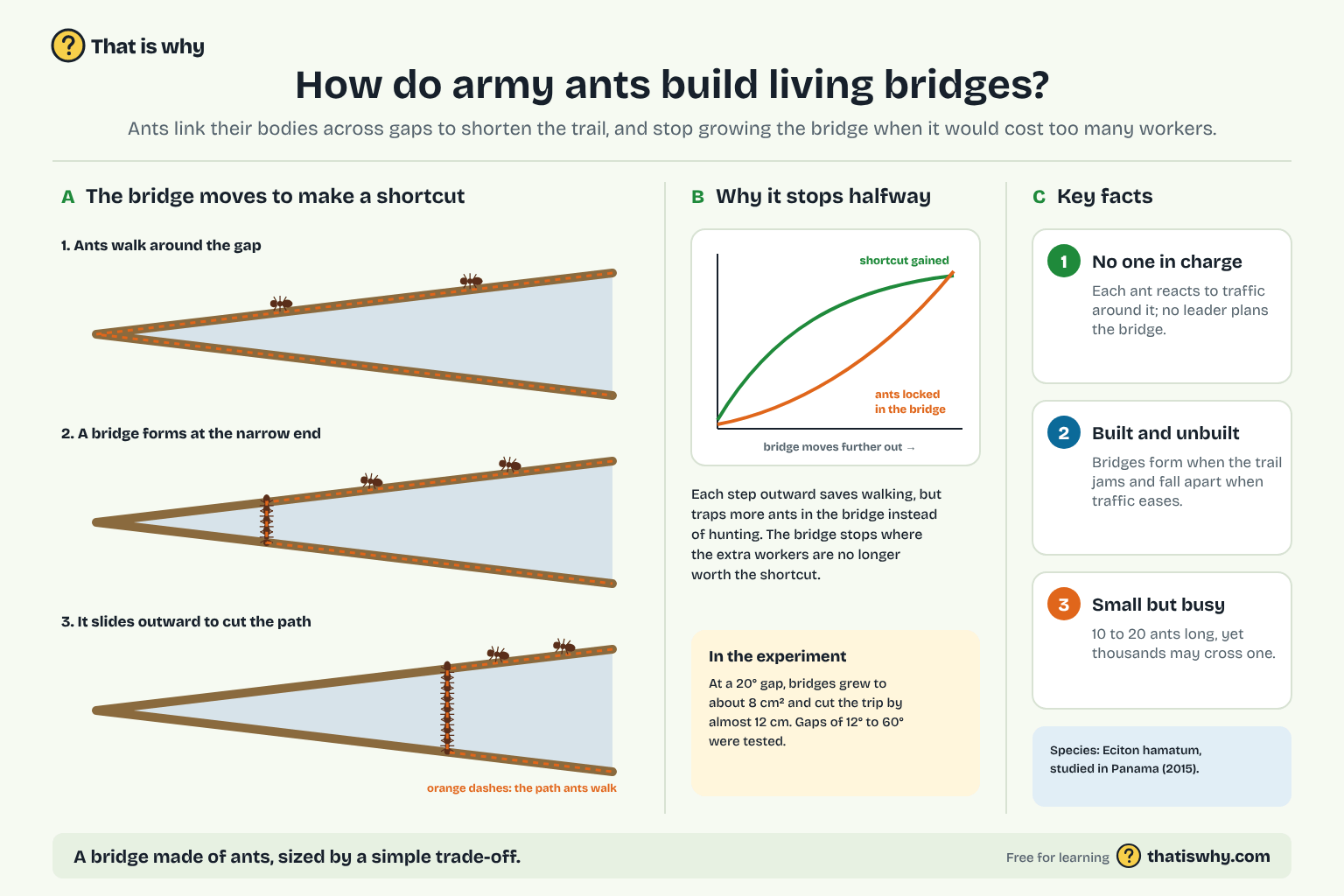
What the diagram shows
A. The bridge moves to make a shortcut. When an army ant trail meets a V-shaped gap, ants first walk around the edges. Soon a few ants link their bodies across the narrow end of the gap, and others walk over them. As traffic flows, the bridge shifts outward toward the wider part of the gap, cutting the distance the colony has to walk. This is self-assembly: a structure built by the animals themselves.
B. Why it stops halfway. Every step outward saves walking, but traps more ants in the bridge instead of hunting. The bridge stops where the extra workers are no longer worth the shortcut, a cost-benefit trade-off. In experiments in Panama with gaps of 12° to 60°, a bridge at a 20° gap grew to about 8 cm² and cut the trip by almost 12 cm.
C. Key facts. No ant is in charge: each reacts to the traffic around it, an example of swarm intelligence. Bridges form when the trail jams and fall apart when traffic eases. They are only 10 to 20 ants long, yet thousands of ants may cross one. The species studied, Eciton hamatum, lives in Central and South American forests; the research was published in 2015.
Key numbers
| Fact | Value |
|---|---|
| Bridge length | 10 to 20 ants (a few centimeters) |
| Gap angles tested | 12°, 20°, 40° and 60° |
| At a 20° gap | bridge about 8 cm², trip about 12 cm shorter |
| Leader | none |
Common misconceptions
Myth A leader ant plans and directs the bridge.
The truth There is no leader. Each ant reacts to the traffic around it, and the bridge emerges from those simple local decisions.
Myth Ants always build the biggest bridge possible.
The truth They stop partway. Every ant in the bridge is one fewer ant hunting, so the bridge only grows while the shortcut is worth it.
Myth Living bridges are permanent structures.
The truth They form when the trail gets congested and fall apart when traffic eases, often several times a day.
Questions to use in class
Tap a question to reveal a model answer.
1Why does the bridge start at the narrow end of a gap?
Only a few ants are needed to span a narrow gap, so it is the cheapest place to start.
2What is the cost of making the bridge longer?
More ants are locked into the bridge and cannot hunt or carry food.
3Why might engineers be interested in how army ants build bridges?
Simple robots following similar rules could link together to build structures, for example in disaster zones.
4Explain the cost-benefit trade-off in your own words.
Moving the bridge outward saves walking distance for every ant, but uses more ants as building material. The bridge settles where the extra distance saved is no longer worth the extra ants used.
Key terms
- Swarm intelligence
- Smart group behavior that emerges when many simple individuals follow local rules, with no leader in charge.
- Self-assembly
- When individuals link together to build a structure out of themselves, like army ants forming living bridges.
- Cost-benefit trade-off
- A balance between what something gains and what it costs. Army ant bridges stop growing when the shortcut is no longer worth the ants it uses.
Sources
- Army ants dynamically adjust living bridges in response to a cost–benefit trade-off (Reid et al., PNAS 2015) New Jersey Institute of Technology
- Ants build 'living' bridges with their bodies, speak volumes about group intelligence Princeton University