Free teaching diagram
Venus Flytrap Diagram: How a Flytrap Counts to Two and Five
Each touch adds a wave of calcium: two close together cross the threshold and close the trap, and five switch on digestion.
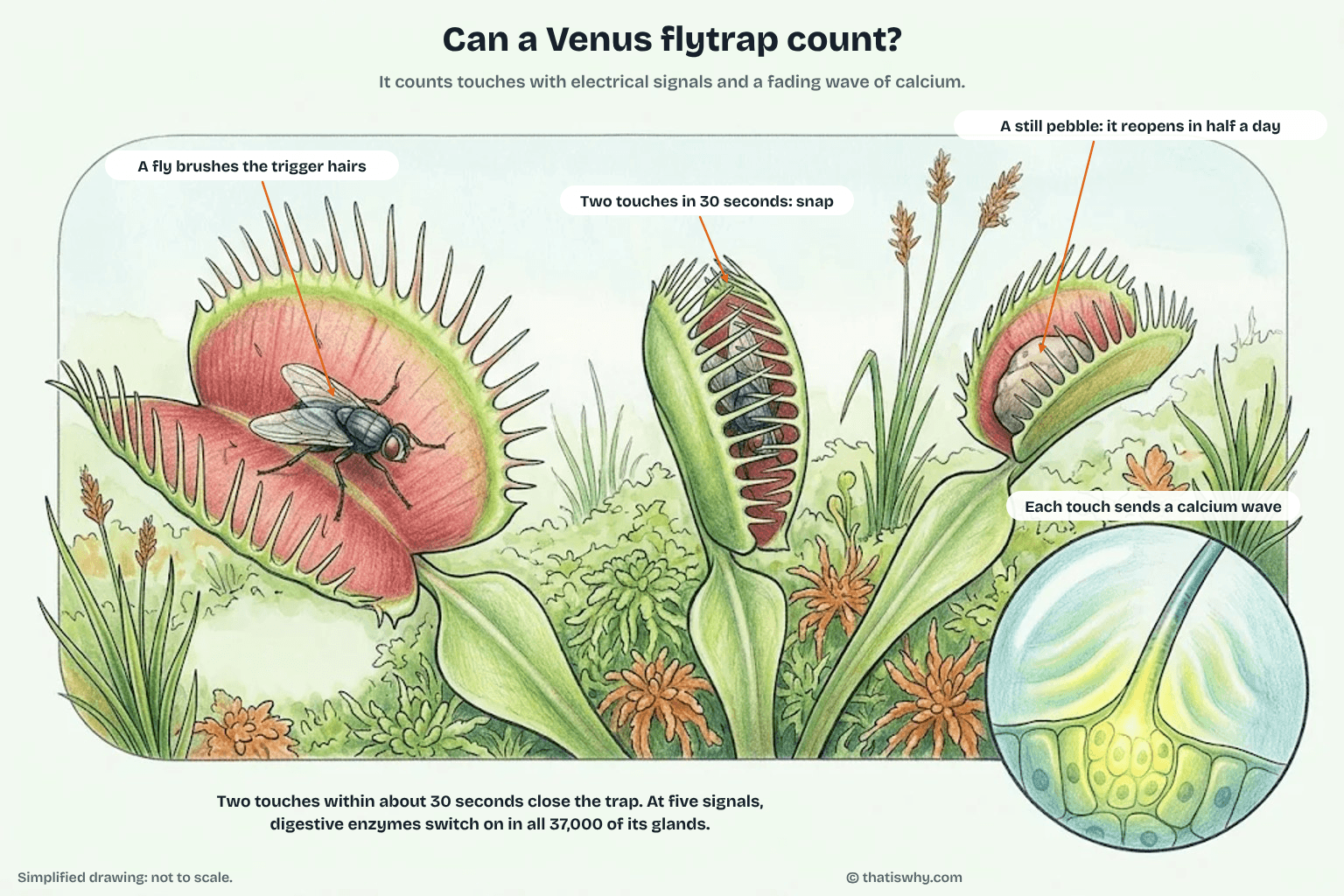
The detailed teaching diagram
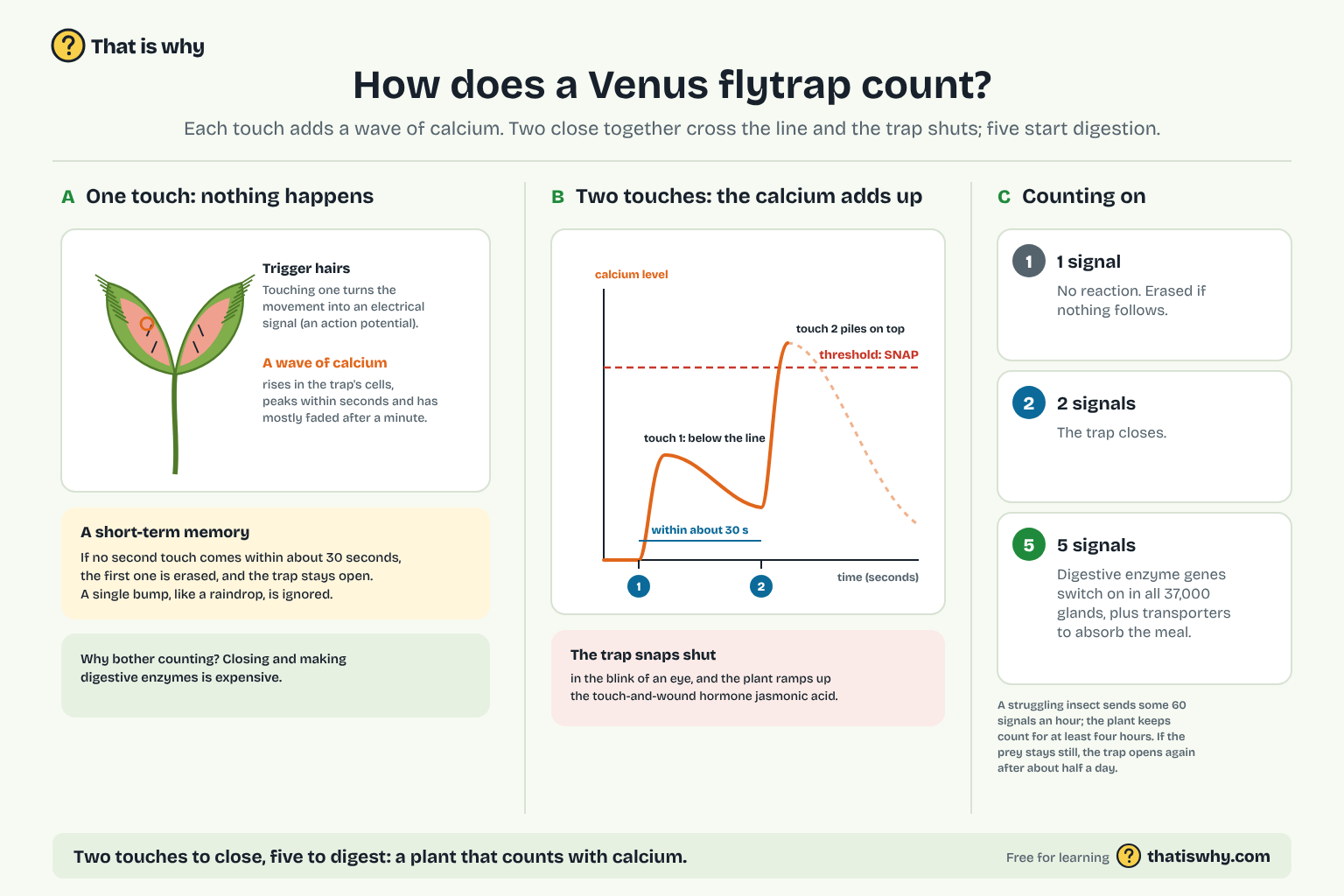
What the diagram shows
A. One touch: nothing happens. Touching one of the trap's trigger hairs turns the movement into an electrical signal called an action potential. A wave of calcium rises in the trap's cells, peaks within seconds and has mostly faded after a minute. If no second touch comes within about 30 seconds, the first one is erased from the plant's short-term memory and the trap stays open. Counting saves the plant from wasting effort, because closing and making nitrogen-rich digestive enzymes is expensive.
B. Two touches: the calcium adds up. A second touch within about 30 seconds piles more calcium on top of what is left from the first. Together they cross a threshold, and the trap snaps shut in the blink of an eye while the plant ramps up the touch-and-wound hormone jasmonic acid. The chart is a simplified sketch, not measured data.
C. Counting on. A struggling insect sends some 60 signals an hour, and the plant keeps count for at least four hours. At five signals, the genes for digestive enzymes switch on in all 37,000 of its glands, along with transporters that absorb the meal. If the prey stays still, the trap opens again after about half a day.
Key numbers
| Fact | Value |
|---|---|
| Touches needed to close the trap | 2, within about 30 seconds |
| Calcium wave | peaks within seconds, mostly gone after a minute |
| Signals needed to start digestion | 5 |
| Glands that switch on digestive enzymes | 37,000 |
| Signals from a struggling insect | some 60 an hour |
| How long the count is remembered | at least four hours |
| Trap reopens if prey stays still | after about half a day |
Common misconceptions
Myth One touch is enough to make a flytrap snap.
The truth One signal causes no reaction. The trap needs a second touch within about 30 seconds.
Myth Once the trap closes, digestion starts.
The truth Digestive enzymes switch on only at five signals; a trap that closes on something still opens again after about half a day.
Myth A plant needs nerves to count.
The truth The flytrap has no nerves or brain. It counts with electrical action potentials and a rising and fading level of calcium.
Questions to use in class
Tap a question to reveal a model answer.
1How many touches does it take to close a Venus flytrap?
Two touches of its trigger hairs within about 30 seconds.
2How does the flytrap remember the first touch?
Each touch makes a wave of calcium that peaks within seconds and fades over about a minute. A second touch piles on top and crosses a threshold.
3When does the flytrap start digesting?
At five signals, it switches on the genes for digestive enzymes in all 37,000 of its glands.
4What happens if the trap closes on something that doesn't move?
It never reaches five signals, and the trap opens again after about half a day.
Key terms
- Action potential
- A quick electrical spike that travels across living cells. Animal nerve cells use it to send messages, and a Venus flytrap's trigger hairs make one each time they are touched.
- Jasmonic acid
- A plant hormone that plants make when they are touched or wounded. In the Venus flytrap it rises when the trap closes and helps switch on digestion.
Sources
- Plants can do maths (Böhm et al., Current Biology 2016) University of Würzburg
- The Venus flytrap can count past 2 Scientific American
- How the Venus flytrap counts (Nature Plants 2020) Biocenter, University of Würzburg