Free teaching diagram
Plant and Animal Diagram: Where the Line Blurs
Six living things that count, remember, smell, copy, plan and team up across the plant-animal line.
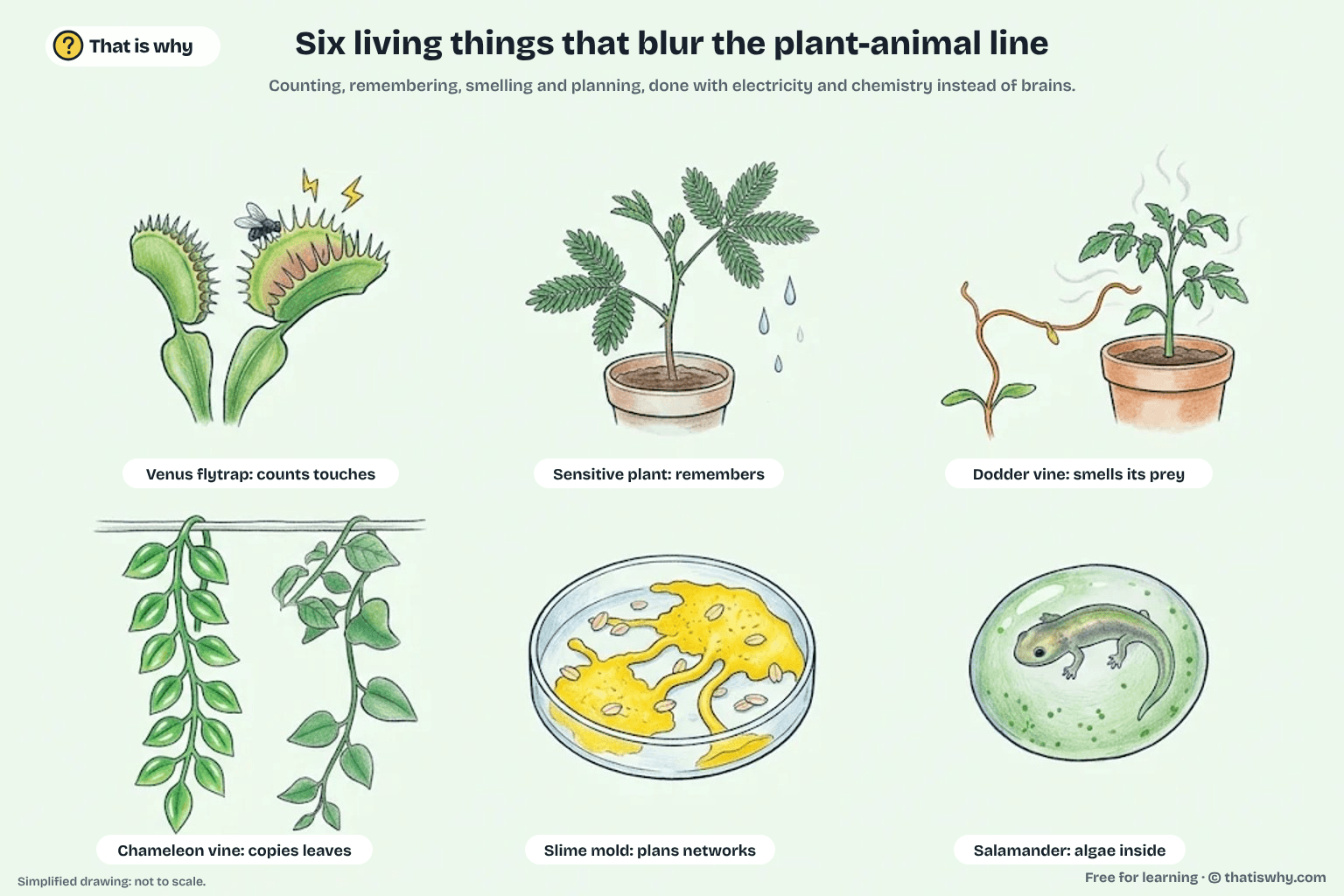
The detailed teaching diagram
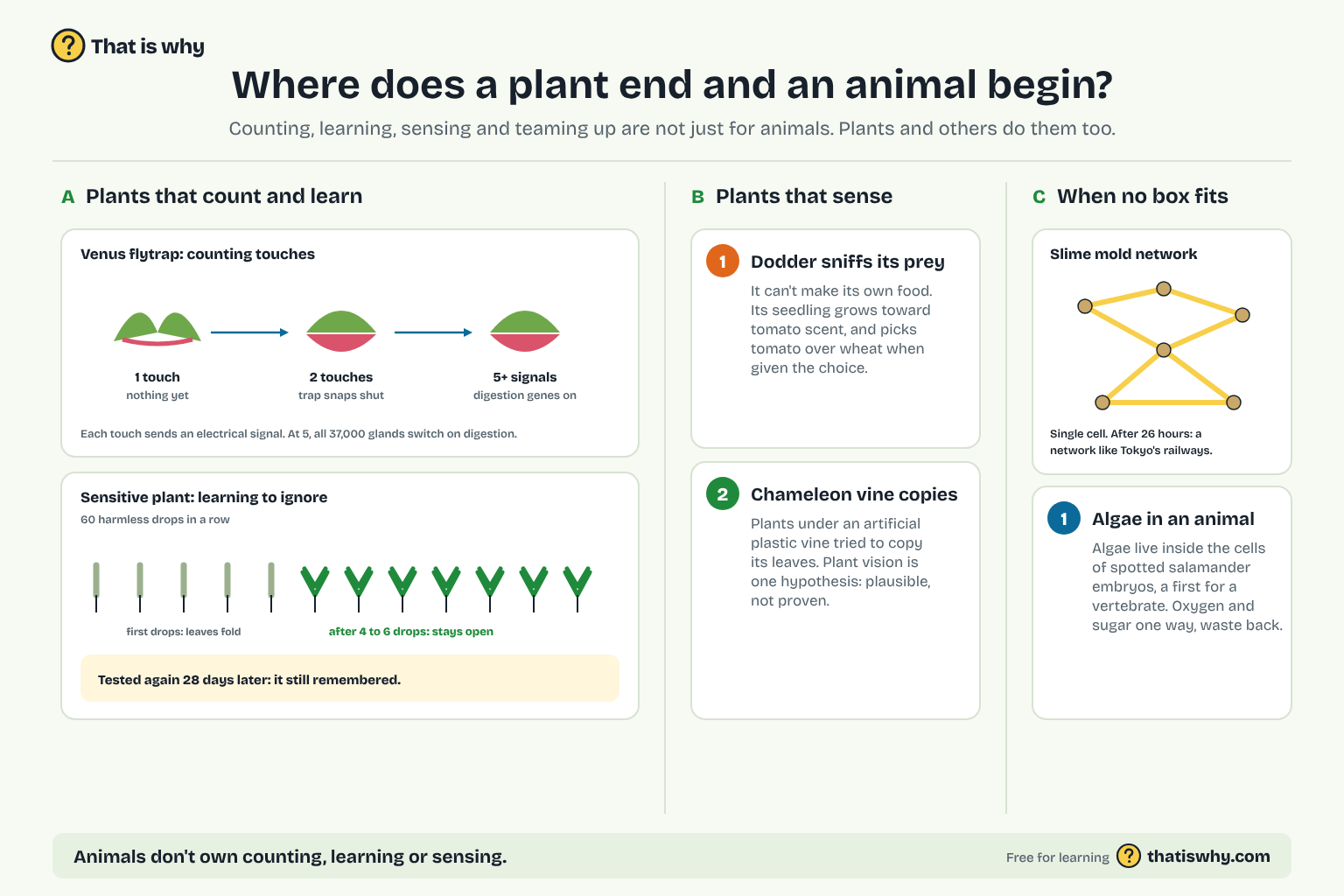
What the diagram shows
A. Plants that count and learn. A Venus flytrap does nothing after one touch, snaps shut after a second, and at five or more signals switches on the genes for digestion in all 37,000 glands. Each touch sends an electrical signal (action potential). A sensitive plant dropped 60 times in a row stopped folding its leaves after four to six drops (habituation), and still remembered when tested again 28 days later.
B. Plants that sense. Dodder can't make its own food. Its seedling grows toward the scent of tomato, and picks tomato over wheat when given the choice. Chameleon vines under an artificial plastic vine tried to copy its leaves; plant vision is one plausible hypothesis, not a proven one.
C. When no box fits. The slime mold Physarum polycephalum, a single cell, grew a network between food sources placed like Tokyo-area cities that after 26 hours resembled the real rail lines. Green algae live inside the cells of spotted salamander embryos, a first for a vertebrate: the algae may supply oxygen and sugar, and the embryo gives back nitrogen-rich waste (symbiosis).
Key numbers
| Fact | Value |
|---|---|
| Touches to close a flytrap | 2 |
| Signals that switch on digestion | 5 or more |
| Flytrap glands | 37,000 |
| Drops before the sensitive plant habituated | 4 to 6 (of 60) |
| How long it remembered | at least 28 days |
| Time for the slime mold network | 26 hours |
Common misconceptions
Myth Plants are unable to learn anything.
The truth Sensitive plants learned to ignore a harmless drop after four to six tries and still ignored it 28 days later.
Myth You need a brain to solve a problem.
The truth A single-celled slime mold built a network with cost, efficiency and fault tolerance comparable to Tokyo’s rail system.
Questions to use in class
Tap a question to reveal a model answer.
1How does a Venus flytrap count?
Each touch sends an electrical signal: two close the trap, and five or more switch on the genes for digestion.
2What did the sensitive plant learn?
To ignore a harmless drop: it stopped folding its leaves after four to six drops and remembered 28 days later.
3How does dodder find its host?
By scent. Its seedling grows toward tomato smell and picks tomato over wheat.
Key terms
- Habituation
- A simple kind of learning: no longer reacting to something that keeps happening and turns out to be harmless. Sensitive plants dropped again and again learned to keep their leaves open.
- Action potential
- A quick electrical spike that travels across living cells. Animal nerve cells use it to send messages, and a Venus flytrap's trigger hairs make one each time they are touched.
- Symbiosis
- A close, long-lasting partnership between two different kinds of living thing, such as the scaly-foot snail and the bacteria that live inside it and make its food.
Sources
- Clever plants learn behaviour (Gagliano et al., Oecologia 2014) The University of Western Australia
- Plants can do maths (Böhm, Hedrich et al., Current Biology 2016) University of Würzburg
- Parasitic plants sniff out hosts (Runyon, Mescher and De Moraes, Science 2006) Penn State University
- Boquila trifoliolata mimics leaves of an artificial plastic host plant (White and Yamashita, 2022) Plant Signaling & Behavior (DOAJ record)
- Slime mould attacks simulates Tokyo rail network (Tero et al., Science 2010) National Geographic
- Slime mold validates efficiency of Tokyo rail network Scientific American
- Solar salamander: photosynthetic algae found inside the cells of a vertebrate Scientific American