Free teaching diagram
Tongue-Eating Louse Diagram: How It Replaces a Fish's Tongue
The louse drains the tongue until it withers, then clings to the stub, and the fish goes on using it as a tongue.
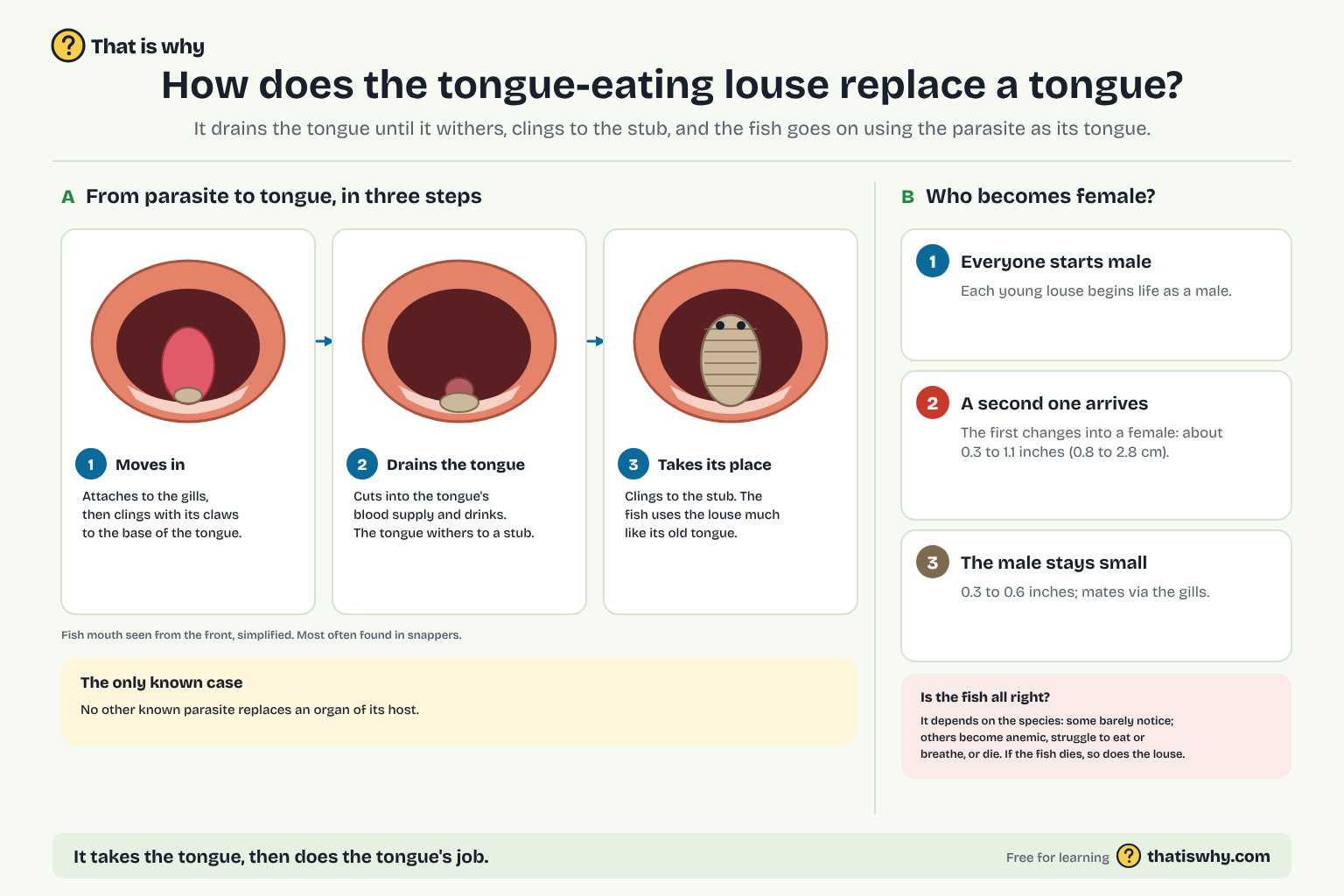
What the diagram shows
A. From parasite to tongue, in three steps. The tongue-eating louse, an isopod called Cymothoa exigua, attaches to a fish's gills and then clings with its claws to the base of the tongue. It cuts into the tongue's blood supply and drinks, and the tongue withers to a stub. The louse then clings to the stub, and the fish uses it much like its old tongue. It is the only known case of a parasite replacing an organ of its host. It is most often found in snappers. The mouths are seen from the front and simplified.
B. Who becomes female? The louse is a protandric hermaphrodite: every louse starts male. When a second louse arrives, the first changes into a female, about 0.3 to 1.1 inches (0.8 to 2.8 cm) long. The newcomer stays male, about 0.3 to 0.6 inches, and reaches her through the gill chamber to mate. Effects on the fish depend on the species: some barely notice, others become anemic, struggle to eat or breathe, or die; if the fish dies, the louse dies too.
Key numbers
| Fact | Value |
|---|---|
| Female length | about 0.3 to 1.1 inches (0.8 to 2.8 cm) |
| Male length | about 0.3 to 0.6 inches (0.8 to 1.5 cm) |
| Usual hosts | snappers (genus Lutjanus) |
| Known parasites that replace a host organ | 1 |
Common misconceptions
Myth The louse eats the whole tongue at once.
The truth It cuts into the tongue's blood supply and drinks; the tongue slowly withers to a stub.
Myth An infected fish always dies.
The truth It depends on the species: some fish barely notice, others become anemic or die.
Myth Females and males are born different.
The truth Every louse starts male; the first one changes into a female when a second arrives.
Questions to use in class
Tap a question to reveal a model answer.
1How does the louse get into the fish?
It attaches to the gills, then clings with its claws to the base of the tongue.
2Does the fish still use its tongue?
The fish uses the louse much like its old tongue once the real tongue has withered to a stub.
3How big is the tongue-eating louse?
Females are about 0.3 to 1.1 inches long; males about 0.3 to 0.6 inches.
4Which fish does it infect?
Most often snappers, fish of the genus Lutjanus.
Key terms
- Isopod
- A group of crustaceans with flattened, many-legged bodies. The tongue-eating louse is an isopod.
- Protandric hermaphroditism
- Starting life as a male and later changing into a female. In the tongue-eating louse, the first louse in a fish turns female when a second one arrives.
Sources
- Tongue Biters Biodiversity Center, University of Texas at Austin
- Tongue-eating louse found on supermarket snapper Practical Fishkeeping