Free teaching diagram
Star-Nosed Mole Nose: Labeled Diagram of the 22 Tentacles
The star-nosed mole's star is 22 tentacles and about 25,000 touch sensors: an eye made of touch.
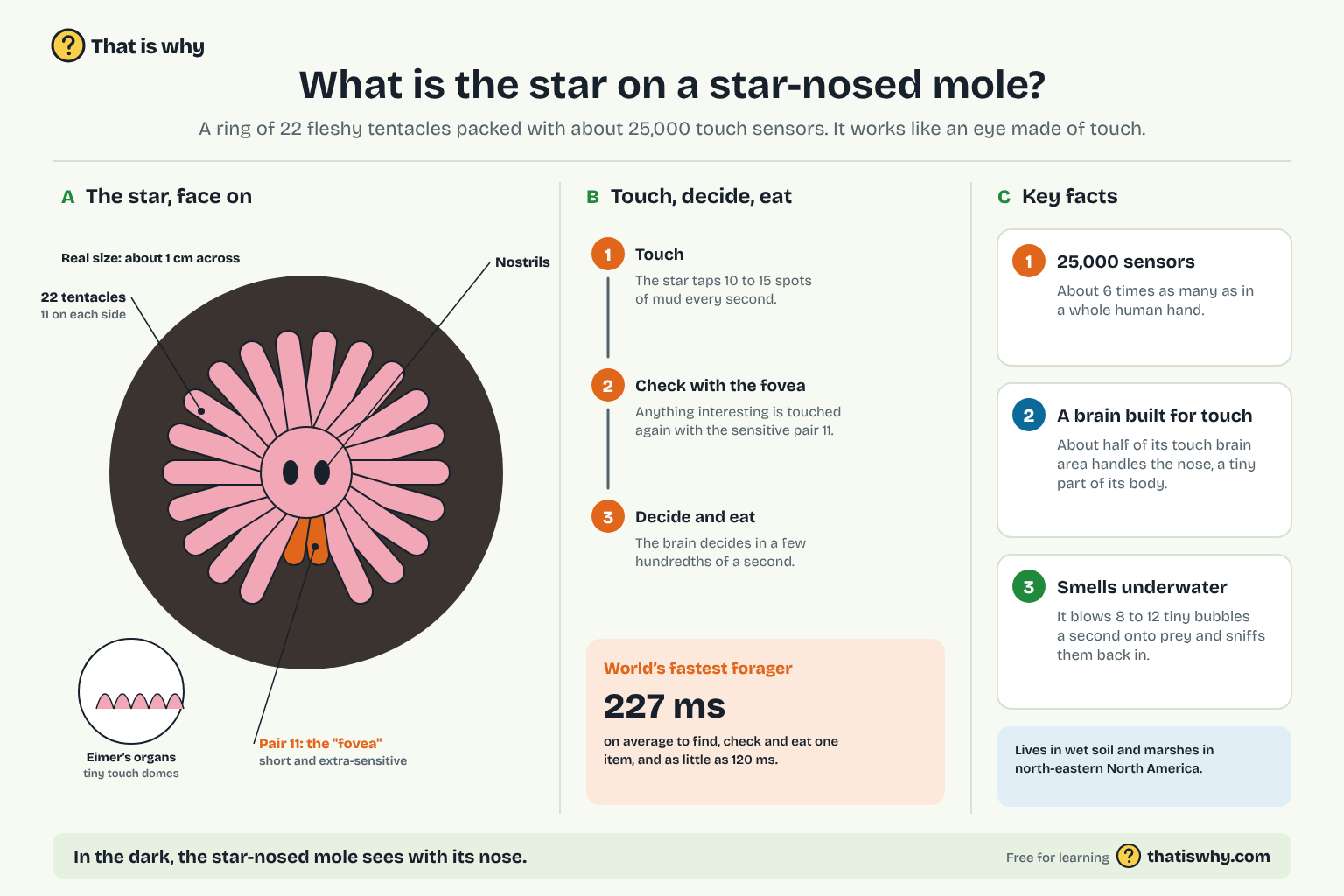
What the diagram shows
A. The star, face on. Around the star-nosed mole's nostrils is a ring of 22 fleshy tentacles, 11 on each side, together only about 1 cm across. They are covered in about 25,000 tiny touch domes called Eimer's organs, each a cluster of nerve endings that act as mechanoreceptors. The short pair at the bottom, pair 11, carries about 900 of them and is the most sensitive part, working like the fovea at the center of an eye.
B. Touch, decide, eat. The mole sweeps its star across the mud, touching 10 to 15 spots a second. Anything interesting gets a second touch with pair 11, and the brain decides within a few hundredths of a second whether it is food. On average it finds, checks and eats an item in 227 ms, and sometimes in as little as 120 ms, making it the fastest known forager among mammals.
C. Key facts. The star has about six times as many touch sensors as a whole human hand. About half of the touch-processing area of the mole's brain (its somatosensory cortex) is given to the nose, even though the nose is a tiny part of its body. The mole can even smell underwater by blowing 8 to 12 tiny bubbles a second onto objects and sniffing them back in. It lives in wet soil and marshes in north-eastern North America.
Key numbers
| Fact | Value |
|---|---|
| Tentacles | 22 (11 on each side) |
| Width of the star | about 1 cm |
| Touch sensors (Eimer's organs) | about 25,000 |
| Touches per second | 10 to 15 |
| Time to handle one item | 227 ms on average, as little as 120 ms |
| Underwater sniffing | 8 to 12 bubbles a second |
Common misconceptions
Myth The star is used for smelling.
The truth The star is a touch organ. The mole does smell, even underwater with bubbles, but the 22 tentacles are packed with touch sensors, not smell receptors.
Myth Star-nosed moles are blind and helpless.
The truth Their eyes are tiny, but their touch is so precise and fast that they are the fastest known foragers among mammals.
Myth All 22 tentacles do the same job.
The truth The short pair at the bottom, pair 11, is extra-sensitive. The mole uses it for a close look, much as we use the center of our eye.
Questions to use in class
Tap a question to reveal a model answer.
1Why is the star sometimes called an eye made of touch?
It scans the surroundings quickly and builds a detailed picture, like an eye does, but using touch sensors instead of light.
2What is a fovea, and which part of the star acts like one?
A fovea is the most sensitive, detailed part of a sense organ, like the center of our retina. On the star, the short pair 11 at the bottom acts as the fovea.
3The mole needs about 227 ms to find, check and eat an item. How many items could it handle in one second at that speed?
About 4 (1,000 ÷ 227 ≈ 4.4).
4Why might so much of the mole's brain be given to its nose?
Its survival depends on touch, so the brain devotes a large share of its touch-processing area to handling the huge flow of signals from the star.
Key terms
- Eimer's organ
- A tiny touch-sensitive dome on the skin of moles, packed with nerve endings. The star-nosed mole's star carries about 25,000 of them.
- Fovea
- The most sensitive, detailed part of a sense organ, like the center of the retina in our eye. On the star-nosed mole's star, the short pair 11 acts as a touch fovea.
- Somatosensory cortex
- The part of the brain's outer layer that processes touch, pressure and body position. In the star-nosed mole, about half of it handles the nose.
- Mechanoreceptor
- A sense receptor that responds to touch, pressure, stretch or vibration.
Sources
- Star-nosed mole Wikipedia
- The star-nosed mole has the world's most sophisticated sniffer American Museum of Natural History